
Remote maintenance
Industrial PC in pocket format
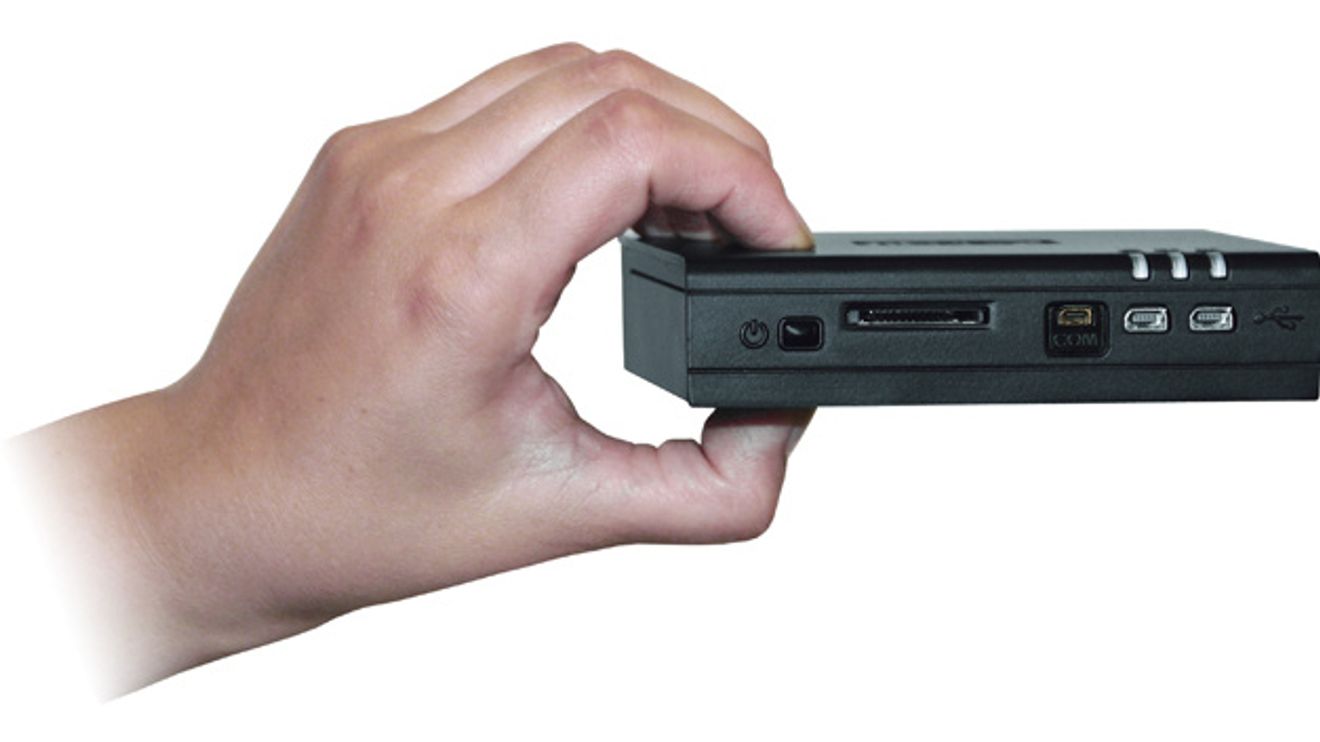
Remote maintenance via industrial PC: Brückner connects its textile machines to the global network using a mini PC. Special feature of the computer: it has a volume of just 0.3 liters.
Industrial PCs can be used for a wide range of applications. For example, the devices control communication with the machine or pass on information to administrative departments such as warehouse management or production management. They can also be used as control units for production processes. Industrial PCs also serve as information terminals for production employees, displaying all relevant production data in the department. They improve production quality, for example by avoiding downtimes by reporting to the warehouse at an early stage.
There is a correspondingly wide range of products for the diverse application scenarios. Whether the all-rounder or a specific solution with a wide range of accessories - detailed planning is required to determine the right choice. Key questions are derived from the requirements: What will the system be used for? Who will use it - production employees, the production manager or will it run passively in the background? How should the industrial PC be integrated into the daily work routine? Are accessories helpful or rather a hindrance?
In order to offer suitable solutions for the various application scenarios, Extra Computer has developed its own device series for industrial use under the brand name 'Pokini'. The portfolio includes industrial PCs, tablets, servers and a workstation. The focus during development was on reliability and great flexibility in terms of connectivity. Various standard front modules allow a wide range of requirements to be met for the various applications. Extra Computer also developed customized front modules for special requirements.
Practical example with 'Pokini Z'

The compact 0.3 liter industrial PCs can also be integrated into the control cabinets of existing systems thanks to a bracket for top-hat rail mounting.
© Extra ComputerOne example of this is the 'Pokini Z', which textile machine manufacturer Brückner uses to control and remotely maintain its systems. The company develops, produces and sells machines and systems for coating and finishing clothing textiles, technical textiles, non-woven fabrics and floor coverings. The systems, which are manufactured exclusively in Bavaria, are used worldwide. This also includes a corresponding service with on-site commissioning and continuous support. For the machine manufacturer, the industrial PCs had to fulfill a number of requirements.
In the textile industry, the overall hardware requirements are high. For example, it must work reliably and without interruption even at high temperatures of up to +70 °C. Due to the high volume of lint in the machines, fanless housings should also be used. As vibrations occur in the system, vibration-proof soldering is also recommended. An SSD is therefore the better choice than a conventional hard disk, as these tend to fail more frequently due to vibration.
In addition to these basic requirements, Brückner has special demands on the devices. The company wants to be able to access its systems at any time via remote maintenance. In the past, this was achieved via customer-specific VPN clients. On the customer side, this meant greater effort to enable access in the first place. In addition, a separate virtual machine had to be created for each customer, as the various VPN clients were not compatible with each other. In 2012, the company therefore decided to develop its own solution - and used the Pokini Z as the hardware basis.
Today, Brückner works with a VPN connection via Teamviewer. This program can also be used to establish a remote desktop connection. As soon as the industrial PC has Internet access, the technicians can access the system. This eliminates the need for additional arrangements with the customer and significantly simplifies the process. Accordingly, a device with a Windows operating system is required.
Another reason for choosing the Pokini Z was the option of being able to use two network cards. This allows the machine network to be separated from the Internet access and maintained remotely via the VPN connection. On the one hand, this simplifies telephone support and, on the other, customers can follow the software configuration themselves via Teamviewer and receive training at the same time.
Integrated WLAN antenna
The integrated WLAN antenna is also an advantage. The systems are very large and sometimes 100 or 200 meters long. When installing the machine, the commissioning engineers must have access to the control system. An access point is set up via the WLAN antenna, which they can access via a laptop. Thanks to the auto-on function, the machine starts up as soon as it is connected to the power supply.
As the operating system is loaded directly into the RAM, no additional UPS is required. Even if a change is made to the operating system or programs, all settings are automatically reset the next time the device is restarted. Brückner provides Extra Computer with the image that is loaded during the production of the Pokinis. This allows the system to restart much faster, as the 'refueling' is automatic and does not have to be done manually. As a rule, the industrial PC is not actively operated, but runs in the background from commissioning. Even security has already been taken care of: the device has a firewall and the
machine users are additionally protected by authentication.
A range of accessories is available to simplify the integration of the Pokini into old machines. Brückner not only equips new systems with the remote maintenance solution, but also upgrades existing systems that are already in operation. In this case, the industrial PCs must be as compact as possible so that they can be retrofitted into control cabinets, for example. The Pokini Z offers a special bracket for top-hat rail mounting for this purpose. VESA brackets for mounting the IPC on the wall or on a monitor as well as a stand are also available. Furthermore, a range of suitable power supply units for the computer as well as additional adapters and cables are available to suit the application scenarios.
Brückner now uses over 300 Pokinis in its systems. These are networked worldwide so that the company can provide support via remote maintenance as far away as China. The Pokini also allows Windows-based software to be installed on the computers on a customer-specific basis.
Author:
Alexander Plöger is Product Manager Industry at Extra Computer.
The 'Pokini Z'
The mini PC is only 0.3 liters in size and works without a fan. With a volume of 0.3 liters, it has a performance of up to 2 GHz thanks to the Intel Atom processor. The device is equipped with up to 2 GB of RAM, which, like the processor, is permanently soldered to the board. This ensures that the components do not come loose due to vibrations. The Pokini Z enables the integration of a 2.5-inch SATA SSD and offers two network connections. The device has an auto-on and wake-on-LAN function as well as PXE boot. It supports the operating systems Linux, Embedded OS and Windows 7. The industrial PC can even run under Windows XP.


You might also be interested in
Kontron Begins Production of 5G Modules in Düsseldorf
Kontron has launched mass production of 5G communication modules in Düsseldorf. The modules, which were developed in Berlin, are used in a variety of sectors, including industry, transportation, and critical infrastructure.
 read more...
Embedded module for CRA-compliant communication
With the 'comX 90' embedded module, Hilscher is expanding its industrial communication portfolio with a new generation of compact communication modules.
read more...Softing Industrial Automation takes over Delta Logic
Softing Industrial Automation has acquired 100% of the shares in Delta Logic Automatisierungstechnik in Schwäbisch Gmünd.
read more...Range of embedded communication interfaces expanded
HMS Networks is launching another version of the embedded communication interfaces 'Anybus CompactCom'. Anybus CompactCom B40 Mini' complements the 40 series with a communication interface that is optimized for automated production.
read more...Update brings support for TIA V19
Delta Logic has updated the 'Accon OPC UA Server' software to version 1.4.0.0. The new features include support for TIA Portal projects of version V19 and for the latest firmware for CPUs of the Siemens S7-1200 and S7-1500 controllers.
read more...The e-paper for the special issue
Communication & networking 09/24
Communication and networking form the backbone of industrial automation. It enables flexible production processes and creates the basis for innovations and new business models. The news is now available in this e-paper.
read more...Test digital simulation live
On September 26 and 27, students at Amberg-Weiden University of Applied Sciences will be able to find out how computer simulation can be applied directly to research and development projects. CADFEM and Ansys invite you to the big live simulation...
read more...TUD opens "incubator" for start-ups
The Technical University of Dresden (TUD) and the Technical University of Munich (TUM) have opened the new "launchhub42 ComSpace". In addition to cutting-edge research for future 6G communication networks, it also focuses on visionary ideas from the...
read more...Remote management platform for the network infrastructure
NetModule has updated its modular 'Connectivity Suite' management platform. Among other things, it consists of a secure network infrastructure for managing the manufacturer's routers.
read more...