

Siemens
Edge rack server in robust
The trend towards hyper-convergent infrastructures is not stopping at the manufacturing and automation industry. Siemens has now launched its first edge rack server in robust industrial PC quality. How is the inner workings of the server designed?

Industrial applications are becoming more demanding and performance-hungry, and with condition monitoring, AI and high-resolution image processing, data streams are constantly growing. Even if the data streams to the cloud were still technically manageable, it is not just performance or cost reasons that speak in favor of cloud-like data processing and infrastructure at the edge: On the one hand, this makes centralization and virtualization easier and, on the other hand, many customers do not want their data to leave the respective campus for confidentiality and security reasons.
In addition, powerful AI accelerators can be integrated more efficiently on site and the shorter data lines for on-site processing ensure lower latency. A powerful cloud or edge IT infrastructure on site also enables OT to be fully integrated into IT instead of just being linked to IT. There is therefore much to be said for operating a powerful cloud infrastructure directly on site at the edge rather than in a remote data center. However, this infrastructure must be robust enough to function reliably even in the harsh industrial environment with its temperature fluctuations, vibrations and air pollution.

Siemens has developed a high-performance edge server system for precisely this purpose. The universal 2U form factor with a depth of only 585 mm (overall dimensions WD: 585 mm × 88 mm × 449 mm) allows easy installation in standardized industrial control cabinets with a depth of 800 mm. The integrated high-performance cooling system with front inlet and easily replaceable filters enables direct operation in industrial halls at temperatures from +5 °C to +45 °C. The systems are tested for vibration and shock resistance and have an EMC-resistant design so that they can also be used in the immediate vicinity of large electrically powered industrial plants. The systems are consistently designed for 24/7/365 continuous operation and can be operated with 230 V(AC). The power supply unit meets the 80 Plus energy efficiency level 'Titanium'.
Why AMD EPYC?
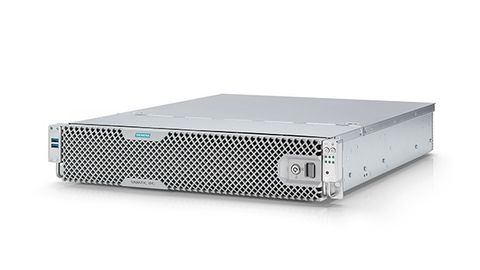
The Siemens industrial server with 'AMD EPYC Embedded' server processors was developed for hyper-converged infrastructures and offers a wide range of possible applications: As a basis for telecommunications services, data centers and private IoT clouds.
© SiemensWhen selecting the processors, Siemens opted for the 'AMD EPYC 9004' family. This is based on AMD's efficient Zen4 technology and is optimized for server and storage applications. Due to the high security requirements for edge and server use, it has independent security processors and a hardware-based TPM (Tamper-Proof-Module) for a secure root-of-trust. The embedded processors are also characterized by long-term availability and extended temperature ranges.
Another feature of the EPYC processors is the realization in AMD's unique chiplet technology. This offers decisive advantages both technically and commercially: Chiplets - individual chips or dies within a single housing - offer the possibility of stacking them on top of each other in a very small space. Compared to an approach with a single monolithic chip within a housing (with its limited number of external connections), significantly higher packing and wiring densities can be achieved. In addition, chips or chiplets of different technologies and functions can be combined in one housing as required.
| The key technical data |
|---|
|
The 'Simatic IPC RS-828A' server is designed for continuous operation at extreme ambient temperatures of +5 °C to +45 °C and can be equipped with two processors from the 'AMD EPYC-9004' family, a maximum of 6 TB RAM (24 DIMMs) and up to eight drives. The processors themselves are scalable in terms of computing power - number of cores and maximum clock and boost frequency. The two onboard 10 GB Ethernet connections ensure powerful and redundant integration into existing networks; fiber optic connections and additional Ethernet interfaces are possible via PCIe expansion cards. The system can accommodate up to seven PCIe expansion cards in total, including two double-slot cards with up to 350 W maximum power dissipation for AI or hardware simulation accelerator cards, for example. Thanks to the compact design and the integrated cooling system with air filter, several systems can be combined and hyper-converged infrastructures or data centers can be set up directly in industrial environments. Windows Server, RedHat Linux and VMware are supported as operating systems and IPMI and Redfish as management solutions. Solutions for edge computing, such as Industrial Edge from Siemens, will also be supported at a later date, enabling IT administrators to implement requirements from production and centrally manage and roll out updates and new apps. Target groups are primarily OEMs and their suppliers, who can use it to set up data centers on site in production or complex production systems and/or consolidate and virtualize existing legacy systems. Other potential applications include discrete production and manufacturing environments, keyword: self-organizing factory, including driverless transport/logistics systems, process automation, simulation and test environments as well as AI applications. The servers are also suitable for setting up an infrastructure for 5G applications and campus networks. |
Among other things, this hybrid multi-chip SoC concept enabled the first x86 server processors in 7 nm technology with significantly higher energy efficiency and more efficient memory access (NUMA - non-uniform memory access). In addition, only chiplets currently make it possible to integrate truly complete systems into a single housing. There is no need for external chipsets or additional I/O chips (bridges), which brings further space and cost advantages.
The internal Infinity Fabric architecture brings additional performance benefits: it enables high memory bandwidths and accelerated I/O performance, which is necessary for server and storage applications. The decisive factors for Siemens when selecting the processor for the EPYC 9004 family were ultimately the higher power density and maximum number of cores (up to 96 cores/192 threads), as well as the higher energy efficiency of the Zen4 architecture in 5 nm process technology compared to the competition. The twelve DDR5 memory channels, which support RAM with 4800 MHz, ensure a theoretical memory bandwidth of up to 480 GB/s. The up to 160 PCI Gen5 lanes supported on the processor side, together with the internal Infinity Fabric networking between the individual dies, enable a high I/O throughput that is twice as high as that of the previous generation in a two-processor configuration.
To reduce energy costs, which are now the biggest cost factor in operating a data center, more and more data centers around the world are using systems with AMD processors.


You might also be interested in
Rittal, Eplan, Cideon, German Edge Cloud
In partnership for more added value
At Hannover Messe, Rittal, Eplan, Cideon and German Edge Cloud demonstrated the opportunities that arise from combining software and hardware solutions across entire ecosystems. They wanted to show that more value creation can be achieved through...
 read more...
Edge computers for complex applications
To enable complex applications with higher requirements, Wago is expanding its portfolio with two powerful edge computers with 16 Gbyte RAM and 32 Gbyte RAM.
read more...First control cabinet made of green steel
The Siemens subsidiary Alpha Verteilertechnik claims to offer the first control cabinet for industry made entirely of green steel.
read more...Siemens quarterly figures Q3-2024
Siemens confirms forecast with a "but"
Siemens is struggling with a weakening automation market in the third quarter. The software business, on the other hand, is developing strongly. It remains to be seen whether this will continue after the switch to a SaaS model.
read more...The e-paper of issue 07/2024
Read in the current issue of Computer&Automation how ChatGPT can provide support in the conception phase, how LLMs are used in code analysis and whether TSN can be considered as a backbone for virtualized control systems.
read more...For personal use
Siemens operates vertical farming for its own use at its site in Frankfurt. Siemens technology is used here. What works here on a small scale is also a future field for agriculture in general.
read more...Siemens sells Innomotics for 3.5 billion euros
Siemens sells Innomotics to KPS Capital Partners for 3.5 billion euros. Preparations for an IPO of the manufacturer of electric motors and large drives were announced in November.
read more...The e-paper of issue 05/2024
Strategies for the future are one of the topics covered in the current issue of Computer&Automation. Read about the reforms that associations are demanding from politicians, the opportunities offered by technologies such as ChatGPT and SPE and...
read more...The top articles in April 2024
The most-read articles in April demonstrate the innovative strength of the automation industry and its ability to adapt new technologies.
read more...