
Interview with Hans Beckhoff
A look back at 20 years of industrial PCs, Ethernet communication & Co.
Computers&AUTOMATION - who could reflect this combination better than Hans Beckhoff, Managing Director of the eponymous company Beckhoff Automation from Verl.
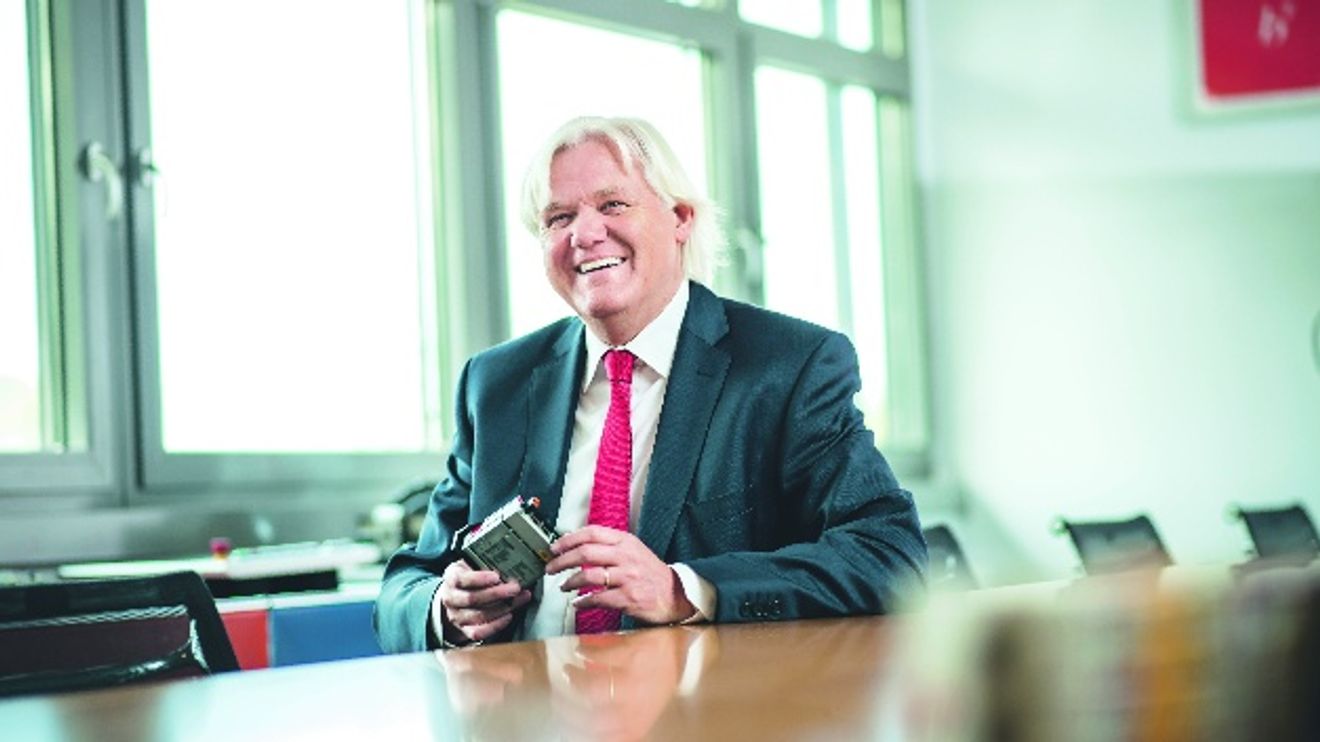
How much longer will the SPS last? In 1990, my answer to this question was: five more years - an incredibly long time by my standards at the time!
© BeckhoffMr. Beckhoff, at the end of the 1990s there was a big debate in the trade journals: Will the industrial PC prevail in industrial automation and will the classic PLC die as a result? The former has happened, but the PLC is still alive. How would you sum up the last 20 years of control technology?
A lot has changed in two decades. In automation technology in particular, there are exciting new innovations every year - sometimes even revolutionary ones; however, we usually only see the actual impact on the market ten years later.
We at Beckhoff supplied the first Industrial PC back in 1986, so we have been using PC-based control technology ever since. And back in 1990, during our first appearance at the Hanover Fair, journalists asked me how long the PLC would last? As a young engineer, I leaned back and said: Five more years - an incredibly long time by my standards back then!
When this journalist asked me the same question again in 1995, Beckhoff was doing well and we had grown wonderfully with our technology - but PC-based control technology accounted for a negligible share of the market overall. On the one hand, this is due to the time constant mentioned at the beginning. On the other hand, there is also a certain inertia among the major suppliers of control technology to stick with tried and tested technology - such as PLC technology.
Regardless of this, we are convinced that IPC technology is by far the most powerful and often even the most cost-effective platform. And also a platform that enables the best integration of IT and automation features.

The turn of the millennium also marked the beginning of Ethernet in the industrial environment. In 2003, Beckhoff itself introduced Ethercat, a corresponding solution that is now widespread and accepted internationally. Did you expect this success?
We were optimistic and knew that we had created something good. But we didn't realize at the time that we were defining a kind of global standard with Ethercat. As so often in our company's history, we proceeded with a certain 'naïve' optimism, believing in our own strength and developing this technology out of our own conviction.
At that time, however, we were already very experienced fieldbus experts: on the one hand, with regard to our own communication systems, which we had already launched on the market. On the other hand, we were also familiar with all other fieldbus systems - essentially the CAN bus and Profibus. Compared to all these existing solutions, the development of Ethercat ultimately represented a real quantum leap: On the one hand, in terms of performance, which we had optimized so that we could collect information slice by slice from many participants in the field with a single Ethernet telegram. On the other hand, we built in distributed clocks right from the start in order to integrate an absolutely accurate system time into an automation system. Another novelty was that back then - something that has almost been forgotten today - every bus had to have a master card. With Ethercat, this was no longer necessary and the system could be operated on a normal Ethernet port.
After the first positive reactions from the market, we finally decided to make Ethercat technology openly available for use. In this context, the Ethercat Technology Group was founded. The release of the technology has certainly contributed significantly to the worldwide success of Ethercat.

Topics such as AI and machine learning will have an impact on machine functionality in the next two to three years.
© BeckhoffWhat other developments - apart from the IPC and Ethernet - have had a significant impact on automation technology over the past 20 years in your opinion?
In 1998, we were able to offer IPCs with one CPU core and a clock frequency of 1 to 2 GHz for controlling a machine. Today, we supply industrial PCs with up to 36 cores and a clock frequency of 4 GHz. This shows that hardware development has made great progress - in other words, Moore's Law has proven its validity over the years. And we believe that this will continue to be the case for at least the next ten years. If we can integrate image processing or measurement technology into the control system today, if we can synchronize 100 axes in a machine instead of 20 and path control is also possible - then this is thanks to this increase in performance.
Another decisive development of the last 20 years is the consolidation of functional areas, for example through the integration of safety into standard control technology. And as far as drive technology is concerned, new drive types such as our eXtended Transport System - XTS for short - based on inverse linear motors have been successfully introduced to the market. Basically, I see specialized magnetic drive types as a trend for the future, because they can now be controlled algorithmically and therefore replace a lot of mechanical work on the machine with software functionality.
With regard to software in particular, the last 20 years have also been a time in which the IT world has moved even closer together with the automation world - in the case of Twincat 3, for example, with the integration of the various tool chains such as Visual C, C++ and IEC 61131 in Microsoft's Visual Studio. Another advantage lies in the integration of Matlab Simulink and thus measurement technology and image processing. In short: I consider this consistent integration of functions originally from different areas or even from different companies in one software package to be one of the most important development trends of the last two decades.
All in all, automation technology has become simpler and more cost-effective. Just think of single-cable technology or the electronic motor nameplate, for example - 20 years ago these were either non-existent or very rare. At the same time, the costs per axis in control technology have fallen by between 20 and 40 % during this period.
One topic that Beckhoff has had on its agenda for over six years, but has not yet presented a market-ready solution, is completely PC-based or freely programmable safety technology. Why are you having such a hard time with this topic?
You have to make a distinction here: We have been supplying hardware-based safety - i.e. the input and output terminals or safety logic terminals - for around ten years now. These are freely programmable using a graphical editor and cover around 80 % of all standard safety functions. We have also decided to do away with the safety hardware CPU and replace it with a purely software-based runtime. We have already developed the mathematical basis and special compiler techniques for this. Internally, this is now a finished product - the only thing missing is a simple graphical editor. This will be available by the end of next year and then the official market launch will take place!
Industry 4.0 has dominated the sector for over five years. What is your own definition of Industry 4.0 and how do you see the sector positioned in this respect today - also internationally?
Industry 4.0 is a complex topic - so your question is not so easy to answer, especially as other buzzwords such as digitalization and IoT keep cropping up in this context.
Let's start with digitalization: Digitalization is something that industry and the whole world has been experiencing since 1970. As hardware and software concepts have evolved, more and more areas of life - and therefore also industry - have been permeated by data-based electronic aids. I therefore do not see this as a major leap in development, but rather a development that has been around for a long time but is accelerating. The good competitiveness of German industry shows that domestic companies have done their homework quite well in this respect compared to other countries.
According to the Acatech model - which famously invented the term Industry 4.0 in 2011 - the third industrial age, in which we found ourselves until recently, is characterized by the fact that the production environment is characterized by local intelligence on the machines. The fourth industrial age that has just dawned is now characterized by the fact that this local intelligence is combined with cloud intelligence. This is also my main way of looking at Industry 4.0 - in other words, machines can 'talk' to each other via the cloud or call up services from the cloud and use them for processes on the machine. Conversely, a higher-level intelligence can view the machines as an extended output arm, for example.
At Beckhoff, we can well imagine that part of the machine intelligence will shift to the cloud - we call this the 'avatar concept'. Examples of this would be controlling a machine with speech recognition running in the cloud or vibration analyses for predictive diagnostics that don't even have to take place online, but can be carried out offline in the cloud. However, we can already 'cloudify' the entire PLC today - depending on availability, bandwidths and achievable response times. With technologies such as 5G, a lot seems to be feasible here; however, the response times are still above
1 ms - so it is not yet possible to control a packaging machine.
Now you can extrapolate and ask: What will communication look like in 20 years?
I personally think that we will then be at around 100 GBaud and will be able to reduce the response times for central applications to well under one millisecond with the help of special switching and radio technologies. And so in 20 years' time, your colleagues will be able to look back and write: 2018 was the time when machines tentatively started to talk to the cloud and call up services from the cloud - today this is completely normal!
What other developments do you think will significantly change automation in the next 20 years?
The basis for intelligence on the machine is, among other things, the hardware. Over the next few years, this will continue to be determined by Moore's Law, so that in 20 years we will certainly be able to use computers on machines that are 100 times more powerful than today. This would mean that it would be possible to control 100 times as many axes or cameras or even operate a 10 times faster machine with a large number of cameras. In this respect, we believe that the use of image processing systems on the machine - also as sensors and not just for workpiece evaluation - will increase dramatically.
On the other hand, the capabilities of the cloud will increase with computing power and increasing communication bandwidth - by at least the same factor. Here, too, it is ultimately up to the engineer's imagination as to what can happen in this cloud. In this context, terms such as artificial intelligence and machine learning come up - topics that will certainly have an impact on machine functionality in the next two to three years rather than in 20 years' time. We at Beckhoff have already set up a working group to investigate artificial intelligence algorithms for possible applications in automation - including path planning in robotics and sensor fusion. The initial results in this regard are very promising!
In the age of Industry 4.0, more and more traditional IT companies and internet companies such as Google, Amazon & Co. are trying to make their mark on industrial automation. Do the established automation technology manufacturers run the risk of this taking the 'butter off their bread'?
I don't think so. After all, the big IT companies - i.e. Google, Microsoft and SAP - are approaching the application level from 'above'. In other words, they have introduced edge computing concepts, for example, which in turn can include local intelligence and machine control intelligence. In this respect, traditional machine control manufacturers still have a big head start in terms of expertise, because automation technology is really complex. In this respect, I'm not too worried that Google, for example, will suddenly offer motion control systems or more complex measurement technology. What's more, the market is simply too small for these companies.
The big IT companies are primarily interested in the data because they can derive lucrative business models from it. Control systems or machine manufacturers can supply this data.
But isn't it precisely these business models and not so much the pure control hardware that will be attractive for machine manufacturers in the future?
In this respect, there will certainly be competition between automation technology providers and data processors. In addition, many mechanical engineering customers also have their own strategy in this regard.
Nevertheless, it is always said that data is the oil of the 21st century. However, in order to implement the new data-driven business models, users must also be prepared to make their data available. Isn't this still usually the case?
Let me put it in positive terms. First of all, I think that the fear of data security is much more pronounced in Germany than in other countries. But if you want to develop successful business models in this area, you should put this fear aside and think about what benefits can be derived from all the data. Within the German AI community and even within the German government's key issues paper on artificial intelligence, there is a proposal to develop an anonymized general database in which personalized data can be entered and then made available anonymously as a general data pool for a wide variety of uses.
There are also many other practical methods: For example, we have agreed with some of our customers that they will occasionally run a test cycle on the machine that makes no statement about what has just been produced. During this test cycle, data is recorded which can then be used for predictive maintenance.
In short, there are solutions to the data problem and I would always recommend not focusing on fear when first thinking about it, but instead looking positively for the possibilities.


You might also be interested in
The e-paper of issue 07/2024
Read in the current issue of Computer&Automation how ChatGPT can provide support in the conception phase, how LLMs are used in code analysis and whether TSN can be considered as a backbone for virtualized control systems.
 read more...
Consistent multicore and multitask support
Beckhoff relies on consistent multicore and multitask support in its current 'TwinCAT MC3' Motion Control generation. Thanks to its modular architecture, axes implemented with 'TwinCAT NC2' can also be seamlessly integrated.
read more...Consistent Multi-Core and Multitask Support
Beckhoff relies on consistent multicore and multitask support in its current 'TwinCAT MC3' Motion Control generation. Thanks to its modular architecture, axes implemented with 'TwinCAT NC2' can also be seamlessly integrated.
read more...Beckhoff simplifies AI training
An evolutionary development every year, a revolutionary leap every five to seven years - this is how Beckhoff aims to secure its technological leadership. At the press conference, the company from Verl also presented some technological highlights.
read more...AI training made easier
An evolutionary development every year, a revolutionary leap every five to seven years - this is how Beckhoff aims to secure its technological leadership. At Hannover Messe, the company from Verl also presented some technological highlights.
read more...HANNOVER MESSE DAILY Day 4
The top news from the fourth issue: Robert Habeck at the trade fair tour +++ Technological AI highlights from Beckhoff +++ Radar sensor technology in focus at Pepperl+Fuchs +++ ASi-5 counter module as an active distributor from Bihl+Wiedemann +++...
read more...These are your winners!
We put 96 products in twelve categories to your vote in December, and now the winners have been chosen! The trophies were presented at a 'Winner's Dinner' at the Seehaus in Munich. These are your "Products of the Year 2024"!
read more...Embedded Computing & IPC - The winners
A 'classic', a 'scene product' and a 'pragmatic approach' convinced the readers of Computer&Automation in the 'Embedded Computing & IPC' category.
read more...Drive technology - The winners
In the 'Drive Technology' category, a product with a very top target group came out on top.
read more...