
3 questions for ... Microsoft
"Edge computing is ultimately the cloud"
Does edge computing make sense without the cloud? Wolfgang Leindecker from Microsoft Austria shows how the technologies can be profitably combined.
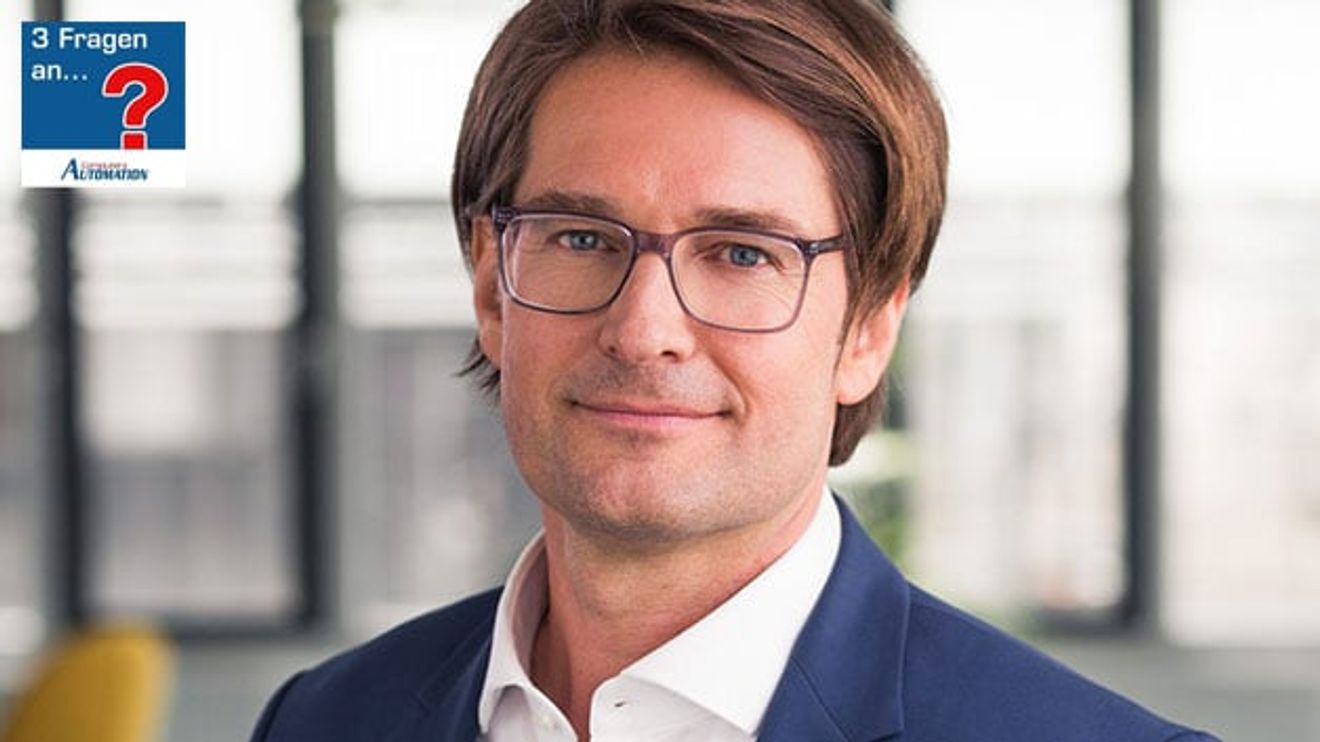
As Head of Solutions Sales and a member of the management team at Microsoft Austria, Wolfgang Leindecker helps Austrian companies to become winners in the digital transformation. Before his move, he was CEO of TTTech Industrial. In this position, he helped drive the global standardization of OPC UA over TSN and the spread of edge computing in the manufacturing sector and was also a member of the supervisory board of a start-up in Silicon Valley.
The Industrial Internet of Things is generating more and more data that needs to be managed. This data complexity needs to be mastered. What role does edge computing play in this?
Leindecker: Edge computing is the decisive factor that makes it possible to manage the rapidly increasing volumes of data and, in particular, the requirements for real-time manipulation of this data.
However, edge computing does not function as a stand-alone solution, but is seamlessly integrated and unfolds its full functionality as a logical extension of the cloud. Edge computing is ultimately the cloud extended by locally distributed computing power.
At the edge, sensor data is pre-selected, software applications are processed or even AI calculations are carried out. What should users bear in mind with regard to the edge software landscape? Which technologies should/must be taken into account
Leindecker: The software environment at the edge must essentially fulfill the following criteria:
- Complete "remote orchestration": all software at the Edge must be able to be completely installed for the first time (as a container or even as a complete virtual machine), updated and parameterized from a central instance. This also applies to edge operating systems.
- Real-time capable handling of huge data streams with open interfaces to the machine world on the one hand and the cloud on the other, as well as local caching of this data.
- Deeply integrated, comprehensive security functions that are subject to an overall concept - "security by design". Without security, Edge Computing technology is useless.
Microsoft offers a comprehensive suite of software modules and integrated partner solutions for this, including Azure IoT Edge, Azure Defender for IoT and a holistic security approach with Azure Sentinel, which detects anomalies and also enables automated responses.
The hardware requirements grow with the tasks. What should users look out for when selecting the right edge computing hardware?
Leindecker: The hardware at the edge must provide sufficient computing power and memory to be able to run a number of applications in virtualized form side by side without them interfering with each other. Modern industrial PCs on the market typically meet these requirements without any problems.
In addition, environmental variables such as permissible temperature ranges, dust and vibration protection must be taken into account.


You might also be interested in
A brief portrait of Wolfgang Leindecker and Microsoft Austria
A brief portrait of Microsoft Austria
 read more...
Microsoft hopes to make the cloud more attractive in uncertain times
The cloud business has allowed Microsoft to grow beyond its Windows niche in recent years. Even in the current uncertain economic situation, the Group sees the cloud as an opportunity.
read more...Nico Hartman heads the Manufacturing division
As Industry Lead Manufacturing, Nico Hartmann is responsible for business with the manufacturing industry at Microsoft Germany.
read more...Microsoft promises fairer competition
Microsoft approaches European cloud providers following competition complaints. The European cloud provider association Cispe criticizes that the initiative does not go far enough.
read more...Multi-cloud time waster
Using several cloud systems at the same time has its advantages. But keeping all the systems running alone eats up almost half the time of IT teams in companies - this is the result of a recently published study.
read more...Digitize factories faster
Microsoft and its partners are now launching an industry initiative for the digitalization of the manufacturing industry. The aim is to develop new solutions for the Industrial Internet of Things faster, more efficiently and more reliably.
read more...Forum Edge & Cloud Control 2021
OT meets IT - exchanging ideas with experts
How are cloud and edge technologies changing manufacturing technology? The Edge & Cloud Control forum will get to the bottom of this question. Keynote speaker Dr. Gunther Kegel will highlight the relevance of data-driven business models.
read more...The edge-to-cloud architecture
HPE, Intel and Microsoft are now jointly launching an integrated edge-to-cloud architecture for industry. The aim is to enable the end-to-end exchange of data and services in heterogeneous and distributed manufacturing environments.
read more...Three questions for... Microsoft
"Lack of emergency management in German companies"
Cyber attacks cause billions in damage and the number of attacks is constantly increasing. Due to a lack of protective measures, SMEs are a particular focus of attacks and have enormous potential for improvement. Thomas Frahler on the status quo.
read more...