

Internet of Things
The winners of the 'Embedded Award 2019'
NürnbergMesse - organizer of embedded world - has presented the 'Embedded Award' to companies for their most innovative achievements in the categories 'Hardware', 'Software' and 'Tools'. For the first time, prizes were also awarded in the categories 'Embedded Vision' and 'Startup'.
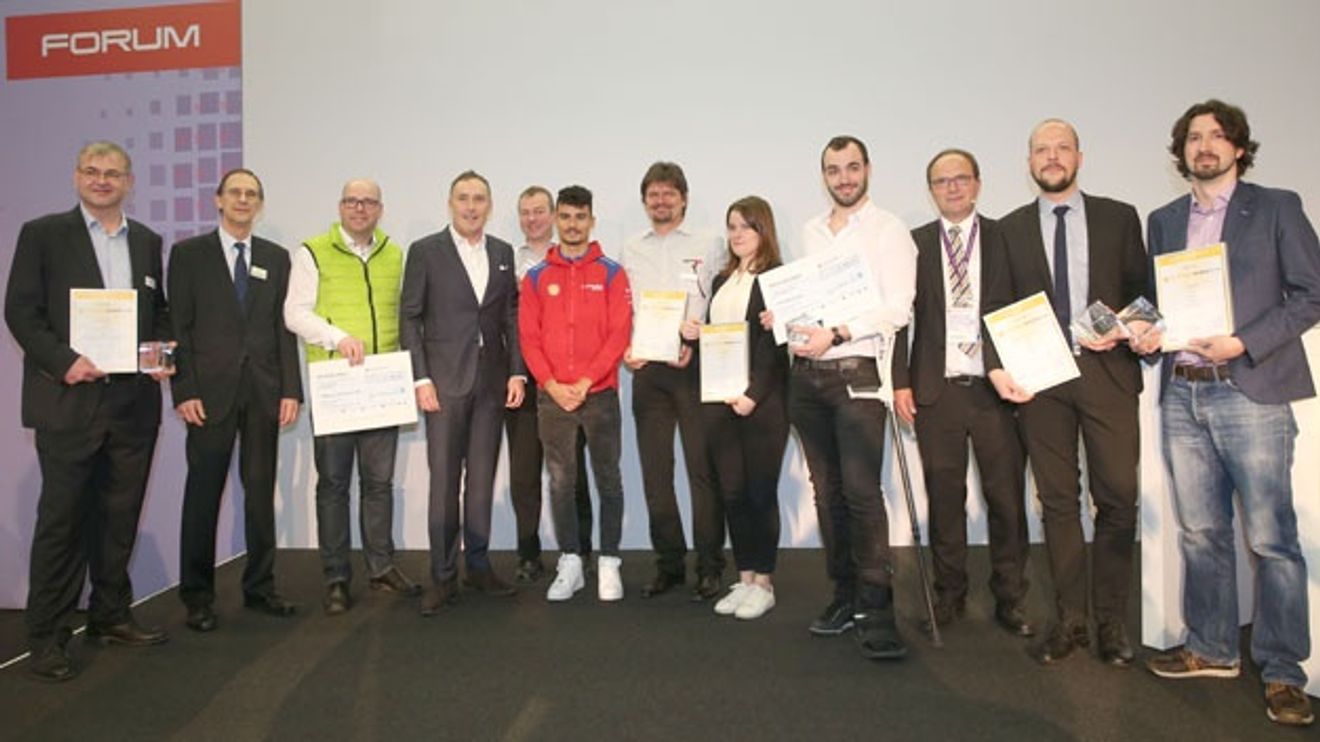
The winners of the 'Embedded Awards 2019' and their well-wishers
© NürnbergMesse, Frank Boxler"We were delighted with the large number of highly innovative entries from embedded system developers in the various categories," says Prof. Axel Sikora, Chairman of the jury and the embedded world advisory board. "And so the jury was once again spoiled for choice. However, we see this as a sign of the innovative strength and dynamism of this industry. The award is embedded world's thanks and recognition for outstanding players," continued Sikora. With the 'Embedded Award', trade fair organizer NürnbergMesse annually honours products that drive the embedded industry and the Internet of Things forward in a special way.
Winner in the 'Tools' category

In the 'Tools' category, the company Göpel Electronic won with its 'ChipVORX-SI'. The 'Embedded Award 2019' was presented by Richard Krowoza (NürnbergMesse, left) and Prof. Axel Sikora (jury chairman, right).
© NürnbergMesse, Frank BoxlerTo reduce the effort required for design validation and production testing of modern, complex, high-density assemblies, Göpel Electronic has developed 'ChipVORX-SI' (Synthetic Instruments) - an innovative technology for the automated use of existing FPGAs as test centers integrated into the design. ChipVORX-SI' uses the native functions of the FPGA for the configuration of so-called embedded instruments and the execution of certain test functions. These instruments, known as 'ChipVORX IP', are automatically generated by the user via an Internet interface using a cloud-supported synthesis process and later loaded and executed fully automatically in the FPGA. This allows the user to configure complex test instruments even without extensive expert knowledge and use them automatically in their application.
Winner in the 'Embedded Vision' category

The winner in the new 'Embedded Vision' category is Basler AG. It receives the prize for its 'BCON for MIPI Development Kit'.
© NürnbergMesse, Frank BoxlerBasler 's new embedded vision kit contains the first camera module to use the image signal processor of Qualcomm 's Snapdragon SoCs under Linux. This product concept significantly reduces the system's processor load, freeing up additional computing power for the actual application. Basler's new development kit comprises a complete development platform for demanding embedded vision projects and combines powerful embedded processing and CSI-2 interface technology with standards and functional features of the machine vision world. The 'dart BCON for MIPI Development Kit' contains a dart camera module (5 MP resolution and 60 fps frame rate) with BCON for MIPI interface and a processing board with a Qualcomm Snapdragon 820 SoC. Thanks to the ready-to-use sample installation and the board support package including all required drivers, integration is just as easy as with any plug-and-play camera interface such as USB 3.0.
Winner in the 'Hardware' category

The winner in the 'Hardware' category is the company Ultrahaptics. It received the award for its ultra-haptic 'Stratos Insprie' module.
© NürnbergMesse, Frank BoxlerUltrahaptics' 'Stratos Insprie' module allows users to experience haptic sensations with their bare hands simply in the air - without actually having to carry or grasp anything. The new slim, autonomous module is designed to be quickly and easily integrated into existing displays or linked to hardware location-based VR or AR applications. Inside the housing are several tiny ultrasonic speakers that are precisely controlled by algorithms integrated into two central ICs (microcontroller and FPGA). The algorithms control the timing and frequency of the emitted ultrasonic pulses so that the pressure generated by a multitude of ultrasonic waves is concentrated at a multitude of points within reach of the user. The unit also includes a LeapMotion camera module that tracks the user's hand movements so that the haptic sensations can be applied directly to the ball of the hand or fingertips.
Winner in the 'Software' category

Hitex is this year's winner of the 'Embedded Award' in the 'Software' category for its 'Aurix SafeTpack' product. Roland Bickel (center) accepted the award from Richard Krowoza (NürnbergMesse, left) and Prof. Axel Sikora (jury chairman, right).
© NürnbergMesse, Frank BoxlerThe 'Aurix SafTpack' from Hitex is a comprehensive safety manager for the second generation of Aurix safety microcontrollers from Infineon. According to the jury, the Aurix microcontroller family, with its further enhanced connectivity, data security and functional safety features, is ideal for a wide range of different automotive and industrial safety applications. These controllers contain 'Logic Built-In Self-Tests' (LBIST) as a supplement to the lockstep technology of the cores. 'SafeTpack' ensures the functional safety of the microcontroller and controls the complex LBIST and other safety features of 'Aurix' so that the developer can concentrate fully on the application. SafeTpack also offers further complex safety functions such as program flow monitoring or the cyclical control of peripheral devices. It coordinates the execution of start-up and cycle tests that ensure the correct operation of the CPU and internal buses. In addition, 'SafeTpack' manages the watchdog system and an optional combined watchdog and power controller.
Winner in the 'Startup' category

The company Wisebatt receives the 'Embedded Award' in the 'Startup' category for its simulation tool. The award was presented by Krowoza (left), Kurt Skupin (WEKA Fachmedien, 2nd from left) and Sikora (2nd from right).
© NürnbergMesse, Frank BoxlerAccording to the jury, Wisebatt's solution of the same name offers a unique simulation tool for electronics engineers developing IoT devices. With this tool, engineers can design virtual prototypes and work out the optimal solution in terms of cost, battery life and performance very early on in the development cycle through close cooperation. The hardware engineers can access complex modeling results within a very short time. In addition, the company offers a "freemium" business model that allows anyone to use 'Wisebatt' for free in the context of public projects - similar to 'GitHub'. This promotes cooperation in open hardware projects and contributes to the virality of the projects.


You might also be interested in
Nine award categories for the first time
The embedded award recognizes outstanding innovations at the embedded world Exhibition&Conference. It is presented in nine specialist disciplines as part of a networking event on the first day of the trade fair.
 read more...
The knowledge hub of the embedded community
The embedded systems industry will meet from March 11 to 13. In seven exhibition halls, exhibitors in Nuremberg will provide information on hardware, software, services and tools. Two accompanying conferences, expert panels and exhibitor forums will...
read more...embedded world 2019 - Summary & outlook
Interview with trade fair director Benedikt Weyerer
What makes embedded world special? How did embedded world 2019 go and what is planned for the 2020 trade fair? Benedikt Weyerer from the trade fair organizer - Nürnberg Messe - in conversation with Ingo Kuss on the 'VIP stage'.
read more...embedded world 2019 / Electromobility
Interview with Formula E racing driver Pascal Wehrlein
Formula E racing driver Pascal Wehrlein was a guest on the 'VIP stage' powered by Markt&Technik and Elektronik at embedded world 2019. Matthäus Hose and Ingo Kuss asked him about Playstation tips and technical innovations in electromobility.
read more...Panel discussion on embedded vision & machine learning
At embedded world 2019, a panel of renowned experts discussed the topic of "Embedded Vision & Machine Learning: new architectures and technologies boosting (new) vision applications." The highlights in the video.
read more...The embedded world 2019 in picture and sound
The second-highest number of visitors in the history of embedded world, more exhibitors, more exhibition space, the new Start-up Area, numerous expert discussions in the forums, the 10th Student Day and around 2000 participants at the two...
read more...Records broken again
The 17th edition of embedded world set new records in terms of exhibitors and exhibition space. At around 31,000, there were slightly fewer visitors than in 2018 - but this is the second-best visitor result in the event's history. The hype topic of...
read more...A rendezvous for marketing decision-makers
13. MEDIA SUMMIT 2019
On February 26, 2019, the 13th Media Summit took place at embedded world, where media and marketing experts from the electronics industry came together. It was about nothing less than the future.
read more...Review of embedded world 2019
More exhibitors, more space and the second-best visitor result: this is how embedded world 2019 can be summarized in figures. WEKA Fachmedien has collected impressions of the trade fair in a series of pictures.
read more...