
TSN certification
The role of the Avnu Alliance
The big goal for TSN and OPC UA is: cross-manufacturer interoperability! - However, a prerequisite for this noble goal is a rigorous and precisely defined certification process. The Avnu Alliance is trying to contribute to such a process.
The Avnu Alliance is a community with the following self-imposed claim: It wants to create an interoperable ecosystem that meets the precise timing and low-latency requirements of various applications with open standards through certification. In this context, it seeks to support cross-manufacturer interoperability of the TSN and OPC UA communication duo.
Generating a certification process is certainly the first step in this direction. However, device providers are also demanding a 'one-stop store' certification, i.e. the possibility of having their product completely tested and certified by a single body - with regard to TSN, OPC UA and the overlying device profiles. At the same time, several independent certification providers should offer their services at competitive prices and ideally cover all global automation hot spots. How can these certification requirements be reconciled in the new era of global standards?
Time Sensitive Networking (TSN), defined by the IEEE in Working Group 802.1, describes the latest evolutionary stage in over thirty years of development of Ethernet standards: unmodified, i.e. 'pure' Ethernet now also enables deterministic, highly precisely synchronized communication in the network. This means that Ethernet is also suitable under real-time conditions, particularly for control tasks. As a result, TSN enables the convergence of critical data traffic - for control tasks, for example - with other types of traffic via a shared infrastructure without conventional protocol gateways with their known limitations and disadvantages.
While the real-time domain was previously covered in manufacturer-driven standards, the so-called Ethernet-based fieldbuses, the convergence of different types of traffic - frictionless through the entire automation pyramid - is only made possible by TSN, which can be seen as a real breakthrough, especially in view of the data consistency required for Industry 4.0 and Industrial IoT applications.
Certification - not a task of the IEEE

How can these technological possibilities now be used to promote a broad ecosystem of interoperable components that transcends manufacturer boundaries? Interoperability testing and certification play a central role here. The IEEE has traditionally limited its role to the provision of industry-independent standards - so other organizations are required here.
TSN testbeds such as that of the IIC (Industrial Internet Consortium) offer the opportunity to check prototypes for interoperability at an early stage and quickly identify initial problems through 'plug tests'. Other TSN testbeds with a regional focus have since been added, such as the LNI (Labs Network Industrie 4.0, focus on SMEs) in Germany or the TSN + OPC UA testbed in China. However, testbeds cannot replace systematic and complete testing for conformity under 'real-life' conditions or formal certification.
The Avnu Alliance has set itself the task of filling this gap, i.e. ensuring the interoperability of TSN. Avnu develops test plans for conformance tests that make it possible to ensure interoperability at network level. The test plans are used to check end devices, infrastructure components (switches) and semiconductors for conformity with the corresponding TSN standards.
First test plans
Starting with the standard for clock synchronization (802.1AS) as the basis for all TSN devices, the Avnu Alliance published initial test plans at SPS IPC Drives 2017 and is currently working intensively on extending these plans to other TSN standards. The backbone for this work are the member companies, which include well-known players from the semiconductor business, IT and automation such as Analog Devices, Belden Hirschmann, Broadcom, Cisco, General Electric, Hilscher, Intel, Microchip, Mitsubishi Electric, National Instruments, NXP, Renesas, Rockwell Automation, Schneider Electric, TTTech and Xilinx.
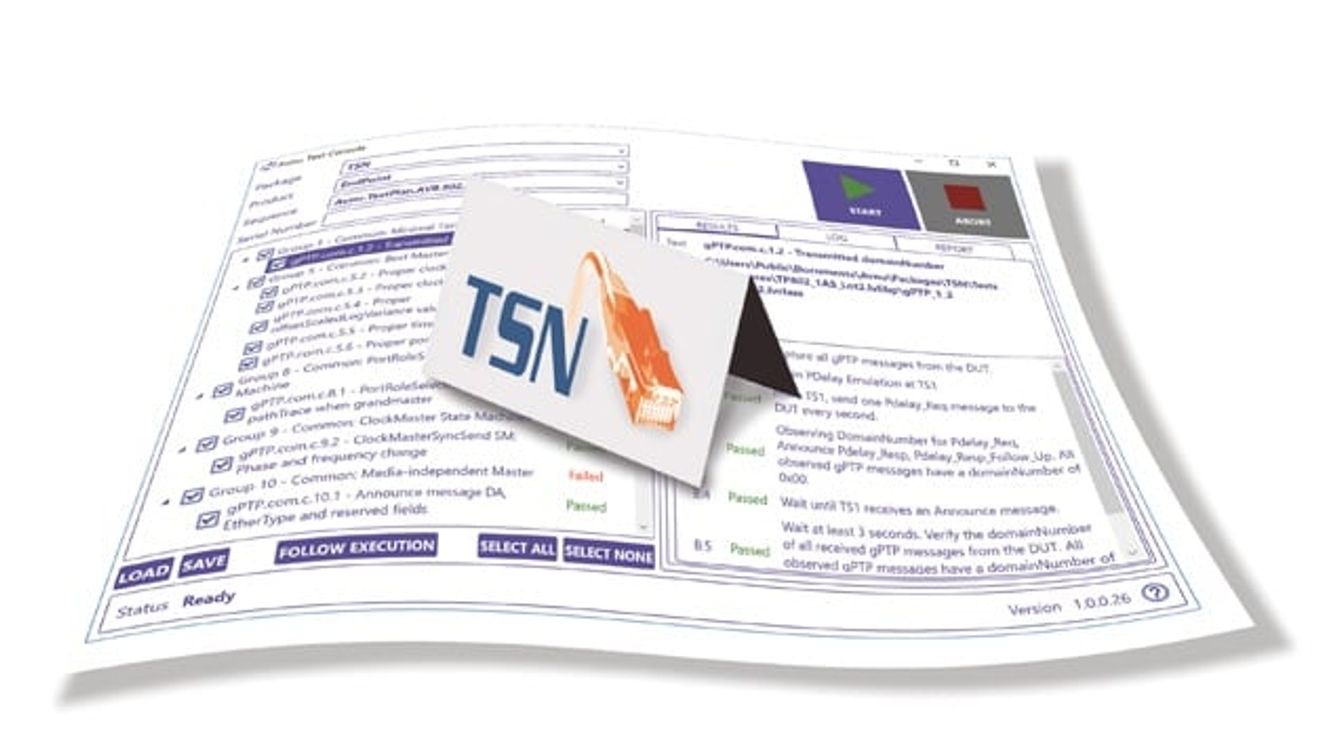
Avnu's role in the TSN ecosystem was on display at SPS IPC Drives 2018: At the joint stand with ISW Stuttgart and IIC, Avnu presented a conformance testing tool as a proof-of-concept and an automated, Linux-based test tool for conformance testing of 802.1AS. The latter can be used in conjunction with a variety of different test devices from low-end to high-performance. An automatically generated results report can be used, for example, by test houses and fieldbus organizations as part of the independent execution of tests. The Avnu test framework is designed to reduce the overall turnaround time for conformance tests and make testing easier.
The previous descriptions address interoperability on layer 2 of the OSI layer model. Once it has been ensured that the underlying network layer is interoperable, it is important to focus attention on the higher layers.
Numerous organizations, such as the OPC Foundation and the various fieldbus organizations, provide standards at application level that are suitable for combination with TSN. OPC UA over TSN, which is also being promoted by the OPC Foundation in a new initiative for use at field level, is a prominent example of such a combination and is now actively supported by almost all major automation providers.
Standards at application level
The Avnu Alliance provides such organizations with test plans to enable them to combine TSN conformance testing with application layer testing. Ultimately, the clear aim is to provide device manufacturers with a 'one-stop store' for certification of the entire communication layer and to ensure that they are not restricted in their choice of test house.
So will automation dominate the future of the Avnu Alliance? Not only automation, but also other sectors such as the automotive industry (on-board networks) or providers of professional audio-video technology are increasingly relying on TSN. Avnu will continue to address these markets with its services. Particularly in view of the constantly increasing investments in new semiconductor technologies, cross-industry standards with the resulting quantities are suitable for enabling the availability of low-cost ASICs. The quality of the test plans and tools, which are not industry-specific at TSN level, also increases with different industries and therefore use cases.
In the age of manufacturer-independent, global standards such as TSN and OPC UA, conformity can only be guaranteed through the cooperative approach of the various standardization organizations. The technological prerequisites are in place - now it is up to the organizations and companies to meet the expectations of the market.
Author:
Georg Kroiss is Business Development Manager Industrial at TTTech and Board Member of the Avnu Alliance.


You might also be interested in
Wago gears up for Time Sensitive Networking (TSN)
In the future, Ethernet TSN will enable continuous communication in machine and plant engineering without gateways and interruptions. Wago is launching two new automation systems on the market for the SPS, with which users can take advantage of all...
 read more...
Arrive in reality!
Time Sensitive Networking has firmly established itself in the vocabulary of the automation industry. All well-known suppliers have started activities to evaluate or even introduce TSN. But where exactly are the goals for the use of TSN and what is...
read more...OPC UA and DDS combined
To date, OPC UA and DDS have often been presented as competitors. Competitors that will both be based on the Ethernet standard TSN. - However, the key to successful automation in the future lies in a combination of the three standards DDS, OPC UA...
read more...The interaction of Ethernet TSN, OPC UA and 5G
Only the reliable and structured interaction of all units in an ant colony ensures its survival. Data communication in a modern industrial network works no differently in a figurative sense.
read more...Where there are still problems with 5G
5G in automation - a hot topic at the moment. How quickly can we actually expect 5G to be used in industry? What obstacles still need to be overcome? Thomas Schildknecht summarizes the key points in this interview.
read more...Data pipeline ASi-5
High data width, short cycle times, improved integration of intelligent sensors and actuators using IO-Link and cloud connectivity via OPC UA - ASi-5 makes AS-Interface fit for the requirements of digitalization.
read more...OPC UA - a must for the industry (Part 2)
OPC UA is regarded as the new communication standard for industrial automation. Part 1 explained why a new communication technology is needed in automation and described the OPC UA methods. Part 2 deals with the OPC UA pub/sub methods and the power...
read more...OPC UA, MQTT and co.
The Industrial Internet of Things (IIoT) covers very different areas of application. The available connectivity technologies and standards are just as diverse as the application areas. How can the right technology be filtered out in each case?
read more...The question of licenses
Will OPC UA in combination with TSN become 'the' standard for industrial communication? What role do licenses play in this question and what part does OSADL play?
read more...