

Reichelt Electronics
Survey on the degree of automation in Europe
In a survey in Germany, France, Italy and the Netherlands, Reichelt Elektronik asked about the degree of automation and the potential of AI and IoT. The majority believe that production will be fully automated within five years.
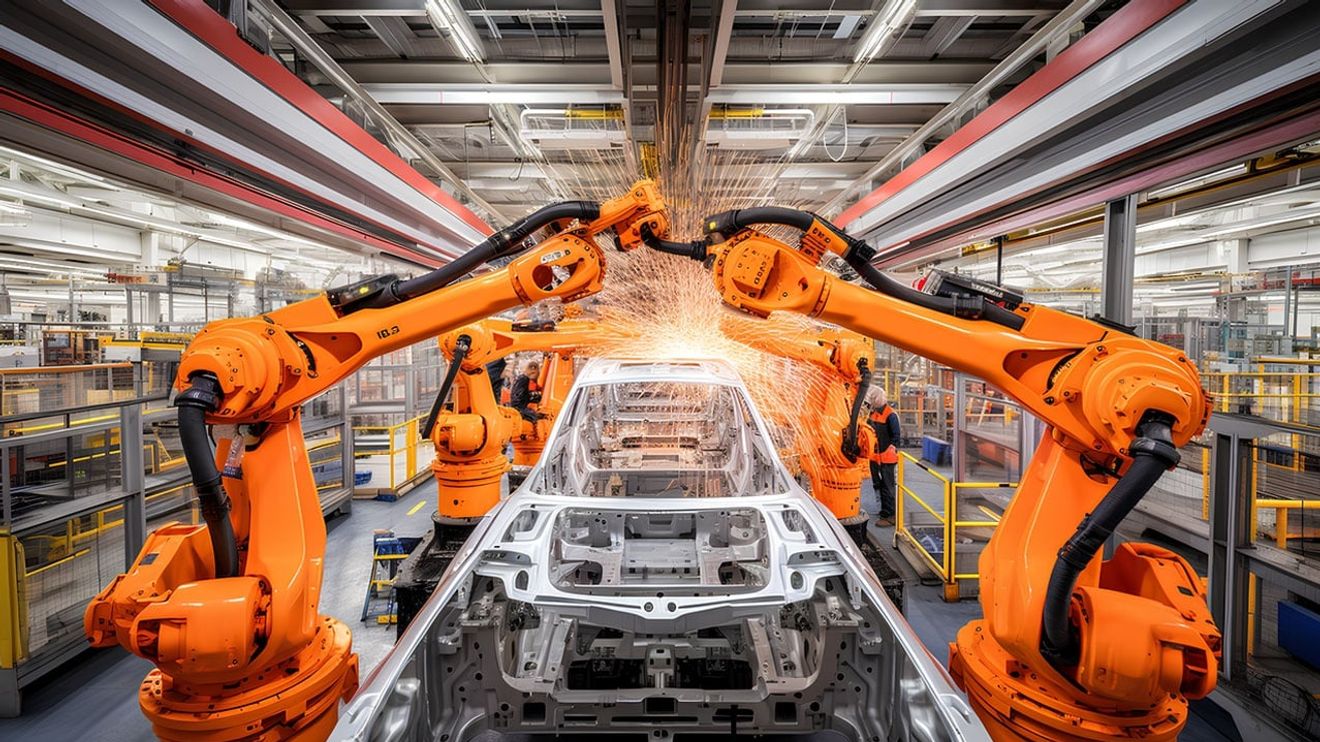
European companies believe in the great potential of automation technology. According to a recent survey conducted by Reichelt Elektronik, 60% of the companies surveyed believe that their production will be fully automated in the next five years. Over two thirds (68%) consider automation solutions to be essential in order to remain competitive.
Germany in the lead - cloud computing dominates
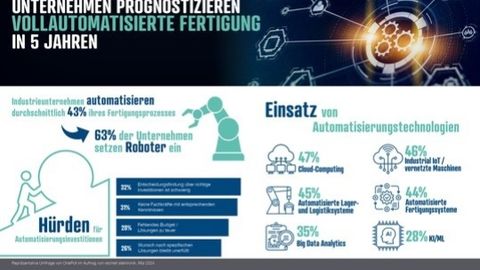
Germany and the Netherlands are among the pioneers when it comes to automation. German companies have already automated 43% of their manufacturing processes, closely followed by the Netherlands with 41% and Italy with 40%. Although France lags behind with 37%, it has ambitious plans to significantly increase the level of automation in the coming years.
Cloud computing (47%) and industrial IoT (46%) are the leading technologies in Germany. The Netherlands leads with 48% of companies using these technologies. Italy and France are lagging behind, with France in particular having the greatest need to catch up, with 32% for IoT and 30% for cloud integration. French companies in particular are aware of the need to catch up here, as 58% hope to automate their production in the next five years. Although data-driven decisions are very important for many companies in order to optimize processes and guarantee their own future viability and innovative strength, all nations tend to perform less well when it comes to the use of big data analytics and artificial intelligence/machine learning (AI/ML). The use of big data analytics is 35% in Germany, 41% in the Netherlands, 33% in Italy and 32% in France. The ranking for artificial intelligence/machine learning (AI/ML) is similar: Germany is in first place (28%), followed by the Netherlands (19%), Italy (19%) and France (26%).
Obstacles to more automation
The obstacles are manifold: high investment costs, a shortage of skilled workers, regulatory uncertainties and insufficient digital maturity on the part of companies. In addition, the insufficient digital maturity of companies and the local infrastructure is hindering successful implementation. Furthermore, doubts among employees and management about the economic benefits are blocking successful adaptation. Technological complexity and integration problems further exacerbate the challenge, preventing many companies from implementing these technologies across the board. Nevertheless, around 50% of companies plan to implement big data and AI/ML by 2026. More than half of those surveyed even believe that AI and automation can alleviate the skills shortage in Europe.
Robots at the heart of European automation
Robots play a key role in automation. According to the IFR World Robotics Report 2023, Germany leads the way in Europe with 415 industrial robots per 10,000 employees in the manufacturing sector. According to the Reichelt survey, 63% of German companies already use robots, followed by France with 58%, the Netherlands with 51% and Italy with 48%. The differences in the use of robots are interesting: while Italy (61%) and France (44%) use robots primarily for repetitive tasks, the focus in Germany and the Netherlands is on physically demanding activities (both 54%).
Automation as the key to market development and sustainability
Automation opens up a wide range of opportunities for European industry. France, Italy and Germany see automation primarily as an opportunity to open up new markets through innovative products (35% in France, 36% in Italy, 39% in Germany). The Netherlands, on the other hand, relies on automation to ensure sustainable production (45%).
The results of the Reichelt survey show that the acceptance and success of automation technologies depend heavily on individual company conditions. While small companies often struggle to find suitable and cost-effective tools, larger companies face the challenge of making the best use of their budgets. Targeted strategies and measures could help to further drive automation across Europe.
The survey was conducted in April/May 2024 by OnePoll among 1250 tech decision-makers from the manufacturing industry in Germany, France, Italy and the Netherlands. The participants come from industries such as aerospace, chemicals, automotive, textiles, mechanical engineering and many more.


You might also be interested in
Siemens continues to grow and starts buyback
With a record order backlog, higher free cash flow and a new share buyback program of up to €6 billion, Siemens is continuing its growth trajectory in the second quarter of 2026.
 read more...
KIT is a national leader in quantum technologies
Whether enormous computing power, ultra-precise sensors or cutting-edge encryption: quantum technologies promise ground-breaking applications. An international ranking by the think tank European Centre for International Political Economy (ECIPE)...
read more...House of Digital Transformation (HoDT)
Application center for AI and quantum computing
The vision of the planned innovation center for artificial intelligence and quantum computing in Frankfurt is to bring future technologies into commercial application. Following the pre-opening of the center in collaboration with the start-up...
read more...New Management Board strengthens digitization in the SME sector
The Industry 4.0 initiative SEF Smart Electronic Factory e.V. confirms Gerd Ohl, Prof. Dr. Gerrit Sames and Ulrike Peter on the Board of Directors. Uwe Jörk was newly appointed. Focus: practical digitalization, use of AI and automation for SMEs.
read more...Deutsche Telekom and Nvidia launch one of Europe's largest AI factories
With the Industrial AI Cloud in Munich, Deutsche Telekom and Nvidia are creating one of the largest AI factories in Europe. Companies can train AI models, carry out simulations and access 10,000 GPUs.
read more...Kubermatic and Flecs simplify app management
Kubermatic and Flecs will work together in the future to make industrial applications easier to provide and production environments more flexible to control.
read more...Dassault Systèmes takes over Ascon Qube technology
Dassault Systèmes is strengthening its strategy for virtual twins and integrating Ascon Qube technology into its Delmia portfolio. The acquisition is intended to provide companies with more flexible and AI-supported production control.
read more...SMEs drive key technologies forward more than corporations
The digital transformation of German industry is making tangible progress - but it is not onlylarge corporations that are focusing on future technologies such as artificial intelligence (AI), the Industrial Internet of Things (IIoT) and autonomous...
read more...Measuring the performance of AI agents
Pendo has introduced 'Agent Analytics', a solution that makes the performance of AI agents measurable.
read more...