
Remote maintenance / remote control
IoT edge gateway ensures power supply
For free-moving mobile cranes, the power supply must be ensured onboard - for example in the form of a battery container. The IoT edge gateway and connection to the cloud open up new possibilities for monitoring this around the clock.


At the heart of the Power Pack are state-of-the-art lithium-ion batteries in combination with a special battery management system.
© Conductix-WampflerElectrified, rubber-tired gantry cranes - so-called 'E-RTG' cranes (Rubber Tired Gantry Cranes) - are used for handling goods between sea and land transportation in the container depots of the ports. As they are not rail-guided, they can be used flexibly for aisle changes in the container depot, for example. However, this has a direct impact on the crane's power supply: when moving outside the container aisle, this can no longer be provided via conductor rails or motorized cable reels, but must be ensured 'on board' the crane.
Until now, diesel generators have generally been used for this purpose, but their acceptance is declining sharply for environmental and cost reasons. As an alternative, Conductix-Wampfler has therefore developed battery containers that are mounted directly on the crane and allow it a high degree of freedom of movement. However, these containers contain technically sophisticated components whose perfect functioning and high availability require regular monitoring of critical operating parameters using appropriate sensors.
Global functionality required

The flexibility of the Edge Gateway is demonstrated by the operating mode: This ranges from online mode (permanent connection) to interval mode (transmission at certain values) to 'sleep mode' (device is only 'woken up' when required).
© SchildknechtConductix-Wampfler's business model of intensive monitoring of its battery containers with a view to Industry 4.0 is challenging because the E-RTG cranes equipped with it are in use worldwide. This initially requires the establishment of globally functional connectivity with the cranes as participants in a communication network (edge) and a data portal at the center of the network at the monitoring company. A further technological challenge in this case results from the environment in which the gateways are to be operated: This is highly 'metallic' and constantly in motion. Two conditions that are considered critical for secure wireless data transmission and therefore require particularly powerful wireless device technology.
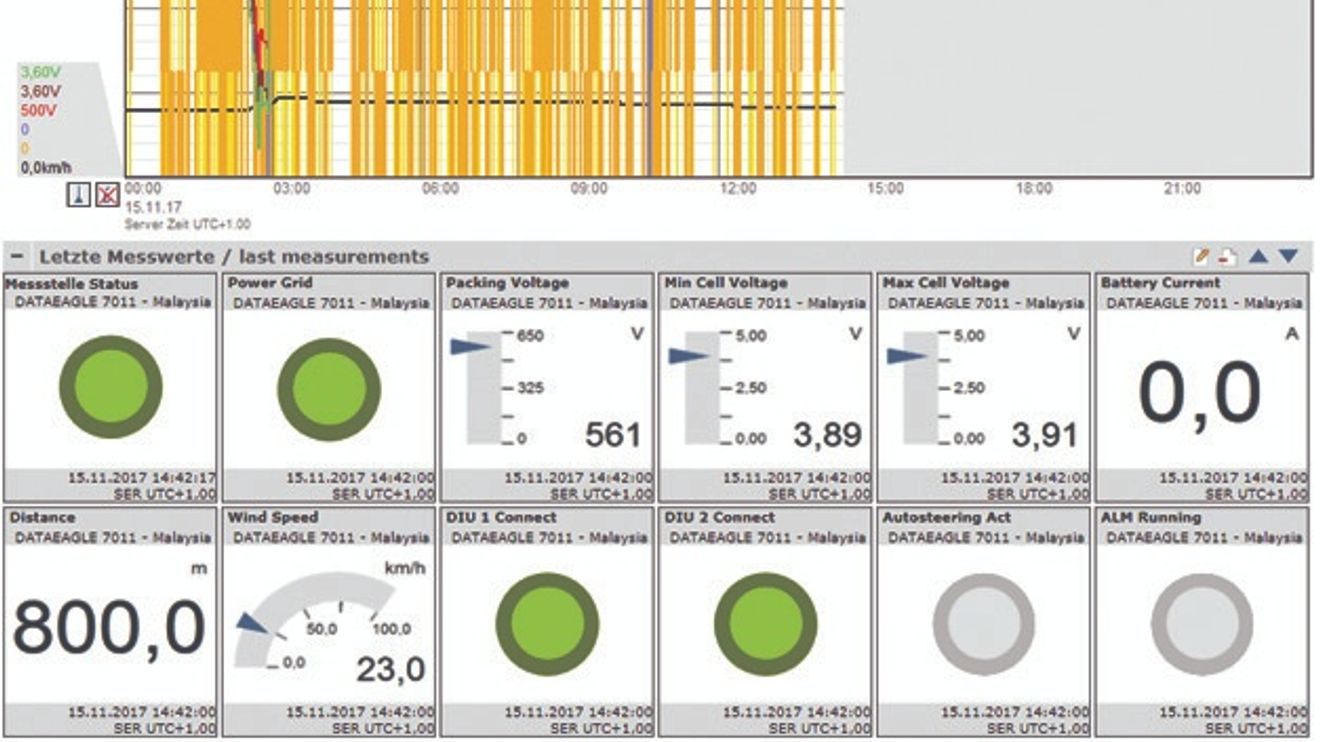
In order to meet these requirements, Conductix-Wampfler has launched an IoT test project together with Schildknecht. The 'Dataeagle 7050' serves as the edge gateway. On the input side, it has a Bluetooth LE interface for wireless recording of up to eight sensor signals and a fieldbus interface. In the case of Conductix-Wampfler, critical sensor data from the respective machine, such as voltage, temperature, pressure or humidity, is continuously recorded via the gateway's Bluetooth interface and pre-processed or compressed in the device. This means that data is only transmitted in the event of an alarm or status change, which ultimately reduces the data stream enormously and enables cost-optimized communication.

This measurement data is then sent to the cloud or to the Schildknecht portal via mobile communications for display and further analysis. A special feature here is that the integrated eSIM card automatically selects the best network from 400 providers (unsteered roaming) - meaning that every machine or battery container can be used worldwide.
It is also possible to manage the parameterization of the gateways, the billing of mobile data or the users in the portal. This channel can also be used to update the software of devices, for example, with TÜV-certified end-to-end encryption of the data. This distinguishes Schildknecht's 'Device Cloud' from a pure data cloud such as Amazon. In general, however, it is possible to connect to common cloud-based systems via the API interface of the Device Cloud. In the long term, there are also plans for users to have the data delivered directly to their own cloud or ERP systems.
The initial results of the project give both partners confidence: "We see this Industry 4.0 solution as an important support for our future business development. Customers expect our systems to be operational at all times. The aim of the ongoing trials is to guarantee precisely this," says Michael Eckle, who is responsible for innovation at Conductix-Wampfler.
Author:
Thomas Schildknecht is the founder and CEO of Schildknecht.


You might also be interested in
Hans Seifert to Become Chief Sales Officer
Sigmatek has appointed Hans Seifert as Chief Sales Officer (CSO). His area of responsibility includes international sales, marketing, application engineering, and support.
 read more...
CC-Link certification for modular I/O system
Weidmüller has received the CC-Link Partner Association (CLPA) certificate for its modular I/O system 'u-remote'. This makes u-remote the first modular I/O system with official CC-Link IE safety certification for CC-Link IE TSN.
read more...Profibus & Profinet International
MTP Specification 2.0 published
Profibus & Profinet International (PI) announces the official release of the Module Type Package (MTP) Specification 2.0. The MTP 2.0 standard creates the basis for true cross-industry interoperability as well as more flexibility and efficiency...
read more...New analog input modules
MicroControl is launching the next generation of compact analog input modules. The new modules are µCAN.4.ai-BOX for voltage/current, µCAN.4.sg-BOX for strain gauge sensors and µCAN.4.ti-BOX for temperature sensors.
read more...Profibus & Profinet International
Profinet leads the field in industrial Ethernet protocols
A recent analysis by the market research institute Omdia confirms that Profinet is the leading technology in the field of industrial Ethernet protocols. In addition to its broad market penetration, Profinet's consistent focus on security is...
read more...Dual leadership in Shanghai
Stefan Becker has been appointed Managing Director of Eckelmann Automation Technology in Shanghai and will manage the subsidiary together with Zhongwei Huang.
read more...Smart control cabinets thanks to new Ethernet/IP technology
Rockwell Automation is launching an Ethernet/IP control cabinet solution. The aim of this further development is to meet the growing demand for smarter, faster and better networked production processes.
read more...Softing Industrial Automation takes over Delta Logic
Softing Industrial Automation has acquired 100% of the shares in Delta Logic Automatisierungstechnik in Schwäbisch Gmünd.
read more...Single-axle drive module for high performance
The modular, dynamic multi-axis servo system 'DIAS-Drive 2000' from Sigmatek has been reinforced: The 'MDP 2200-L-01' single-axis module for controlling synchronous servo motors provides up to 20 A rated current.
read more...