
OPC UA over TSN
Clear commitment from an automation specialist
B&R was and is one of the companies that is strongly committed to the development and standardization of OPC UA over TSN - for communication at controller and field level. What are the reasons for this commitment?

The big step has been taken: the OPC Foundation's 'OPC UA including TSN' initiative makes OPC UA the uniform communication standard in the Industrial IoT. An important step here is that the standardization and further development of OPC UA for the field level will take place under the umbrella of the OPC Foundation. This fulfills a long-standing wish of the market: The result is a manufacturer-independent and interface-free solution for communication in industry.
B&R supports this development by participating in the involved standardization organizations of the OPC Foundation, IEC/IEEE and VDMA. With B&R's active participation in testbeds such as the Industrial Internet Consortium, the company wants to help ensure that machine builders and operators benefit from harmonized communication in industry as soon as possible.
The requirements
The reasons for and requirements of OPC UA over TSN are derived from the expectations of the Industrial IoT. This essentially concerns the design of efficient and effective production processes, while at the same time reducing the costs of commissioning and maintenance as well as the cost-efficient mass production of individualized products. This requires a transformation of conventional production lines into flexible production units and permanent insight into production processes without disrupting machine operation. Other aspects include the growing number of network participants, the increasing volume of data and the vision of developing a technology that will be able to cope with the extreme time requirements of the coming decades. During standardization, care is therefore being taken at all levels to ensure that OPC UA over TSN can also meet the requirements of future industrial IoT applications.
An important indicator of the performance capability of the technology - especially in motion control applications - is the shortest achievable cycle time. It quantifies the time a controller needs to send all outgoing data packets to all corresponding network participants and, in turn, receive all incoming data packets from the participants. It is important that all network participants receive the outgoing data packets from the controller within the same cycle. Achieving the shortest possible cycle times is seen as the greatest challenge. If the technology meets this requirement, it can also be used at any time in environments with lower time requirements.
The white paper 'OPC UA TSN - A new Solution for Industrial Communication' compares the cycle times of various industrial Ethernet solutions with OPC UA over TSN. The outstanding feature is that network participants can communicate up to 18 times faster with OPC UA over TSN than with all protocols currently available on the market. This opens up new possibilities in the area of highly synchronized drive applications and control tasks.
The technology also allows the simultaneous control of more than 10,000 nodes in a network and benefits from bandwidth expansions of the Ethernet standard, so that even large amounts of data can be handled without any problems. This is an advantage for big data analysis or integrated vision applications, for example.
Plug and produce
In future, OPC UA over TSN will enable plug-and-produce-capable networks that are easy to administer and configure. Devices can be recognized and integrated using the OPC UA information model. By standardizing application profiles for I/O, motion and safety, users can access the largest ecosystem of components.
Integration and administration are significantly reduced thanks to the manufacturer-independent description of machine processes using OPC UA Companion specifications. This saves users time and resources during commissioning and during ongoing production.
Series devices in brief

The OPC UA TSN bus controller is already available as a prototype and will go into series production in the second half of 2019.
© B&RThe core standards for OPC UA over TSN have been finalized and the first products based on them are about to go into series production. In the second half of 2019, B&R will launch series production of controllers and bus controllers that communicate with OPC UA over TSN. The hardware is designed in such a way that future additions to the standards can be adopted with software or firmware upgrades.
B&R plans to take the next step in expanding its portfolio in 2020, focusing on integrating the new technology into servo drives. Existing Powerlink networks can be easily integrated into an OPC UA over TSN network. A corresponding companion specification ensures that data is exchanged in real time and without any loss of information.
Author: Stefan Bina is Product Manager Industrial IoT Network Solutions at B&R.
Two application examples
Automobile production
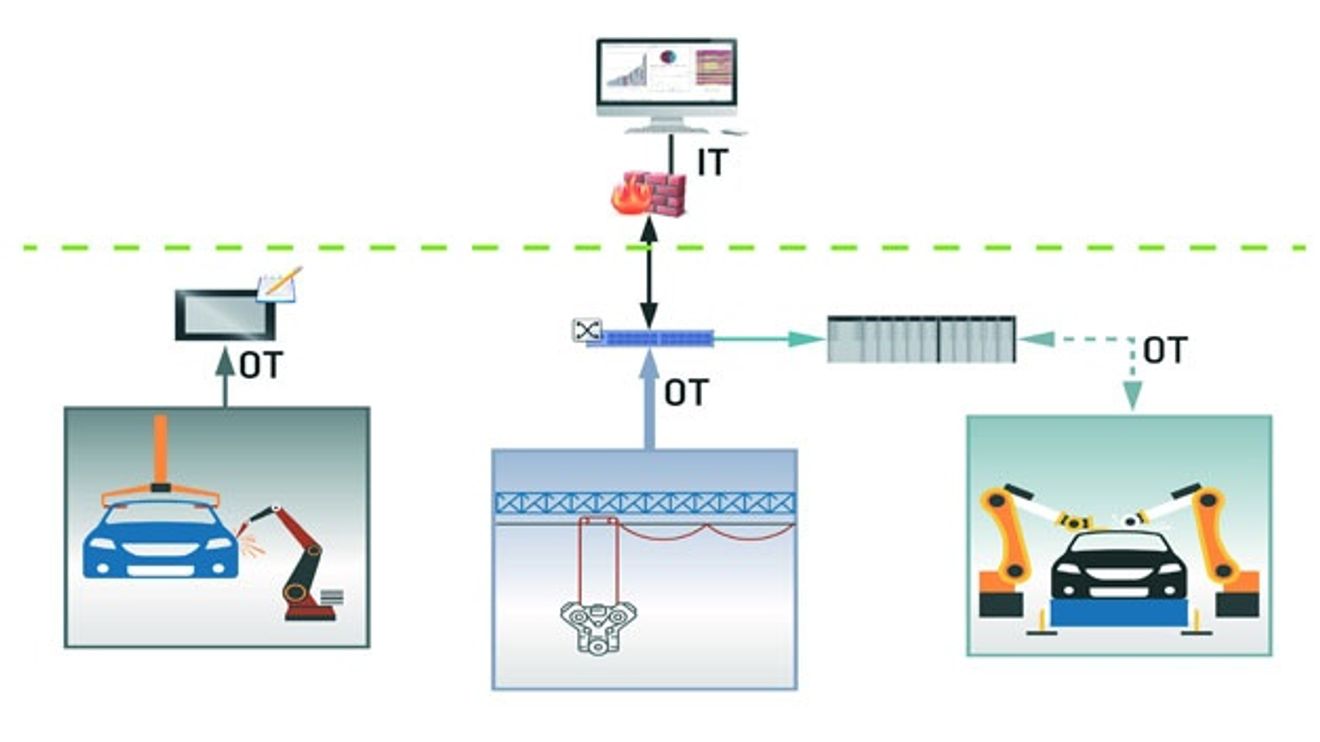
For years, car bodies have been welded together on fully automated production lines by highly synchronized robots - all humans have to do is monitor whether all the machines are working correctly. However, what looks like a prime example of the production of the future has a few weak points. There is no standardized communication between the individual production steps. Data can only be exchanged via specially programmed interfaces. There is neither a standardized production control system nor a standardized database. Often, each production unit not only has its own control system, but also a completely independent IT infrastructure. The effort required to configure and administer such a large number of networks is very high. Communication between the individual islands is only possible via specially programmed gateways. A lot of resources are wasted at this point. While the processes and workflows within the production units are highly optimized and automated, there is only marginal coordination between the individual process steps.
A standardized network is a first step towards digitally networking production. This requires communication technology that is understood by all devices and components across all manufacturers. This includes machines and lines, but also individual sensors and actuators as well as higher-level systems such as MES, SCADA and ERP systems.
The big vision is the complete virtualization of the regulation and control of automation components and functions. This can reduce overall costs and production downtimes, while at the same time increasing machine utilization through continuous process optimization.
Requirements for the food industry
The demands placed on production in the food industry have risen sharply in recent years. Manufacturers not only have to increase throughput and productivity, but also meet the demand for ever smaller batch sizes with new approaches in the production of food and luxury foods. As a result, modular machine concepts and individually assembled production lines are increasingly finding their way into production halls. This often requires machine parts from different manufacturers to be integrated into a common network.

At present, this can only be achieved using individually programmed gateway solutions. In future, however, OPC UA over TSN will enable the modules to be simply connected to the network and automatically establish communication with the other modules. All the machine operator has to do is confirm that the new configuration is correct and the machine can continue production - with high-precision synchronization in the low microsecond range. This significantly increases throughput and the highly synchronized integration of robots into the machine is also possible without any problems.
As communication with OPC UA is possible up to SCADA and ERP systems and even into the cloud, new methods of predictive maintenance and process optimization can also be easily implemented. This allows food manufacturers to easily increase the productivity of their systems.


You might also be interested in
Wago gears up for Time Sensitive Networking (TSN)
In the future, Ethernet TSN will enable continuous communication in machine and plant engineering without gateways and interruptions. Wago is launching two new automation systems on the market for the SPS, with which users can take advantage of all...
 read more...
Arrive in reality!
Time Sensitive Networking has firmly established itself in the vocabulary of the automation industry. All well-known suppliers have started activities to evaluate or even introduce TSN. But where exactly are the goals for the use of TSN and what is...
read more...OPC UA and DDS combined
To date, OPC UA and DDS have often been presented as competitors. Competitors that will both be based on the Ethernet standard TSN. - However, the key to successful automation in the future lies in a combination of the three standards DDS, OPC UA...
read more...The interaction of Ethernet TSN, OPC UA and 5G
Only the reliable and structured interaction of all units in an ant colony ensures its survival. Data communication in a modern industrial network works no differently in a figurative sense.
read more...Where there are still problems with 5G
5G in automation - a hot topic at the moment. How quickly can we actually expect 5G to be used in industry? What obstacles still need to be overcome? Thomas Schildknecht summarizes the key points in this interview.
read more...Data pipeline ASi-5
High data width, short cycle times, improved integration of intelligent sensors and actuators using IO-Link and cloud connectivity via OPC UA - ASi-5 makes AS-Interface fit for the requirements of digitalization.
read more...OPC UA - a must for the industry (Part 2)
OPC UA is regarded as the new communication standard for industrial automation. Part 1 explained why a new communication technology is needed in automation and described the OPC UA methods. Part 2 deals with the OPC UA pub/sub methods and the power...
read more...OPC UA, MQTT and co.
The Industrial Internet of Things (IIoT) covers very different areas of application. The available connectivity technologies and standards are just as diverse as the application areas. How can the right technology be filtered out in each case?
read more...The question of licenses
Will OPC UA in combination with TSN become 'the' standard for industrial communication? What role do licenses play in this question and what part does OSADL play?
read more...