

SSV Software Systems
Blueprint for IoT applications
Industrial IoT applications should pay for themselves as quickly as possible, but should also be designed for a long product life cycle. From a developer's perspective, a good plan, a modular concept and reusable components help with this technological balancing act.

Application development in the Internet of Things is becoming an ever greater challenge. An almost unmanageable range of different technology modules plus a global competitive environment that has never existed before in information technology at this level of intensity, as well as emerging legislative initiatives on cyber security such as the EU Cyber Resilience Act, are one thing. Multidimensional cost aspects, the need to bring new products and solutions to market as quickly as possible, uncertain global hardware component supply chains and the shortage of skilled workers for development, installation and service are other influencing factors. All in all, IoT solution developers are well advised to create something like a blueprint with reusable functional components. However, there are no generally applicable standards for all IoT application categories. In this respect, individual initiative is required.
Focus on the data flow
Many IoT applications were originally developed from a proof of concept (PoC) and were modified until a certain degree of practicality and user benefit was achieved. They are now used in this state and are constantly being developed further due to changing customer requirements. The result of this approach is often relatively poor documentation of the overall context. This not only has a negative impact on the reliability and maintenance of an application, but also on the operational security and competitiveness of the application provider. In this respect, professional IoT developers should create a standard blueprint for their own applications. This allows a learning curve with empirical values and security concepts based on these to be implemented for the individual components and further developed over the entire application life cycle.
Figure 1 on the left shows an example based on the flow of data and information. The entire IoT application is shown as a modular end-to-end solution. At the bottom left is a device endpoint (IoT device), and on the right is the web client of a human user or an IT application. Between these two security-critical points, authenticity, data integrity and contextual confidentiality are required. Here is a brief overview of the reusable individual components:
- IoT Device: Sensors that collect data and actuators that perform actions (close or open valve).
- Device hub: The communication and data node for the connections to the individual sensors and actuators.
- Device logic: Runtime environment with software functions to enable the flow of data between the sensors and actuators as well as higher-level database functions.
- Database: Collective term for the storage functions of an IoT application. Implementation details of the database functions are determined individually.
- Business logic: Runtime environment with software functions to enable the flow of data between external users and applications as well as the database functions of an IoT application.
- Web server: Communication and data technology hub for the connections to external users and other applications.
- Web client: Users and applications that can be assigned to a specific IoT application. They are usually the data consumers, and in many cases also data sources.
A simple practical example
In the right-hand section of Fig. 1, the IoT application modules described above are transferred to an industrial IoT condition monitoring application. A controller (PLC) plus gateway is used as an IoT device to transfer changed PLC status data to an MQTT broker (device hub). When new status data arrives, the broker generates an event. This starts a device logic process. This takes the MQTT data from the broker, converts it into the format required by the application and saves a new data object in the application database (ADB, the database for this example).
The right-side database interface enables external users and IT applications to access the condition monitoring data. Human users can access the respective data via a web browser, while applications can access it via a REST API, for example. In addition to these typical web clients, OPC UA-based data access could also be implemented. Each external web server access generates an event trigger for the business logic of the IoT application to execute certain actions. In practice, this part of the application can be implemented using WSGI (Web Server Gateway Interface), for example. It ensures that a web client request is supplied with appropriately prepared data via ADB access. This data is dynamically integrated into a website for user access. The REST-based request from another application is answered by the WSGI process with a JSON object, for example, which then contains the required data.
Documenting the data flow
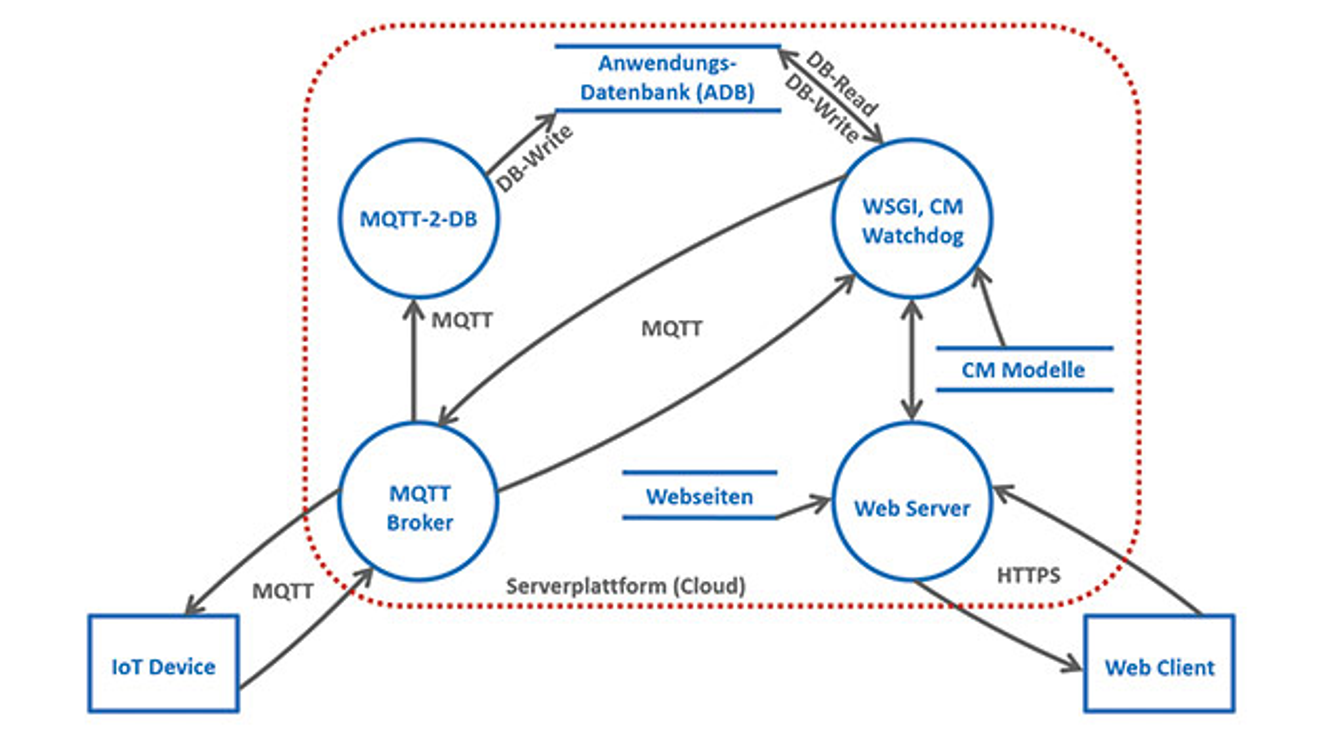
Figure 2: A data flow diagram (DFD) should exist for each (sub)function of an IoT application. It visualizes the data flow between the entities, processes and storage functions. The protocols used and security limits can also be entered in a DFD. If this diagram is created at the start of an IoT development project, security by design is possible.
© SSVEvery professional IoT application also includes a data flow diagram (DFD), which shows the external entities, processes, data storage functions, data and information flows and trust boundaries. There are various symbols and notations for creating DFDs. Entities are represented by rectangles, processes by circles and storage functions by two parallel horizontal lines. A label can be found inside each of these symbols. The data flow is indicated by arrows. Dotted lines are used to represent the confidence limits. Figure 2 shows the DFD for the condition monitoring example application described above. It was created according to generally valid DFD rules:
- Each individual process should have at least one input and one output.
- A data storage system must have an incoming and an outgoing data flow. In some use cases, the incoming data path is omitted for reasons of simplification (e.g. a storage system for static web pages; storing the web pages in a database would be a sub-application with its own DFD).
- Data that is stored in a database must pass through at least one process.
- All processes of a DFD have a data flow to another process, data store or entity.
- Data that is stored in a system must always run through a process.
- Only processes change data, whereas a data storage system does not.
The respective communication protocols used for data transfer between entities and processes can also be entered in a DFD. Furthermore, the trust limits should be marked in the DFD in order to ensure the necessary cybersecurity as part of a threat analysis. If the DFD is created at the beginning of an IoT solution development, security by design is possible.
Digital twin as an extension

The author: Klaus-Dieter Walter is a member of the management board at SSV Software.
© SSV Software SystemsA central database with an IoT interface on one side and a web client interface on the other also offers an ideal environment for implementing digital twins. This requires additional data storage options, for example for the design and configuration data of a machine or system. In the next article in the 'Digital Twin' series, the author will look at these aspects.


You might also be interested in
Scalable integration of machine data in IIOT applications
The digitalization and networking of systems forms the basis for optimized production. But how can it be implemented smoothly? How can data exchange between machines and systems, OT/IT integration and cloud connectivity be designed securely and...
 read more...
Siemens cooperates with Hilscher
Siemens is cooperating with Hilscher to integrate Hilscher's cifX PC card technology into Siemens' Simatic IPCs. This gives customers flexible access to all relevant fieldbus and real-time Ethernet systems.
read more...Manage and secure assets
In today's fast-paced industrial environment, it is essential that production processes run smoothly and efficiently. However, one critical aspect that is often overlooked is the importance of PLC backup and restore procedures.
read more...Update brings support for TIA V19
Delta Logic has updated the 'Accon OPC UA Server' software to version 1.4.0.0. The new features include support for TIA Portal projects of version V19 and for the latest firmware for CPUs of the Siemens S7-1200 and S7-1500 controllers.
read more...Branch office opened in Norway
The Austrian company Bachmann electronic, which specializes in automation technology for maritime applications, renewable energies and industry, is opening a branch in Norway.
read more...Raquel Torres is the new President
Raquel Torres succeeds John Conway as President of UniversalAutomation.Org.
read more...Subsidiary founded in Vietnam
The Schmersal Group has founded a new subsidiary in Ho Chi Minh City, Schmersal Vietnam Co. Ltd.
read more...Safe programming of PLCs
In collaboration with Codesys, Fraunhofer IEM has integrated static code analysis development methods into the Codesys development environment commonly used for PLCs.
read more...RoboDK and Keba work together
RoboDK and Keba Industrial Automation have announced their collaboration. Together, they want to simplify the life cycle of a process solution with integrated robotics - from quotation preparation to after-sales support.
read more...