
That was the Wireless Congress 2016
Before the next boom
Industry 4.0, Industrial Internet and IoT are driving the development of new wireless technology. Low Power Wide Area Networks (LPWAN) are currently predicted to grow rapidly. Several wireless technologies are competing with each other - and with mobile communications.
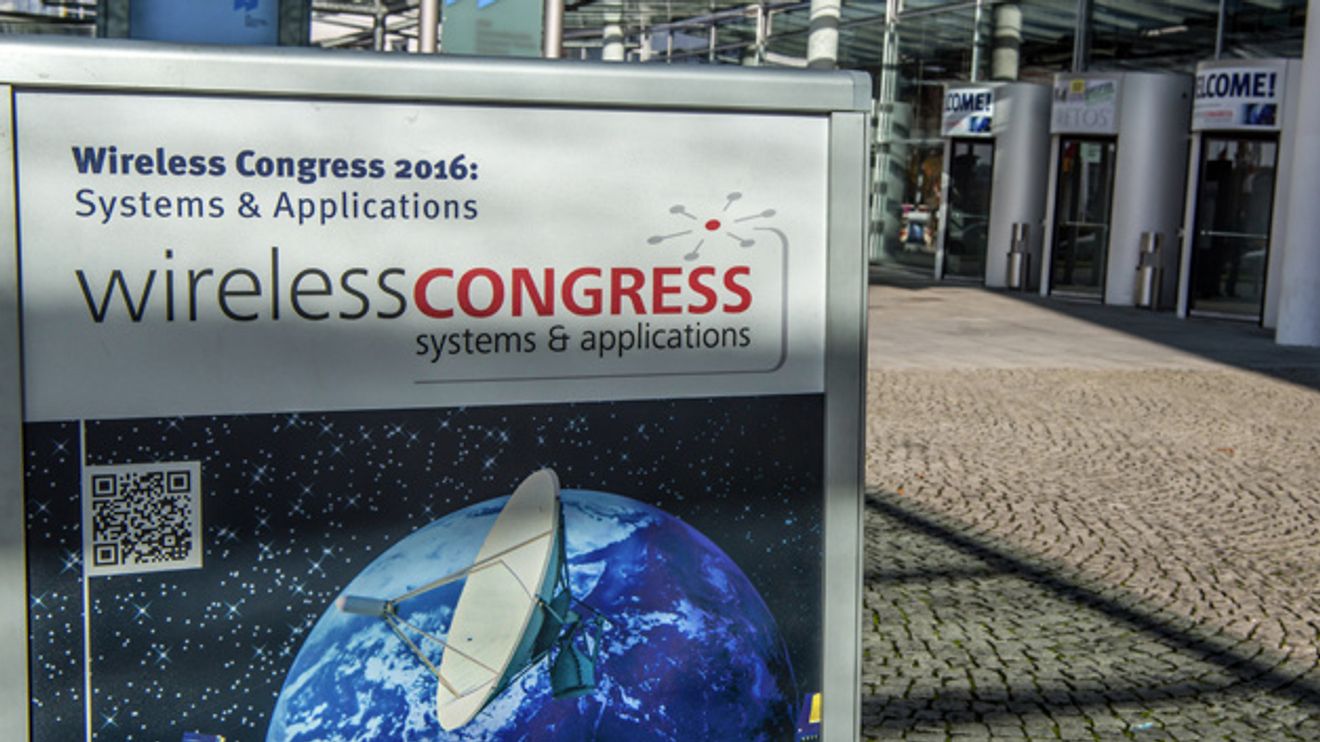
The Wireless Congress Systems & Applications took place for the 13th time at Electronica 2016.
© Horacio Canals)With the theme "Wireless for Wide Area with Low Power", this year's Wireless Congress Systems & Applications has chosen the current trend towards Low Power Wide Area Networks (LPWAN) as its motto. Up to now, utility companies, e.g. for energy and water, have been almost the sole users of these still new wireless technologies. However, market researchers at IHS Markit are already predicting strong growth for the use of LPWAN in industrial applications next year. For the following years up to 2019, they expect even higher growth for LPWAN technologies, which will be largely driven by industrial applications. In 2019, almost 80 million LPWAN-enabled devices for use in industry are expected to be delivered, out of a total of just over 110 million LPWAN devices (Fig. 1).


Figure 2: Dale Ford, Technology Vice President & Chief Analyst at IHS Markit, believes that Europe is currently the largest market for LPWAN devices with a share of around 50 percent.
© Horacio Canals
A total of 191 million devices will then communicate via LPWAN, 105 million in industrial applications alone. This data was presented by Dale Ford, Technology Vice President & Chief Analyst at IHS Markit (Fig. 2), in his presentation "LPWAN & M2M Applications", which opened the Wireless Congress 2016 at Electronica on November 9.
In the second opening lecture, Prof. Dr.-Ing. Hans D. Schotten, University of Kaiserslautern and German Research Center for Artificial Intelligence GmbH (Fig. 3), focused on wireless communication for Industry 4.0 - on the fifth generation of mobile communications and LPWAN. He made it clear that the requirements for 5G go far beyond the needs of production automation in the context of Industry 4.0. In addition to the communication requirements of industry, 5G should also be able to address the utilities industry, the transport and logistics sector and automotive applications. To this end, he gave an overview of the work within the German research program "Reliable, wireless communication in industry".


Figure 4: Prof. Dr.-Ing. Axel Sikora, Offenburg University of Applied Sciences and Hahn-Schickard Gesellschaft für Angewandte Forschung e.V., opened the 13th Wireless Congress Systems & Applications on November 9 at the International Congress Center, Munich.
© Horacio CanalsThe participants of the 13th Wireless Congress Systems & Applications were welcomed by Prof. Dr.-Ing. Axel Sikora, Offenburg University of Applied Sciences and Hahn-Schickard Gesellschaft für Angewandte Forschung e.V. (Fig. 4), who opened the congress. He also moderated the panel discussion on the second day of the congress on the topic of "Low Power Wide Area Networks for Industrial IoT - Licensed versus Unlicensed Bands?".
During the discussion, Aurelius Wosylus, Director Sales & Partners at Sigfox in Germany, emphasized that the previously rather sluggish mobile communications industry had adopted new standards such as LTE Cat NB1 in less than a year in response to the introduction of LPWAN technologies in the unlicensed sub-GHz band. He also drew attention to price-sensitive applications for which communication via mobile radio would simply be out of the question for cost reasons.
Smart is not always intelligent

Figure 5: Cees Links, General Manager Low Power Wireless at Qorvo, Inc., opened Session 1 "Wireless IoT" with an outlook on the "Internet of Services".
© Horacio CanalsEverything is or will be smart in the future. The house will become a smart home or smart building, consumption meters will become smart meters, the electricity grid will become a smart grid. The term "smart" is in vogue and is being used in an almost inflationary manner. However, most of the products advertised as "smart" today are anything but intelligent. This was the tenor of the presentation "The Internet of Things is a Service Application" by Cees Links, General Manager Low Power Wireless at Qorvo, who opened Session 1 "Wireless IoT" (Fig. 5).
He began the presentation by describing his experience with the gas supplier's smart meter. The newly installed "smart" consumption meter documented the consumption of the uninterrupted hot water boiler in the unoccupied basement of his house over several days. It was only days later that he noticed that he could hear the gas boiler running non-stop. He then had to wade through water on his way to the gas boiler on the first floor. A leak in the hot water pipe had caused a continuous demand for hot water, flooded the lower rooms of his house and later left him with a "smart" bill from the gas supplier.
He would expect an intelligent consumption meter to be able to detect abnormal modes of operation and inform the user. His conclusion: the Internet of Things will only be able to become what is so loudly propagated today through a meaningful evaluation of information.
Successful with a new concept
The Wireless Congress 2016 - which has been jointly organized by Elektronik, Electronica and ZVEI for the past 13 years - once again proved to be an important platform for the exchange of information and networking among wireless experts. 450 participants from all over the world attended this year's Wireless Congress on November 9 and 10 at the International Congress Center Munich - around 25 percent more than in the previous year. They were able to choose the topics relevant to them from the two-day program with 64 presentations, eight tutorials, two keynotes and a panel discussion. Compared to previous congresses, the tutorials on both afternoons were extremely popular. For the first time, they ran after the sessions with the presentations and no additional ticket had to be purchased for participation. This meant that participants could even switch between the tutorials.
Anyone who missed the 13th Wireless Congress Systems & Applications can purchase the conference proceedings afterwards to find out about the latest technical developments in the field of wireless. It is available in electronic form at a price of 240 euros and can be ordered by sending an e-mail to the editorial office([email protected]).


You might also be interested in
New Automation Management Board strengthened
New Automation, the training association for industrial companies in the field of automation technology, has expanded its board and set up new projects for young talent.
 read more...
Increase in orders for the German electrical and digital industry
The German electrical and digital industry started the second half of 2024 with a fifth more orders (+20.8% year-on-year).
read more...5G and Industrial Wireless Arena continues to grow
Next year, the three partners VDMA, ZVEI and Deutsche Messe will continue their collaboration at Hannover Messe 2025 as part of the special show "5G and Wireless Arena".
read more...Downward trend in incoming orders continues
Orders in the German electrical and digital industry continued to fall in June. The decline is particularly noticeable this month, which is due to the good month of the previous year.
read more...Electrical exports continue to shrink
The German electrical and digital industry is once again feeling the effects of weaker demand from abroad. Germany's most important trading partner is also holding back.
read more...No recovery yet for electrical and digital industry
The German electrical and digital industry also suffered a decline in orders in May 2024. This was reported by the ZVEI.
read more...China and Spain with growth
The electrical and digital industry recorded a double-digit percentage decline in exports in March. Only exports to China and Spain increased. This puts the first quarter in the red.
read more...ZVEI calls for a turnaround in efficiency
"Far too often we stand in our own way"
At the eSummit in Berlin, the ZVEI is calling for the efficiency revolution to start now. This involves the broad electrification of all areas of life, especially the industrial, transportation and residential sectors.
read more...The e-paper of issue 05/2024
Strategies for the future are one of the topics covered in the current issue of Computer&Automation. Read about the reforms that associations are demanding from politicians, the opportunities offered by technologies such as ChatGPT and SPE and...
read more...