

Focus on Aapp-based Automation
The Vertical Farming Demonstrator
The focus of this year's presentation by the Open Industry 4.0 Alliance is the showcase of a vertical farming demonstrator. Through three use cases, it highlights the multi-vendor approach and interoperability within synergistic projects.
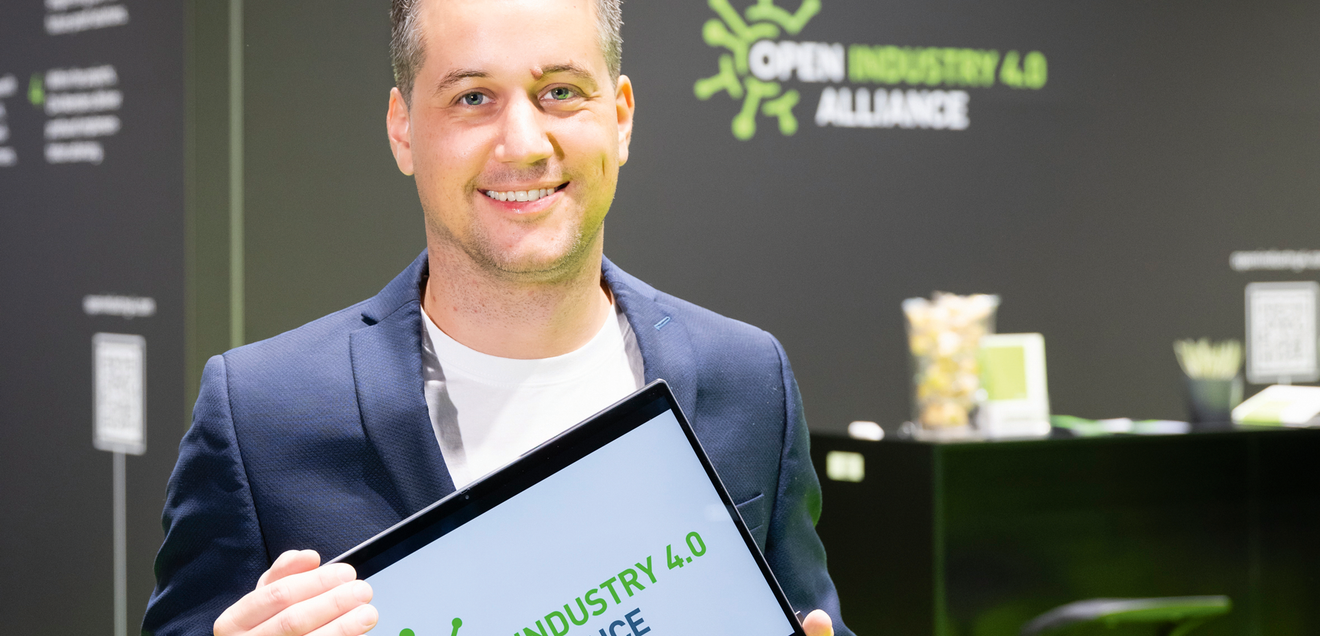
In addition to the new edition of the Digital Twin Challenge, the demonstrator will emphasize Digital Twin Enablement and the Asset Administration Shell (AAS). The demonstrator illustrates the multi-vendor approach and interoperability in synergistic projects through three specific use cases: »Engineering to Operations«, »Industrial Control as a Service« and »Automated as Built«.
The Karlsruhe Institute of Technology (KIT) originally developed the project in collaboration with OI4 Alliance member companies Boehringer Ingelheim and Endress+Hauser. Other members are now involved, namely Beckhoff, Copa-Data, Flecs and Zeta. This demonstration illustrates the integration of Information Technology (IT) and Operational Technology (OT) under the new OI4 Architectural Guardrails.
With the Vertical Farming Demonstrator, the Open Industry 4.0 Alliance demonstrates how manufacturers can sustainably optimize and streamline planning processes in the process industry by ensuring interoperability based on standards, such as the Asset Administration Shell as an implementation of the digital twin. This reduces manual effort, shortens the time needed for planning new facilities, and optimizes time to market.
"The central aspect here is ensuring interoperability for data, interfaces and semantics over the entire life cycle," says Michael Riester, Head of Research & Development at Endress+Hauser, explaining the benefits that the participating companies and partners would like to emphasize in particular:
- Shorter time to market: By using the demonstrator and the consistent application of Digital Twin technology as well as the seamless integration of IT and OT, the time it takes to bring new solutions to market can be significantly reduced.
- Lower complexity and higher performance of automation systems: The multi-vendor approach and the use of interoperable components lead to a significant reduction in complexity. Instead of conventional isolated solutions, the demonstrator offers a consistent, coordinated solution that also increases the performance of the automation systems. Eliminating physical PLC/edge hardware and dispensing with conventional fieldbuses simplifies engineering and enables more efficient, scalable systems.
- Reduction of manual effort during operation: Thanks to the "as-a-Service" approach and the automation options offered by the Asset Administration Shell, manual effort during operation is significantly reduced. This not only saves working time and costs, but also minimizes sources of error that could arise from manual intervention.
»This cooperation demonstrates the scalability of OT technology, which is made possible by eliminating physical PLC/edge hardware and dispensing with classic fieldbuses. The as-a-Service approach significantly simplifies modern engineering,« explains Samuel Greising, Managing Director at Flecs.
Open Industry 4.0 Alliance at the SPS: Hall 5, Stand 160


You might also be interested in
Virtual Commissioning as the Key to Competitiveness
Virtual commissioning is becoming a strategic success factor in manufacturing. A study by Visual Components shows why early simulation reduces costs, minimizes risks and ensures competitiveness.
 read more...
Owner Family re-enters the Operating Business
For the first time in almost 20 years, the Lenze Group's owner family is returning to the operational side of the business. Lena Günther and Dr. Moritz Belling take on management roles and are to help shape the automation specialist's future program.
read more...Orientation for Industry and Automation
SPS 2025 shows practical Solutions for 'Industrial AI'
From November 25 to 27, 2025, the automation industry will meet at SPS in Nuremberg. Around 1150 exhibitors will present technologies and solutions for smart production, with a focus on industrial AI, digitalization and safety.
read more...Register now at the Early Bird Price!
The program of the TSN/A Conference 2025 has been announced! On September 23 and 24, the international community from industry, research and development will once again meet in Stuttgart to discuss the latest developments in Time-Sensitive...
read more...Siemens continues its growth trajectory
Siemens continued its growth trajectory in the third quarter of fiscal year 2025 (ending June 30, 2025). However, the Industrial Business recorded a decline of 7 percent.
read more...AI agents in the industry | Part 2
Data Architecture as a Foundation in the AI Era
When an AI Agent recommends replacing critical network infrastructure based on subtle performance degradation patterns, human operators face a trust challenge. Should they allocate budget and resources based on advice from the "digital colleague"?...
read more...Companies Expand Use of AI Agents in Core Processes
A new IBM study shows that companies no longer see AI agents as an experiment, but want to use them on a large scale for core business processes.
read more...Robotics Insider on the Opportunities of Humanoid Robots
Humanoid robots are still in their infancy. Nikolayi Ensslen (Synapticon) and Michael Mayer-Rosa (Delta Electronics) explain why transparency is now more important than PR, what real progress is being made - and how the industry needs to build trust.
read more...Global Platforms for the Industry
SPS - Smart Production Solutions is further expanding its international presence. With expos and stages in China, Italy, the USA, Thailand and Malaysia, it offers the industry international platforms for innovation and networking.
read more...