

Hannover Messe 2023
AI arrives in the industry
At the start of the trade fair, Microsoft's Head of Germany Marianne Janik called for greater use of artificial intelligence (AI) in Germany.
"AI provides the impetus for a new German speed," she said at the start of the trade fair. The new technology could help to overcome obstacles such as the labor shortage and accelerate innovation processes. "Advances in the field of artificial intelligence offer Germany a unique opportunity to pick up the pace and achieve ambitious goals in a considered and responsible manner," Janik continued.
At the latest since the ChatGPT voice bot became known, the topic of artificial intelligence has finally moved into the public spotlight. It has a reputation for not only being able to change many industrial processes, but also for turning entire professions upside down or even making them disappear completely. According to many experts, however, the AI sector is only at the very beginning of its development, and the universally admired results of ChatGPT are just a foretaste of what AI could achieve in the near future.
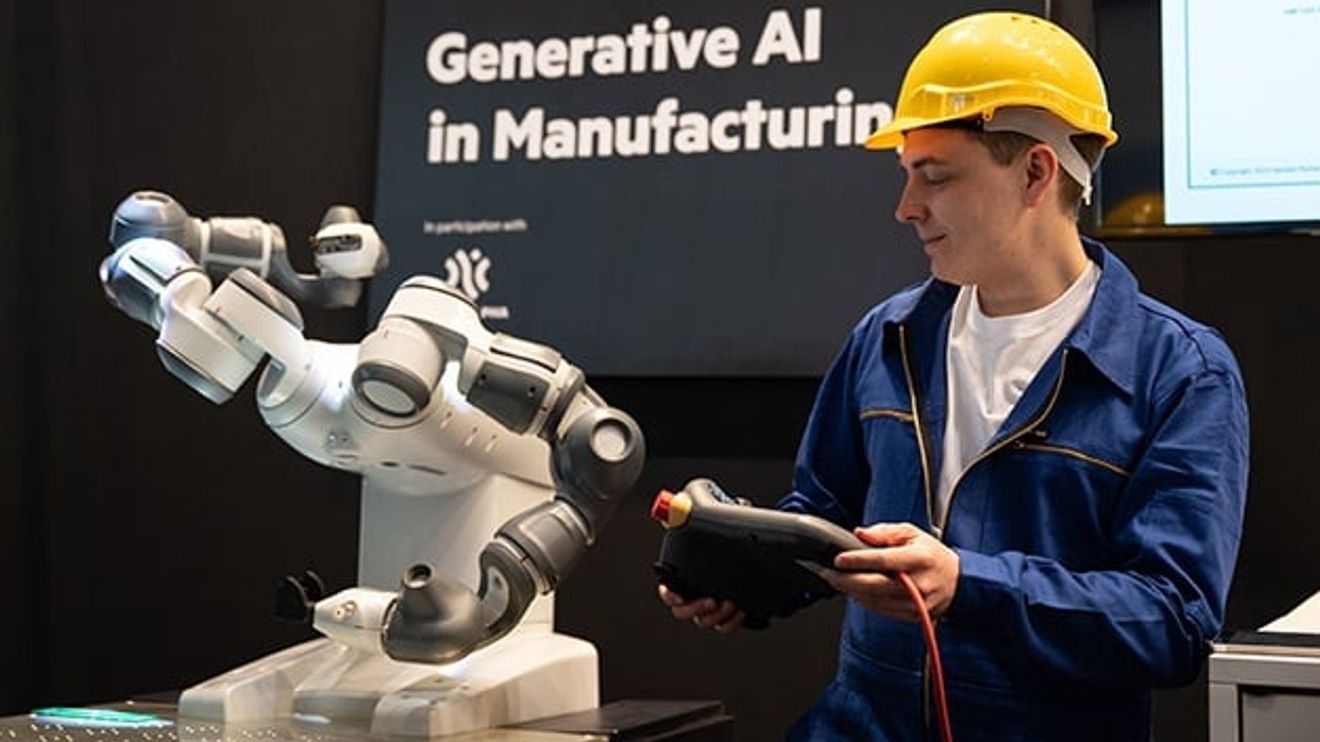
An important aspect of the use of AI is the optimization of processes in companies, with concepts that fall under the umbrella terms of AI and machine learning (ML) going hand in hand. Together with Intel and Kyndryl, software virtualization leader VMware (Hall 15, Stand F59) will be demonstrating at the Hannover Messe how smart robotics based on AI and machine learning can take over quality assurance on the assembly line. This requires a lot of computing power, which in many cases has to be provided by high-performance data centers.
However, there are also application scenarios that require computing power at the far edge. One example that Intel, Kyndryl and VMware also refer to is wind turbines, where the on-site use of AI is intended to optimize maintenance. In the case of highly automated AI decisions, it is obviously crucial how reliably the result of an AI can be evaluated, as the Fraunhofer Institute for Intelligent Analysis and Information Systems ISIA, based in Sankt Augustin near Bonn, emphasizes. Specifically, for example, an autonomous vehicle must be able to reliably recognize the objects and people in its environment so that it can react appropriately. A system for assessing uncertainty, which the institute is working on and will be presenting at the trade fair (Hall 16, Stand A12), helps to assess whether the system's decision is trustworthy or whether certain fallback mechanisms need to be activated.
Thomas Meier, Chief Technologist at Hewlett Packard Enterprise, said: "AI is a core component of many of our products, for example servers, storage systems or networks. Among other things, AI helps our customers to optimize the performance of these systems and to predict and prevent problems." For years, millions of sensor data have been collected every second from systems around the world and used to train AI, which in turn is intended to support users in operation and predictive maintenance. "Since 2010, we have analyzed more than a thousand trillion data points in this way and saved our customers more than 1.5 million hours of lost productivity," Meier continues.
Generative AI to accelerate digital change
A third of industrial decision-makers in medium-sized and large companies in Germany already believe that generative AI can accelerate digital change in their companies. This was revealed by a representative survey of 1,500 industrial managers in Germany conducted by the opinion research institute Civey on behalf of Microsoft, as announced by the Windows company on the occasion of the Hannover Messe.
More than half (62%) of those surveyed even see multiple benefits for generative AI in industry. According to them, cost savings (51%), increased efficiency (45%) and the optimization of business processes (41%) are the main benefits. In addition, 42% of all respondents see the reduction of routine activities as a way of mitigating the shortage of skilled workers.
Nevertheless, only around 8% have used generative AI in their company to date. The practical use or plans for implementation obviously depend on the size of the company. More than a quarter of managers from large companies (1,000 employees or more) are already using or planning to use generative AI (28%). In smaller companies (up to 49 employees), the proportion is only half of this, namely 14%. For medium-sized companies (up to 999 employees), the figure is 18%.


You might also be interested in
E-Paper: HANNOVER MESSE DAILY Day 4
The top news from the fourth issue: Robert Habeck at the Hannover Messe +++ First virtual Simatic controller +++ 75th anniversary at Pilz +++ Interview with Schneider Electric +++ The long road to the App Store +++ 20 years of Optris +++ Sustainable...
 read more...
Converging Digital Twin Models
Siemens and Microsoft are working together to facilitate the exchange of digital twin models and data. To this end, they are merging Digital Twin Definition Language with the W3C Thing Description Standard.
read more...Facilitate the replacement of digital twin models
Siemens and Microsoft are working together to facilitate the exchange of digital twin models and data. To this end, they are merging Digital Twin Definition Language with the W3C Thing Description Standard.
read more...Vodafone and Microsoft agree on comprehensive partnership
Microsoft's share price has shot up in recent months in anticipation of good business with AI applications. Now the first major orders are trickling in. In return, Microsoft is buying telecommunications solutions on a large scale.
read more...The e-paper special: looking for products of the year 2024
They've earned it: all 96 nominated products from 12 categories in their own e-paper. Browse through the individual areas and make your personal selection. You can also find out more about the companies and their solutions in the accompanying video...
read more...AI is what we make of it
Everyone is talking about generative artificial intelligence. But what added value does it bring? How can it be integrated into industrial processes? An assessment from Microsoft.
read more...25 years of Computer&Automation - The e-paper
For 25 years, Computer&Automation has accompanied the growing influence of IT in automation technology. Ultimately, IT and automation can no longer be clearly separated. In this anniversary issue, you can read about the importance that...
read more...The top articles in May 2023
The fact that the fight against climate change is undisputedly the biggest global challenge is also reflected in the most-read articles of May. New applications with the digital twin and trends in AI in dialog continue to top the list.
read more...The chatbot as a teacher
The potential of text-based dialog systems is demonstrated by a free interactive online course from Münster University of Applied Sciences. A chatbot acts as a teacher to teach the basics of programming.
read more...