
TenAsys - TSN series part 20
A resource-based approach
The added value of TSN results primarily from IT/OT convergence in the end points. Exploiting the potential is still complex and requires in-depth knowledge of network technology. An application-centric, resource-based approach is presented as an alternative.
Time-Sensitive Networking (TSN) extends standard Ethernet according to IEEE 802.1 with functions for synchronization and deterministic data communication. It is regarded as the key to convergent IT/OT networks, which are the decisive prerequisite for the digitalization of production.
TSN works on layer 2 of the OSI model and is therefore a data connection technology that can be used by various protocols at a higher level. Since the start of TSN activities, several widespread Ethernet-based industrial communication standards have been extended so that they can operate on the basis of a TSN network in future, for example Profinet and CC-Link IE TSN. Direct field communication, which is standardized under the name OPC UA FX, should also be possible in the future using TSN on the basis of OPC UA, which has so far been widely used mainly at the IT/OT interface.
On the one hand, the large number of TSN-based approaches to industrial communication show the broad acceptance and underline the necessity of convergent real-time networks for digitalization. On the other hand, the different approaches also cause irritation among users, as they use and configure the TSN standards differently.
The development of TSN in the IEEE task groups and the associated vision of IT/OT convergence using a standard Ethernet are now more than ten years old. As the standardization of TSN and the overlaying protocols is still ongoing and infrastructure and endpoint hardware are only slowly coming onto the market, real installations are still limited.
The challenges
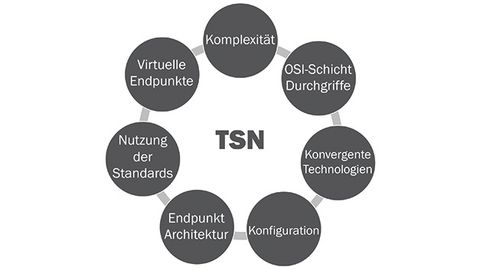
Despite the great potential of TSN, its use presents users with many challenges. TSN offers a large number of basic functions for deterministic communication. However, there is neither standardization nor a general consensus on how to combine them. In particular, different TSN-based protocols use different approaches. The configuration of the selected mechanisms has also not been conclusively clarified. The endpoints pose a particular challenge: Their architecture is outside the focus of the IEEE 802.1 standards, there are no suitable abstraction layers for a clean separation of the layers and potentially several virtual endpoints can be realized on one physical endpoint.
Combined, the factors summarized in Figure 1 lead to a high level of complexity. As a result, companies wishing to take advantage of TSN need to consult technical experts who are familiar with the intricacies of the technology and know how it can be used for specific use cases.
TSN from the user's perspective
The complexity is offset by the wishes of the users. Distributed real-time applications should be easy to implement on TSN-based systems. This requires functions that can create, manage and easily use deterministic communication relationships. The focus is clearly on the application: solutions for the user therefore extend in particular to the endpoints and application engineering, whereas the network must be managed automatically. To date, the lack of corresponding solutions for endpoints has been an obstacle to the acceptance and broad adaptation of TSN. The industry needs an abstraction layer that simplifies the configuration of time-critical applications and endpoints in order to make TSN accessible to everyone.
A resource-based approach

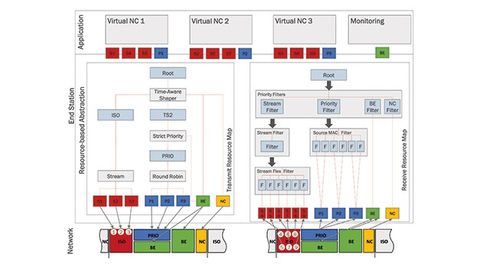
Figure 2: The different layers in the endpoint, as well as their core functions and interfaces.
© TenAsysWhile networks are typically developed and considered very explicitly in the OT environment, in IT they are usually seen as a given part of the infrastructure and used as an available resource. A resource view is also possible in the OT environment: instead of standards, network configurations and low-level communication, users can see various communication relationships. What the resource is here can differ depending on the approach to using TSN:
- Physical network interfaces
- Traffic classes with certain deterministic guarantees
- Streams with guaranteed deterministic properties
Applications can be developed on the basis of these communication resources without in-depth knowledge of the technology. However, the prerequisite is that a subordinate system implements this abstraction and takes care of the necessary configuration.
Systems basically consist of hardware-software combinations. TSN-capable hardware in the form of network controllers is increasingly coming onto the market and can implement some of the functions. However, it should be noted that there is no such thing as "the" TSN hardware, but that different controllers offer different hardware support, whereby complementary software functions are always required. Particular attention should be paid to the widely used controllers that efficiently support various TSN functions but were not specifically developed for TSN use (e.g. the I210 Ethernet controller from Intel). Accordingly, a great deal of expert knowledge is required in addition to the software components in order to use them effectively. From an endpoint perspective, three layers can be identified(Fig. 2):
- Application layer
- Abstraction layer
- Hardware layer

There are interfaces between the layers. The corresponding hardware-specific interfaces are used from the hardware to the abstraction, while the resource-based approach is reflected at the interface between the abstraction and the application: there are communication resources for sending and receiving as well as management interfaces for the resources.
The resource-based approach allows the entire system - from the hardware to the application interface - to be mapped uniformly using resource maps. A map is required for both the send and receive directions. In the send direction - starting from the physical interface, which represents the root - the resources are divided into ever new resources via various shapers.
These different shapers can be used:
- Time-aware shaper
- Credit-based shaper
- Priority-based shaper
- Stream-based shaper
These can correspond exactly to the respective TSN functions, for example the time-aware shaper according to IEEE 802.1Qbv. In addition, shapers can also be implemented only locally in the endpoint, for example to enable fine-grained traffic classes for a larger number of parallel applications in the endpoint with fair access to the network.
In the receive direction, which is also described by a map, the incoming data from the physical interface is further divided using filters.
The resources defined in the maps correspond to the user interface. The user can therefore select various entry points - from the physical interface to fine-grained traffic classes - to realize his application. The configuration of the resource maps is decisive for the efficiency of the approach. Depending on the usage, various options are provided:
- Static or default configurations
- (Partial) configuration using interfaces to centralized or distributed network management or application engineering
- Manual configuration using APIs
- Use of specific configurations for TSN-based solutions such as Profinet over TSN or CC-Link IE TSN
The send and receive logic is implemented in the abstraction layer and the hardware, which are configured on the basis of the maps.
TSN: Application example and implementation perspective
The virtualization of multiple controllers is a typical use case for TSN. The main advantage of this approach is that multiple virtual controllers can run in parallel on a multi-core industrial PC. So instead of deploying and managing many discrete hardware controllers, plant operators can consolidate all their real-time control tasks on a few powerful multi-function automation controllers.
This use case will serve to illustrate the resource-based approach. It is assumed that three machines, each with two axes, are operated using virtualized controllers. All controllers are to be executed on the same endpoint. The communication between the controllers and the drives consists of real-time streams in both directions, configuration data to be prioritized and best-effort data for monitoring functions(Figure 3).
To implement the communication, resource maps are set up on both the receiving and sending sides, which combine various shapers and filters(Fig. 4). The actual applications are implemented based on the resources. On the application side, for example, it would be possible to use the stream resources for OPC UA pub/sub traffic, the prioritized traffic class for OPC UA client servers, as well as the use of best-effort for access via web-based monitoring.
The prospects for implementation
The resource-based approach can be used in real-time operating systems, but requires in-depth interventions in the classic network architecture. This requires close coupling with time synchronization and, in particular, with application scheduling. The resource-based approach is currently being integrated and tested in the INtime RTOS from TenAsys.
This approach makes it possible to develop real-time applications based on TSN without having to understand the intricacies of TSN components, traffic shaping and timing offsets in detail. Instead, the INtime application development tools and utilities act as a network configuration interface, allowing solutions to be implemented at the application level and executed deterministically, depending on what the use case requires. At the same time, standard IT workloads can be run on the same platform, for example via Windows, without interfering with the real-time applications.

The demonstrators expected in 2024 should not only present the approach, but also make an important contribution to the cross-platform abstraction of real-time applications and their communication.
| TSN sightseeing at the SPS |
|---|
|
For automation experts, there is probably no better place to find out about trends and developments in the industry than at the SPS trade fair in Nuremberg. During our tours of this year's event, we took a particular look at the TSN trends: In previous years, there were relatively few exhibitors who addressed TSN on their stands - but they did so very boldly. This has changed. TSN was no longer presented as prominently this year, but it was on far more stands. Every chip manufacturer now offers TSN-capable hardware - whether simply as a MAC, integrated with a processor, special solutions for drive technology, for example, or as a switch solution. Industrial switches with TSN often complement various endpoint solutions. There are also an increasing number of software solutions: Solutions with a minimal footprint, open solutions based on Linux or integrated RTOS OPC UA variants. In general, TSN was seen by many fieldbus organizations as a supplement or as an alternative layer 2 - confirmed by the increasing number of available products. Various exhibitors also focused on the critical topic of configuration in their exhibits, providing insights into network and application management. In terms of industrial control systems and components, the first manufacturers also dared to focus on the performance of TSN, for example by juggling a golf ball using rope kinematics. To summarize, we saw significantly less marketing than in previous years, but a much greater breadth and, in particular, maturity of TSN solutions. As always, we look forward to your feedback, comments and suggestions on our series. Yours, Florian Frick and Meinrad Happacher |


You might also be interested in
First TSN certification program
AVNU's TSN certification program is the first of its kind to certify Time Sensitive Networking (TSN) capabilities, specifically the 802.1 TSN standards developed by IEEE SA.
 read more...
Industrial Ethernet dominates
Every year, HMS Networks conducts a market analysis of industrial networks. The latest study shows that the market for industrial networks is continuing to expand, with expected growth of 7% in 2024.
read more...AI - Paving the way for TSN?
What requirements does the use of AI place on automation and networking? Do the mechanisms of Time Sensitive Networks in combination with Profinet perhaps form the optimal architecture for AI applications?
read more...Enabler of SW-defined production?
Digitalization is often reduced to the addition of digital services to traditional systems. However, the real potential lies in a digital ecosystem that needs to be established as part of software-defined manufacturing - TSN plays an important role...
read more...TSN - The current state of affairs
TSN is the extension of the IEEE Ethernet standards to include deterministic quality-of-service mechanisms and is therefore a key enabler for the digitalization of production. This article summarizes current developments and places them in an...
read more...Focus on interoperability
Testbeds play a decisive role in the development of TSN towards a cross-manufacturer ecosystem. What progress has the TSN testbed at ISW made in recent years and what current challenges are currently being discussed there?
read more...Lua - an alternative to PLC programming?
When programming real-time applications, developers still fall back on their usual, albeit often complex, languages such as C and C++ or traditional PLC programming. Scripting languages such as Lua are an interesting alternative.
read more...Trumpf collaborates with the IPAI AI Network
Trumpf is a new partner of the IPAI AI network in Heilbronn. Together, the two parties plan to develop and test artificial intelligence applications for industry.
read more...TSN as the Foundation of the Digital Industry
TSN/A Conference 2026 – Get your Early Bird Ticket now!
With a top-notch program and leading experts from industry, research, and standardization, the 11th TSN/A Conference 2026 will once again bring together the international TSN community under the theme “Multi-Industry Adoption of TSN.”
read more...