

German Telekom
5G mmWave: From the lab to the factory
5G mmWave technology is commercially available for industrial customers for the first time. Deutsche Telekom has tested the 5G frequencies in the millimeter wave range (mmWave) at 26 gigahertz with use cases from industry.
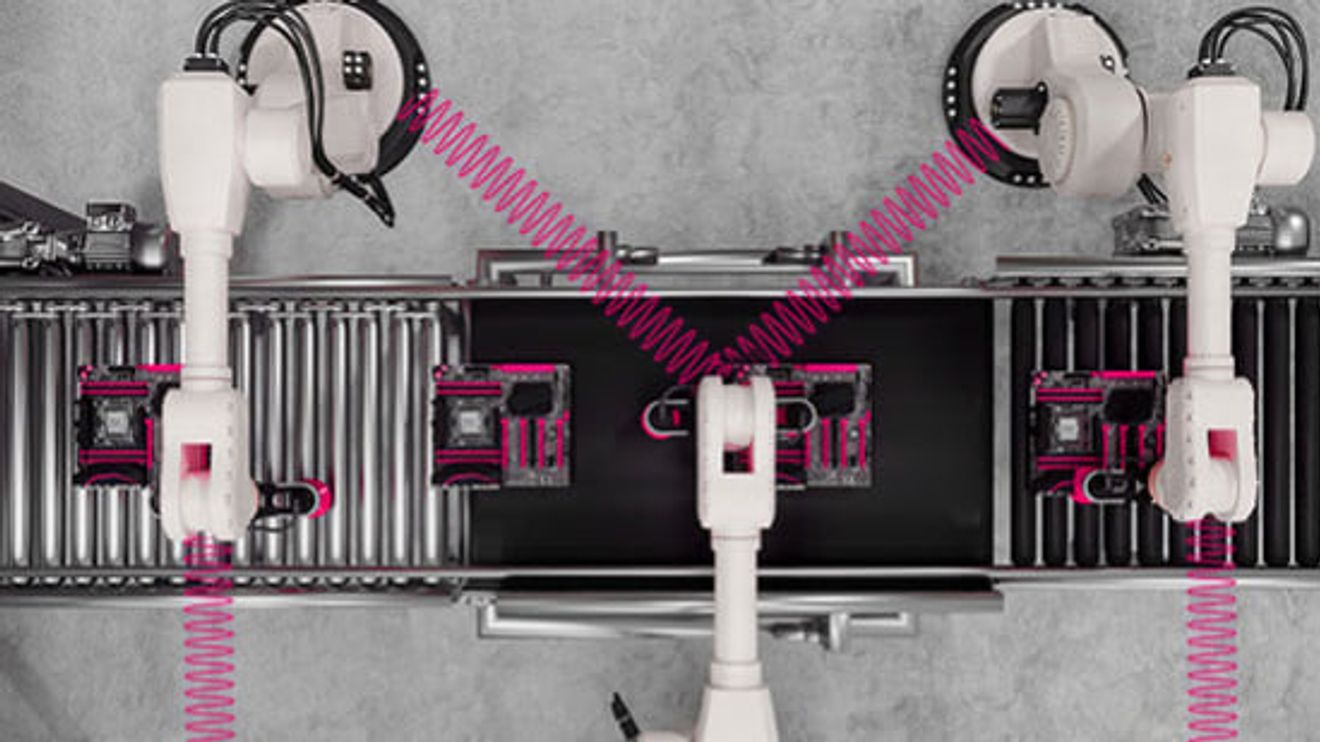
At the 5G Campus of the Werner-von-Siemens Center in Berlin, autonomous industrial machines and robots were networked with a router. In addition to 5G standalone in the industrial spectrum at 3.7 Ghz, this also supports the so-called mmWave spectrum for the first time. With low latency times of three to four milliseconds RTT (round trip time) and a data rate of over 4 gigabits per second in download and 2 gigabits in upload, these millimeter waves are particularly suitable for data-intensive applications in the manufacturing industry. 5G mmWave communication is enabled by Telit Cinterion, a global provider offering end-to-end IoT solutions.
While customers are already using 5G campus networks in the so-called mid-band for many industrial applications, applications in the field of autonomous vehicles and manufacturing industry can now be realized. The special capability of mmWaves lies in its ability to transmit large amounts of data in real time. The frequency spectrum around 26 GHz is allocated exclusively to interested parties in Germany by the Federal Network Agency. It can currently only be used for local applications. "It is very important for our industrial customers to be able to upload data from the machines in order to analyze it in real time," explains Klaus Werner, Managing Director Business Customers Telekom Deutschland GmbH.
Autonomous robots at the Werner-von-Siemens Center
The 5G standalone campus network at the Werner-von-Siemens Center operates separately from Telekom's public mobile network. The entire infrastructure, from the antennas and active system technology to the core network, comes from Ericsson. Based on this network, a fleet of autonomously driving and operating robots works on various use cases in the center. The 5G millimeter waves come into play when the requirements for communication and data transmission increase, and therefore also when solving more complex tasks. For example, in a computer vision application: the robot picks up an order and checks whether the ordered goods are complete on the way to the next destination. If there is a discrepancy, it reorders the goods directly.


You might also be interested in
5G and Industrial Wireless Arena continues to grow
Next year, the three partners VDMA, ZVEI and Deutsche Messe will continue their collaboration at Hannover Messe 2025 as part of the special show "5G and Wireless Arena".
 read more...
The e-paper for the special issue
Communication & networking 09/24
Communication and networking form the backbone of industrial automation. It enables flexible production processes and creates the basis for innovations and new business models. The news is now available in this e-paper.
read more...TUD opens "incubator" for start-ups
The Technical University of Dresden (TUD) and the Technical University of Munich (TUM) have opened the new "launchhub42 ComSpace". In addition to cutting-edge research for future 6G communication networks, it also focuses on visionary ideas from the...
read more...Partnership for networked manufacturing with 5G and real-time positioning
Telekom and Trumpf are further expanding their cooperation in the field of positioning systems for the networked industry. The agreement that has now been signed will facilitate the joint market launch.
read more...Second managing director appointed
Eduard B. Wagner, founder and Managing Director of Insys icom, appoints Florian Froschermeier as second Managing Director. This organizational change took effect on 1 April 2024.
read more...Radio-based communication
Steute Technologies' Controltec division will be presenting its wireless industrial switching devices in a suitable environment - at the Industrial Wireless Arena + 5G Networks & Applications at the VDMA joint stand.
read more...Communication & networking - The winners
TSN, fast data migration and muting are among the key features of the winning products in the 'Communication & Networking' category.
read more...Telekom presents "mobile mast-to-go"
A transmission mast for temporary network coverage on company premises, construction sites or in disaster areas - the "mobile radio mast-to-go" with sectorized antenna is flexible in many ways.
read more...Efficiently modernize agricultural implements
b-plus has been dealing with the topic of "ISOBUS" for over 10 years. Especially with the increasing demand for technical applications in agricultural engineering, the future lies in the integration of the data bus system.
read more...