

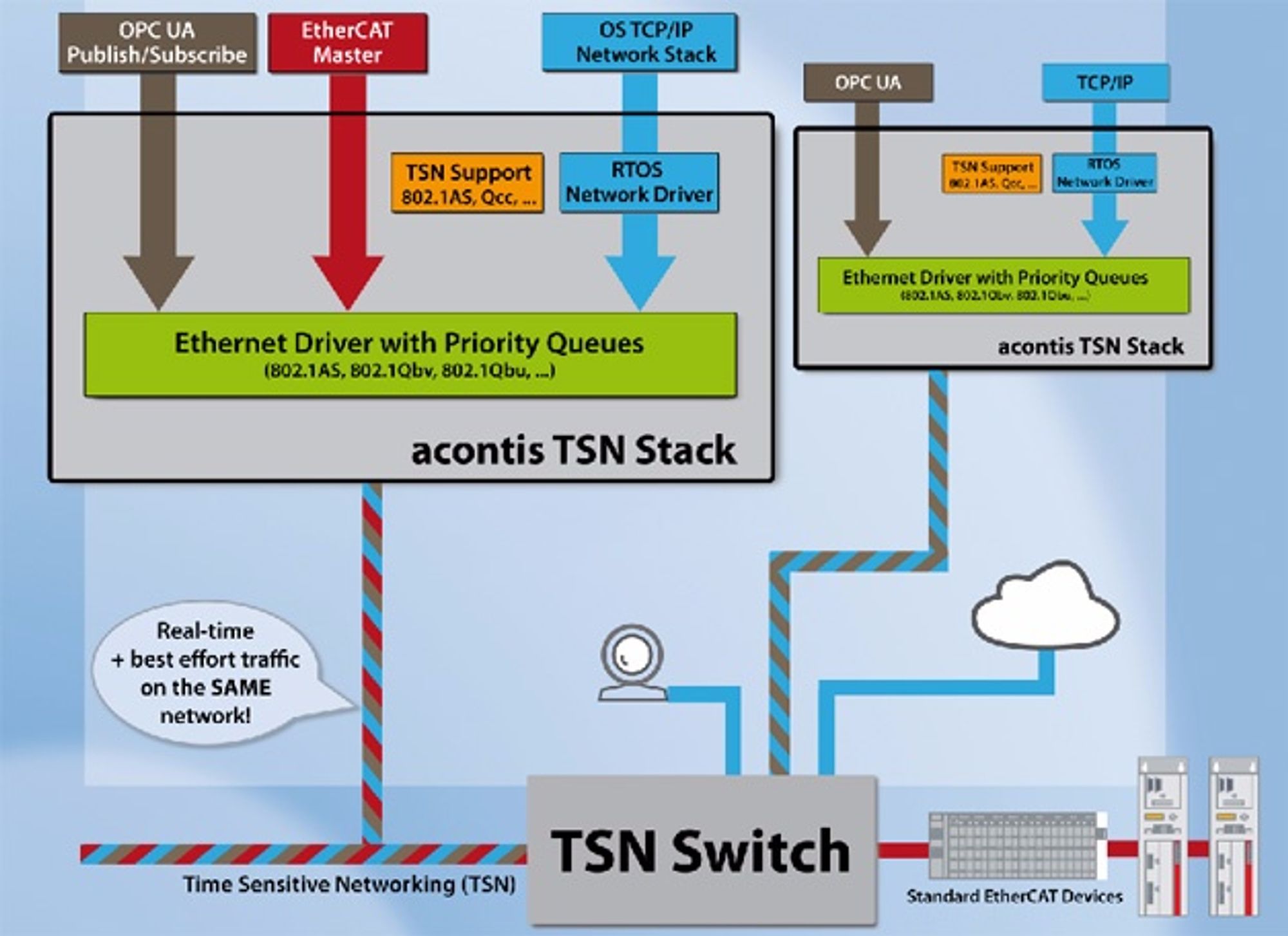
The drivers supplied with most real-time operating systems are not real-time capable - a knock-out criterion for automation devices that are to be connected to a TSN network. If automation devices are to be connected to a TSN network, the entire real-time chain from the application on the device's real-time operating system (RTOS) to the TSN stack, the Ethernet controller driver and the Ethernet hardware must be completely deterministic - both when sending and receiving. In addition, normal, non-real-time TCP/IP/Ethernet communication via the TCP/IP stack of the RTOS must also be possible in parallel via the same Ethernet controller without disrupting real-time traffic. A special mechanism in the Acontis Ethernet drivers ensures the necessary handling of high-priority Time Scheduled and low-priority Best Effort telegrams, such as conventional TCP/IP telegrams. The protocols already tested and available above the TSN stack are Ethercat and OPC UA Pub/Sub. As before, the conventional OPC UA client/server is processed via the TCP/IP stack of the RTOS and fed to the low-priority best effort processing queue in the Acontis drivers.