
Smart cameras
Optimized production
Covering three tasks with just one visualization system - this was the requirement when redesigning a bag filling system for the food industry. Smart camera technology makes it possible.


The 'FMH 80' form, fill and seal machine from SN Maschinenbau, specially designed for the food industry.
© Leuze EelectronicWhen developing the 'FMH 80' form, fill and seal machine, the designers at SN Maschinenbau wanted to solve various tasks with a single camera system. The aim was firstly to make the monitoring of the best-before date (BBD) economical, secondly to recognize reference codes - also automatically switchable when changing products - and thirdly to measure the position of the print mark on the packaging in order to output a control variable (in mm) to a servo drive and to be able to correct the sealing stations of the vertical sealing seams during the process. This allows pressure fluctuations on the packaging to be corrected automatically. With the new machine concept, an open, hygienic machine design with a reduced part volume has been realized, which eliminates hidden areas and edges and is therefore easy to clean.
Checking reference codes
The first task is the verification of reference codes. The products and recipes programmed into the machine are changed directly via the control system, without manual intervention by an employee. In addition, continuous quality control is required to ensure that the correct contents are actually filled into the correct packaging. This requires an optical visualization system that reads the reference codes and compares them accordingly.
SN Maschinenbau chose the 'LSIS 462i' visualization system from Leuze Electronic. This camera-based technology is used in combination with the 'KRTM20' contrast scanner, which can store different contrast values of the print marks on the packaging, which are called up directly from the control system.
In the past, either reference codes, which were displayed in the form of a barcode, or 2D codes could be recognized. For future customer tasks, however, it was important for the machine manufacturer to have a solution for barcodes, data matrix and QR codes in equal measure - hence the 'LSIS 462i', which can recognize different types of reference codes as a multi-code-capable high-speed reader. The inspection takes place while the packaging is moving at a speed of up to 4 m/s. Due to the strict hygiene regulations in the food industry, the reader in the pouch packaging machine was also installed in a stainless steel protective housing with a high degree of protection.
Check best-before dates
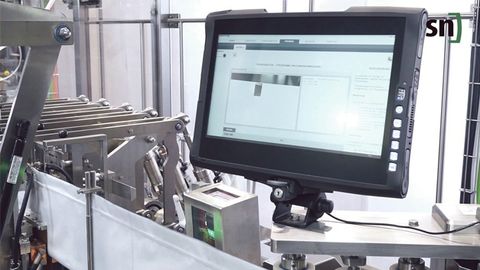
Print mark measurement in the bag filling system. Due to the hygienically demanding environment with additional stainless steel housing and visualization on an industrial tablet.
© Leuze ElectronicAnother challenge in this application is checking the legibility of the best-before date labels. In the past, if BBD codes were printed with poor quality, the data was illegible due to incorrect embossing in the packaging technology or the print was completely missing, bags printed in this way could only be recognized with significantly more expensive systems. The smart camera technology now in use, on the other hand, evaluates the best-before date labels on each individual bag based on several quality features - both when stationary and in motion. A second reader detects the quality of each code in the same way and also carries out a reference code comparison to ensure that the packaging really does contain what it promises. The integrated homogeneous lighting also contributes to the good legibility of the BBD. Thanks to its built-in RGB LEDs, the camera-based visualization optics are independent of ambient light and can be individually adapted to any packaging design. In addition, its focus can be switched automatically using a motor, meaning that no mechanical intervention or opening of the camera by an employee is required. Changes to the packaging properties can be stored in recipes and called up by the operator with the machine recipe.
The stationary smart camera used in the bag filling machine combines 1D code reading with smart camera technology. The device reads barcodes, 1D and 2D codes, both printed and directly marked. At the same time, it recognizes best-before dates. During the process, the camera incorporates measurement results or provides an adjustment aid for the format changeover in order to quickly find the position of the print mark. The operator is shown the directions of the necessary changeovers.
The complete solution
The contrast sensor can store up to 128 contrast values simultaneously, which enables fast product changes and high throughput, even in the area of print mark control. The smart camera can be integrated using a reproducible mechanical attachment. Reference codes are set and programs are changed directly from the control system without the need for manual intervention. An integrated display enables diagnostics for commissioning and adjustment during operation directly on the device. The software is also included in the smart camera. Configuration is carried out directly via the web-based software tool 'webConfig', which is independent of the operating system, so that no separate parameterization software is required.
Author:
Martina Schili is responsible for Corporate Communications/Public Relations at Leuze Electronic in Owen.


You might also be interested in
The transparent power supply
Transparency in the production process requires the continuous recording of measured values and their forwarding to the control systems. The example of a modern automatic circuit breaker shows what this can look like in the field of 24 V (DC) power...
 read more...
Efficient administration of distributed control systems
With a large number of control systems in the field, it is often difficult to maintain an overview. This is where the 'Codesys Automation Server' comes in: It enables convenient administration of all controllers via the digital image of each PLC in...
read more...The 'SEAP 4.0' project
I4.0 has been accompanying automation technology since 2011. The main results of this work are the Reference Architecture Model Industry 4.0 (RAMI 4.0), the I4.0 component and the asset administration shell. The concept of the asset administration...
read more...Automate the test
Machine and system manufacturers are increasingly moving towards simulating control software before commissioning in order to correct any errors in advance. Instead of carrying out the tests manually as before, it is advisable to switch to an...
read more...From the sensor to the cloud
How can sensor data be uploaded to a cloud platform? At SPS IPC Drives, Hilscher is presenting a technology platform that is intended as a system solution for OEMs and also includes the aspects of diagnostics and maintenance.
read more...Digital prototyping
Digitization projects are often viewed with scepticism. This makes it all the more important to involve employees in new workflows and processes right from the start. Rapid prototyping methods and processes are suitable for this - for example when...
read more...Operation by foot
Safe area monitoring combined with active machine operation - this is exactly what a dynamic safety mat offers. Workers can trigger defined actions using their feet and virtual buttons. Their hands remain free, enabling new operating concepts.
read more...Modular and secure
Increasingly complex applications require increasingly flexible system components - including safety gate protection. With a modular system, users can adapt their solution to individual requirements.
read more...20 % more productive
Flying chips, vibration and splash water: industrial PCs have to cope with such influences in the production of clamping tools. With BDE and CAD software on board, they increase productivity by 20 %.
read more...