
Bin-picking
AI-based gripping of any objects
Grasping any object without knowing it in advance is an almost insurmountable task for robots. An AI-based software solution in combination with an intelligent 3D stereo vision camera solves this problem.

The so-called 'reach into the box' is one of the most difficult tasks in robotics. The aim of this scenario is to program robots in such a way that they can pick random objects from boxes. A typical application of such a task, also known as 'bin-picking', is the removal of arbitrary objects and their picking in logistics. The biggest problem with such approaches is usually the reliable recognition of unsorted objects and the high cost of programming the systems.
With the vision system platform 'robobrain.vision', the Munich-based start-up Robominds has developed an economical solution for the simple implementation of such bin-picking applications by robots that does not require complex and therefore costly programming. "Robobrain.vision allows robots to pick any objects without having to be taught or scanned beforehand. These objects can also overlap and have any surface and geometry," summarizes Tobias Rietzler, CEO of Robominds.
Support from AI
The 'secret' of the system consists of combining a 3D stereovision camera, an industrial computer and the robobrain.vision solution, which is based on artificial intelligence methods: The 3D camera first captures high-resolution 3D images of the work area using Active Infrared Stereovision. This is based on two 2D cameras, each with a resolution of 1920 x 1080 pixels, which enable 3D images with a resulting resolution of 1280 x 720 pixels. The 3D camera is housed in an IP54-rated housing and is therefore sufficiently protected for the majority of industrial applications.
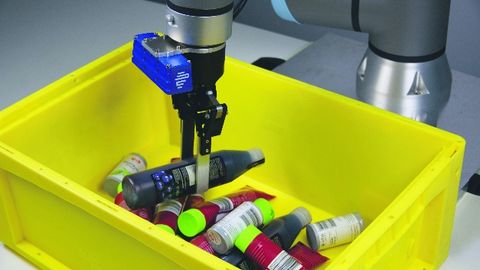
robobrain.vision' allows robots to grasp any object without having to be trained or scanned beforehand.
© RobomindsOnce the image has been captured, the integrated robobrain.vision software determines the possible gripping points of the unsorted workpieces and forwards the calculated data to the robot. This works even in changing light conditions and with new, unknown objects, without the products to be gripped having to be scanned or trained in advance.
This procedure is made possible for the user by an easy-to-use HTML 5 web interface and an intuitive calibration wizard, which ensures quick adaptation to the current recording situation between the camera and robot. A separate wizard is also available for defining the region of interest (ROI). In this way, the user can easily adjust all algorithm settings.
The software solution integrated in robobrain.vision uses methods of a specially developed artificial intelligence to automatically recognize the workpieces at hand and determine their gripping points - regardless of their material and shape. This gripping point evaluation takes into account parameters such as the quality of the grip, the probability of a collision with the crate and collisions with other objects in the crate. All in all, this means that even unknown objects can be processed without the need for instructional learning steps, which reduces the set-up times when changing the products to be gripped to practically zero.
Important camera parameters - for example for better recognition of the depth image - are defined by the system itself. Ready-made script modules and program modules support the user in setting up the robot tasks. The existing tools perform a variety of tasks in robotics that were previously not used - including the picking of items in intralogistics, kitting applications (the assembly of objects in logistics centers) or the separation of bulk goods.
One interesting idea is to feed vision data back into the specially created 'robobrain cloud'. The aim of this measure is to improve the quality of the 'robobrains' used by enabling all systems to learn from the results of each individual system. The 'robobrain' systems supplied as a complete solution are based on industrial PCs that use NVIDIA chips to accelerate the execution of the AI models.
Intuitive operation
Thanks to the intuitive user interface, users can carry out the configuration via a large control panel or directly in the web browser without having to install additional software. Even complex robot applications can be configured, installed and integrated flexibly and quickly in this way. robobrain.vision can be used by several robots simultaneously and is not subject to any restrictions on the number of robot axes.
The simple integration and use of robobrain.vision is also demonstrated by its compatibility with various robots: with a plug-in for Universal Robots, the system is suitable for collaborative robot landscapes, but also works with robots from other manufacturers such as Kuka and Franka thanks to simple interfaces. This flexibility also includes the topic of gripping: As the processes and gripping objects can be different for each application, a variety of parallel and vacuum grippers such as OnRobot, Robotiq and Schmalz are supported. The system's gripper options are to be further expanded in the future.
Author:
Mark Stevens is a Business Developer at Robominds in Munich.


You might also be interested in
Quo vadis image processing?
Innovations in the fields of artificial intelligence and embedded vision as well as special processors and development environments for image processing open up a broader spectrum for the technology. An overview.
 read more...
Autonomous thanks to artificial intelligence
Machine vision for reliable quality assurance via plug & play and without a great deal of specialist knowledge - conventional image processing systems are generally a long way from this ideal. A German-Israeli start-up wants to change this.
read more...A direct comparison of solutions
The topic of machine learning raises a number of questions: Which data should be analyzed using which methods? What role does the user play in the data analysis process? And what about the real-time capability, explainability and reliability of the...
read more...The benefits of artificial intelligence for sensor technology
With the technologies and processes of deep learning, industrial sensor technology is on the verge of a far-reaching leap in functionality. Image-based sensors in particular are a field with great potential.
read more...Which gripper for which application?
Advances in the field of end-of-arm tooling (EoAT) make it possible: grippers and sensors are becoming increasingly intelligent and easier to operate. This expands the range of applications for collaborative robots and quickly pays for itself.
read more...Artificial intelligence requires computing power
The integration of AI in industrial applications is increasing the need for computing solutions that can cope with the complexity of the tasks involved. In addition to the CPU, processors specialized in AI algorithms and large amounts of data are...
read more...More usability through AI?
Flexible and cost-transparent booking of temporarily required resources - a promise that cloud providers often fail to keep: Although the offerings are comprehensive and powerful, they are just as confusing and lack transparency in terms of price. A...
read more...The arrival of AI in mechanical engineering
The number of real AI projects in mechanical and plant engineering is still very limited. This will soon change with a new generation of engineers and, above all, with the market launch of corresponding development tools.
read more...Computer-based vision for robotic systems
Computer-based vision is becoming increasingly important for robotic systems. But how can hard real-time applications and time-sensitive networking be combined with vision systems and artificial intelligence (AI)?
read more...