
Recycling instead of mining
Raw materials lying dormant in the drawer
According to Bitkom, around 210 million old cell phones were stored in German households last year. This means that 87% of people had at least one discarded cell phone. This figure has more than doubled since 2015.
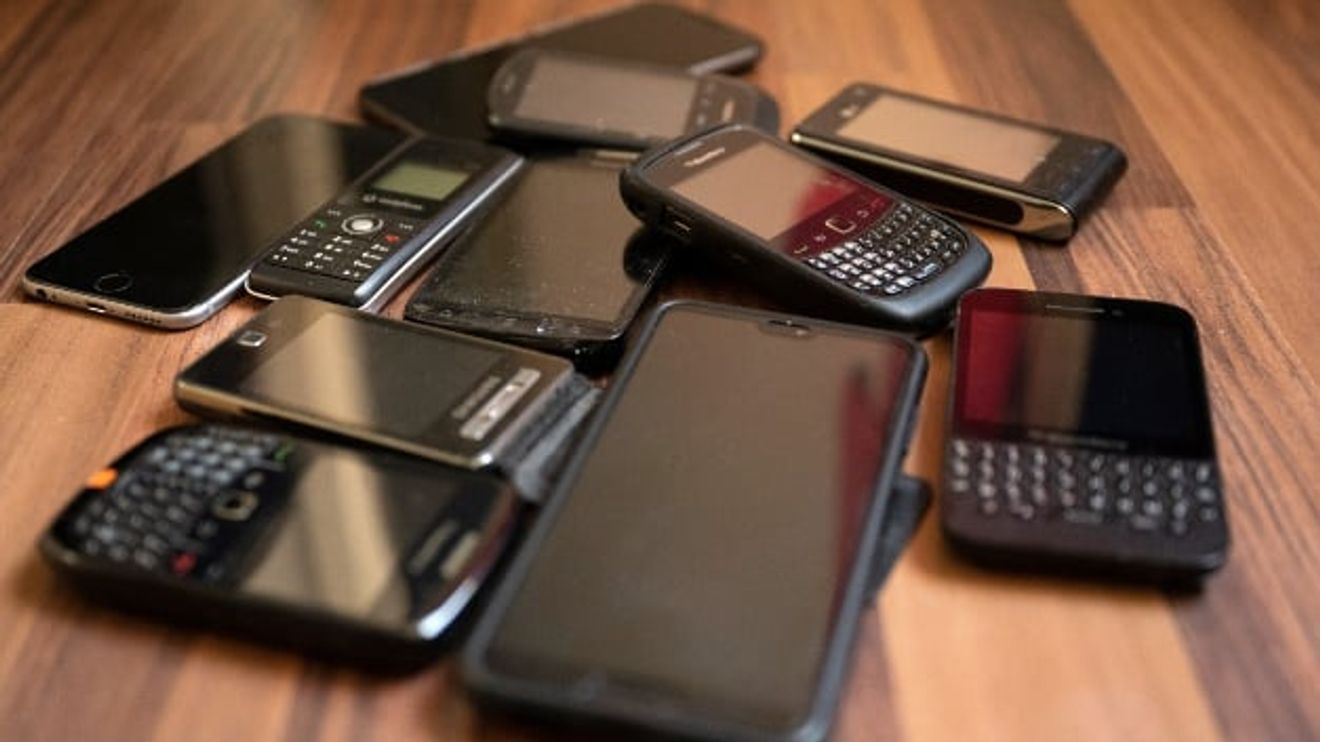
The drawer phones belong to the so-called urban mine. In contrast to the classic raw material mine, this describes the man-made raw material deposits: "All the goods that we humans have ever created," explains Britta Bookhagen from the Federal Institute for Geosciences and Natural Resources (BGR). These so-called anthropogenic deposits include bridges, cars, houses, washing machines - and smartphones. Gold, copper and nickel, for example, can be extracted from cell phones, while steel in particular can be extracted from cars and bridges.
In the strategic consideration of the urban mine, it is initially irrelevant "whether the goods are still being actively used and will only be released in the foreseeable future or whether they have already reached the end of their useful life", writes the Federal Environment Agency (UBA) on its website. Metals and construction minerals in particular often remain in infrastructures, buildings and everyday goods for a long time. "Over decades, enormous stocks of materials have accumulated in this way, which hold great potential as a future source of secondary raw materials."
The vision: becoming less dependent on raw material imports
Felix Müller, responsible for the topic of urban mining at the Federal Environment Agency (UBA): "The vision is to become less dependent on raw material imports; rather, we should become veritable raw material producers with secondary extraction. In this way, we can also open up a new economic field."
© Felix Müller privateAccording to UBA figures, the German economy uses around 1.3 billion tons of materials domestically every year - this includes products such as cars as well as pure raw materials. Germany is heavily dependent on imports, especially for metal and energy raw materials, according to the BGR's latest raw materials situation report from December. Germany is almost completely dependent on imports, especially for newly extracted metals.
However, the world's raw materials are finite, international competition is growing and costs are rising - as is the pressure on natural areas and their ecosystems. Recycling metals or building materials, for example, can therefore help to conserve the earth's natural resources - and also reduce greenhouse gas emissions, groundwater pollution and biodiversity loss, says Felix Müller, who is responsible for urban mining at the Federal Environment Agency.
And expansion will not only help the environment: "The vision is to become less dependent on raw material imports, but rather to become veritable raw material producers through secondary extraction. That way, we can also open up a new economic field," says Müller. According to him, Germany's anthropogenic deposits are enriched with around 550 million tons of material per year. The expert says: "As long as material stocks continue to grow at this rate, we are still a long way from a sustainable circular economy. But the growing stockpile holds the immense potential to close material cycles far better in the future than we have been able to do so far. We need to set the course for this now and adapt the framework conditions." The German government is therefore also currently working on a national urban mining strategy.
Recycling instead of hoarding

Britta Bookhagen, Head of the Recycling Raw Materials Department at the Federal Institute for Geosciences and Natural Resources (BGR). She clarifies: "Urban mining refers to products at the end of their life." Only when all other avenues, such as repairing or reselling, have been exhausted is it a matter of recycling - "not into the drawer, please", says Bookhagen.
© BGR/M.Sack"Mining" in the urban mine is not done with a bucket wheel excavator and pickaxe, but by recycling - and so to a certain extent it is also a task for society as a whole, says geologist Bookhagen. However, she clarifies: "Urban mining refers to products at the end of their life." Only when all other options, such as repairing or reselling, have been exhausted is it a matter of recycling - "not into the drawer, please", says Bookhagen.
There is currently a veritable treasure trove of gold in German drawers. In a 2020 study, Bookhagen and her colleagues came to the conclusion that the approximately 200 million smartphones in German drawers contain around 3.4 tons of gold, 1,300 tons of copper and 520 tons of nickel, among other things. In a report published on Monday, researchers from the Cologne Institute for Economic Research calculated that the value of the metal in unused cell phones is around 240 million euros. In view of the material value of smartphones sold in 2021 of 23.5 million euros, the drawer phones could therefore cover the material requirements for new smartphones for over ten years. However, the authors themselves qualify the calculation: The reality looks different, "as not all drawer phones are sent for recycling and are also completely recyclable".
Better data situation desirable
This is precisely the biggest difficulty with urban mining, says expert Bookhagen: "It is very difficult to estimate which raw materials will come back to us, how and when." On the one hand, it is not at all clear how much steel or aluminum was used in a car or washing machine 50 years ago, nor how it can be most effectively recovered and processed. Better data is needed here. "One thing is certain: The urban warehouse is growing and has a high recyclable material content."
Recovering raw materials from urban mines has great potential to become less dependent on raw material imports and rising costs, says Bookhagen. Germany and Europe are doing well compared to other parts of the world. "But we mustn't forget: even if we could get everything out of the urban mine, it wouldn't cover our demand for raw materials," the expert continues. The hunger for raw materials is too great for that.


You might also be interested in
First recyclable plastic bicycle frame
Igus continues to expand its bicycle component business and launches the first injection-molded bicycle frame made of composite material for advanced bikes.
 read more...
Award for climate-friendly innovation
Continental has awarded the Climate Solutions Prize to a sustainable solution for the first time: Biotic, a biotech start-up specializing in biological plastic alternatives, came out on top in the 'Pioneering Sustainable Material' technology...
read more...Detailed planning with real-time tool
The real-time planning module Felios-Liveplanner from Inform makes it possible to combine short-term manual rescheduling on the store floor with global production planning.
read more...AS-Interface for drive and conveyor technology
ASi-3 for collecting individual binary signals, ASi-5 for complex tasks where high transmission speeds and large data bandwidths as well as efficient addressing of participants are important - a 'dream team' especially for intralogistics systems.
read more...Interview with Maria Dobritzsch, Lapp
Green copper
Lapp aims to reduce the carbon footprint of its products by 20 percent by 2025, based on the 2020/2021 financial year. Maria Dobritzsch, responsible for sustainability at Lapp, explains the role of copper as a raw material in this.
read more...Plan production changes with foresight
Contact Software launches a new version of the open low-code platform Elements.
read more...Highest level of electronic waste expected
Broken and unused electrical appliances are a thorn in the side of environmentalists. In light of International WEEE Day, they are calling on consumers to repair or recycle appliances.
read more...Apps as microservices
Msg Plaut is now presenting an IT marketplace called Smart Factory Platform. Companies will be able to use it to purchase agile individual solutions and thus keep their production processes up to date.
read more...German companies often lose out
Warehouses cost money. For this reason, manufacturers have started to shift warehousing to the transportation chain. However, this only works as long as the required parts are available and deliveries arrive on time. This is exactly what is...
read more...