
From driverless cars to the app store
Centuries and their technologies
In just a few decades, we have seen ground-breaking advances in different areas. These innovations have transformed the way we live, work, learn and communicate. A selection of highlights of these achievements.


1728: A silk weaver from Lyon uses perforated wooden boards to control his looms. Jacques de Vaucanson from Grenoble develops this simple loom into a mechanically controlled model using a wooden punched card. The system became the model for early calculating machines.

1838: William Robert Grove discovers a cell with an amalgamated zinc electrode on the one hand and a platinum electrode in nitric acid on the other, which delivers a voltage of 2 V. In the same year, Christian Friedrich Schönbein describes the first experiment in which a voltage is detected between two electrodes in an aqueous solution wetted with hydrogen and oxygen. In his publication "New observations on the Voltaic polarization of solid and liquid conductors", he explains how platinum electrodes in sulphuric acid are charged in opposite directions, depending on whether hydrogen or oxygen (or chlorine) is present. Grove then builds a corresponding voltage source - the forerunner of today's fuel cell, the "gas battery", is born.
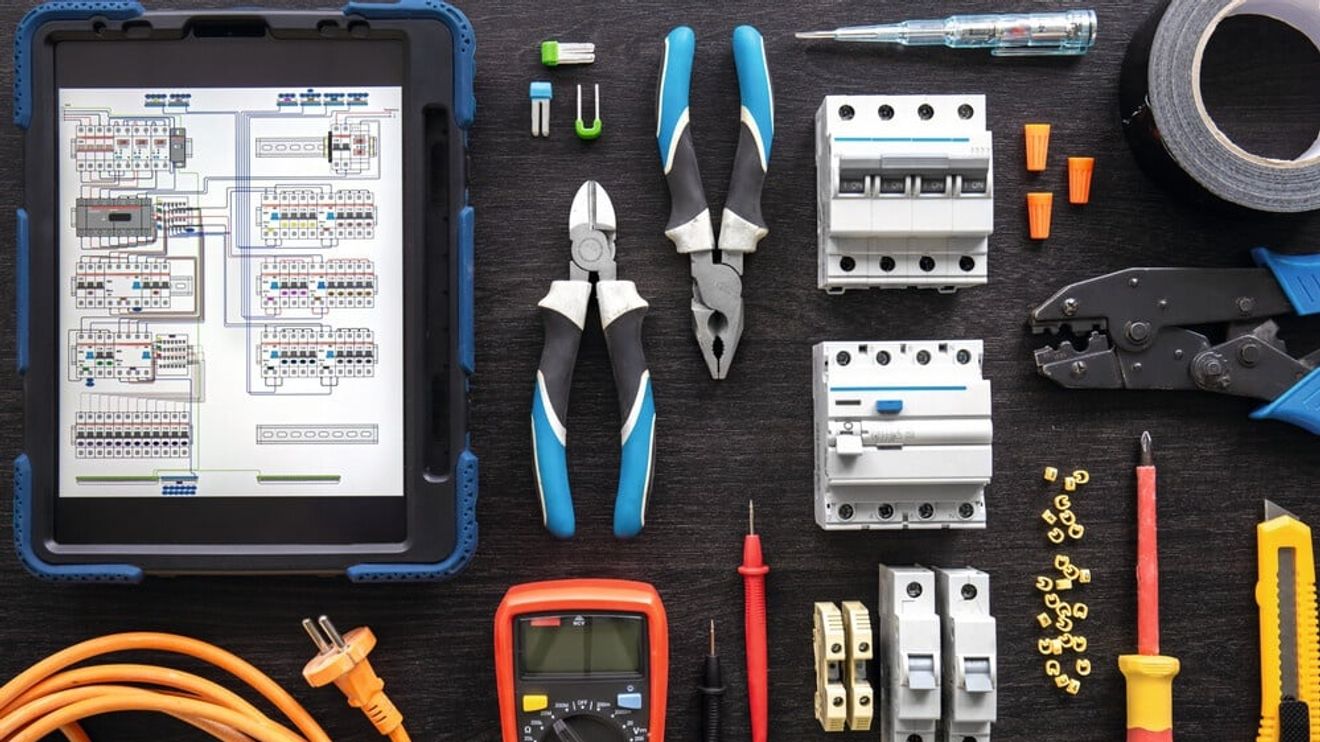
January 21/22, 1893: The founding conference of the "Association of German Electrical Engineers" (VDE) takes place in Berlin. 37 delegates from Germany's electrotechnical associations, the first of which was founded in 1879, adopt the founding protocol and elect the first board of directors. The newly founded association holds its first annual meeting in Cologne from September 28 to 30. The VDE's first technical commission is also formed at this meeting. Its task is to draw up regulations on the installation of low-voltage electrical systems. Today, the name is "Verband der Elektrotechnik, Elektronik und Informationstechnik e.V." (VDE).

October 29, 1923: Radio broadcasting begins. Friedrich Georg Knöpfke, Director of Funkstunde Berlin, speaks the famous words: "Attention, attention! This is the broadcasting
Berlin, in the Vox Haus. On wave 400 meters."
Director Knöpfke continues: "Ladies and gentlemen, we would like to inform you
that the entertainment radio service will begin broadcasting music performances by wireless telephone today. Their use is subject to authorization. Our first number will be a cello solo with piano accompaniment, Andantino by Kreisler, played by Mr. Kapellmeister Otto Urak, with Mr. Fritz Goldschmidt at the piano."

1968: Odo J. Struger and Richard E. Morley invent the programmable logic controller (PLC). This first programmable logic controller (PLC) makes it possible to replace the many wires with software programs and eliminate the need for relays. In the simplest case, the PLC itself has inputs, outputs, an operating system and an interface via which the user program can be loaded, which in turn determines how the outputs are switched depending on the inputs. Today, the trend is towards virtual PLCs.
Timeline of technologies - continued

September 1968: On September 11, Continental's first electronically controlled driverless car is launched on the Contidrom test track in the Lüneburg Heath. Among other things, the Mercedes-Benz/8 is equipped with electromechanical steering, electromechanical throttle control and a radio system for measured value feedback. The control electronics and an electro-pneumatic braking system are housed in the luggage compartment. A wire is laid in the middle of the test track, which generates an electromagnetic field when energized, which in turn is detected by antennas on the bumper. A principle that is still used today for automated driving.

In1983, Fred Cohen, a student at the University of Southern California, presents the world's first computer virus on a Unix system. Today, malware is omnipresent. In August 2022, the industry association Bitkom e.V. estimated the annual damage caused by cyber attacks on German companies at 203 billion euros.

1993: On April 30, the directorate of the European nuclear research center CERN releases the World Wide Web to the public free of charge. However, the concept had already been published in 1991, but for the next two years it was only used by universities, research laboratories and the hypertext community. The world's first website, info.cern.ch, was published on August 6, 1991.

29 January 1998: Twelve companies sign an agreement to participate in the International Space Station program. Barely eleven months later, a Proton heavy-lift rocket launches the first ISS component into space: the Russian-built cargo and propulsion module Zarya. Further modules follow, including for research purposes. The research island has been permanently manned since November 2, 2000. Among other things, physics and materials research is carried out on the international space station, which is also used for the further development of electronic components.

July 10, 2008: Apple's own software store for the iPhone is launched - the Apple App Store. At the start, Steve Jobs can imagine an annual turnover of around half a billion, "and maybe one day it will be a billion".
According to a study by the market research company Analysis Group, Apple will generate almost 98 billion euros directly from digital goods and services from the Apple App Store in 2022. In recent years, the industry has also discovered the concept for itself and is developing its own app stores.


You might also be interested in
New Automation Management Board strengthened
New Automation, the training association for industrial companies in the field of automation technology, has expanded its board and set up new projects for young talent.
 read more...
Staufen study from the industry
Bosses must be coaches and mentors
The role of managers in industry is changing. Above all, managers need strong communication skills and empathy. What is the specific list of requirements for a modern manager today?
read more...The e-paper for the special issue
Communication & networking 09/24
Communication and networking form the backbone of industrial automation. It enables flexible production processes and creates the basis for innovations and new business models. The news is now available in this e-paper.
read more...Automated detection of damage to trains
No more overlooked damage: A project team at TH Wildau has optimized the inspection of passenger trains using AI-supported computer-visual techniques. The results of the "ESPEK" project are summarized by the research partners.
read more...The top 10 articles in August 2024
The top 10 articles from Computer&Automation in August 2024. Readers were most interested in these reports.
read more...The e-paper of issue 9/2024
The hype surrounding AI is inspiring, but the reality requires a sober approach to the technology. Computer&Automation 9/24 looks at topics relating to AI & security, the EU AI Act, secure IIoT projects and OPC UA FX "From the cloud to the...
read more...Robots become human
The World Robot Conference 2024 showed the world new versions of humanoid robots. The exhibition areas were dedicated to the topics of "Industrial Robots", "Service Robots", "Special Robots" and "Artificial Intelligence".
read more...Ankush Malhotra becomes new Group CEO
Ankush Malhotra has been appointed as the new Group CEO of the technology and automation company Element Logic. He succeeds Dag-Adler Blakseth, who co-founded the company almost 40 years ago.
read more...The future of warehouse work is robot-assisted
Modern robotic systems are key elements in making the day-to-day work of warehouse workers easier. Robotic solutions reduce the physical strain on employees, prevent errors and also increase efficiency.
read more...