
Mechanical and plant engineering
Billions in damage caused by counterfeiting
The amount of damage caused to the German economy by counterfeiting continues to rise. This was reported by the VDMA in a study. China is still the country with the most counterfeits.

Product and brand piracy causes billions of euros in damage in the mechanical engineering sector, which has continued to rise over the past two years. According to the current study "Product Piracy 2020", the annual damage has now grown to 7.6 billion euros - in 2018 it was still 7.3 billion euros. A turnover of this amount would mean the equivalent of almost 35,000 jobs in the mechanical and plant engineering sector.
But when does product piracy actually begin and how is it defined? In the study, the VDMA (German Engineering Federation) only refers to unauthorized copying. Unauthorized copying (synonymous with product piracy or plagiarism) refers to the following points:
- copying in violation of special protection rights (trademarks, patents) or
- copying without infringement of special protection rights but in an anti-competitive manner
Sad record for China
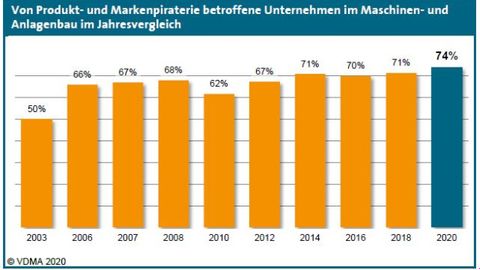
Every two years, the VDMA surveys its member companies on the threats and effects of counterfeiting. In the latest study, which was conducted by the Fraunhofer Institute for Applied and Integrated Security AISEC on behalf of the VDMA, 74% of the companies surveyed stated that they were affected by product piracy. In companies with more than 500 employees, the proportion was as high as 90 percent - both are new highs.
A total of 57 percent of the companies surveyed reported counterfeit products that pose a risk to their systems. This shows that counterfeiting is not just a trivial offense, as the operation of machines or systems with counterfeit components poses a risk to the operator, explains Steffen Zimmermann from VDMA.
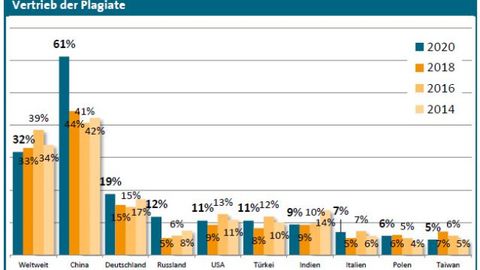
"A trend reversal can also be seen in the perceived threat from counterfeiters. While the figure recently fell to 39%, 52% of those surveyed have now reported an increase in the perceived threat level," says Zimmermann. The trade in counterfeit machines and components is flourishing particularly strongly in China, with the People's Republic being named as the most important country for selling counterfeits (61%), followed by Germany with 19%. Russia is in third place for the first time with 12 percent.
Competitors are usually clients
Most of the companies surveyed cite competitors as the source of counterfeits (72%), but they also see business partners, customers, suppliers or joint venture partners as the source of counterfeits (41%). Individual parts are counterfeited most frequently (64 percent), followed by design plagiarism (60 percent). Counterfeiters also bring complete machines onto the market as counterfeits (40 percent).
Companies have little hope of being reimbursed for the damage caused through legal action. Only 26% of the companies surveyed initiate civil court proceedings at all - compared to 39% in 2018. Around half of those surveyed did not take any action at all. "Small and medium-sized companies in particular seem to be increasingly resigned or shy away from the expense of legal action," says VDMA expert Zimmermann.
The complete study "Product Piracy 2020" can be found on the VDMA website.


You might also be interested in
Interview with Hartmut Rauen, VDMA
"Germany remains the most important area for innovation and action"
Mechanical and plant engineering is Germany's job and innovation engine. In this interview, Hartmut Rauen talks about the VDMA's tasks in times of digitalization and which trends and technologies will provide a boost for the industry.
 read more...
The 'Subscription Economy'
The most significant economic trend of the current decade? Ownership is becoming a burden and more and more customers are paying for services on a subscription basis. The service subscription is thus becoming the central building block of the...
read more...ZVEI: The digital nameplate 4.0
Since the end of 2018, the ZVEI and Helmut Schmidt University Hamburg have been working with manufacturers in the automation industry to implement the 'Digital Nameplate 4.0' project. Gunther Koschnick, Managing Director of the Automation...
read more...No forecast for 2020
Siemens is suspending its forecast for 2020. The reason is the current situation. Nevertheless, the company "delivered a robust quarter despite complicated environmental conditions".
read more..."Three questions for..." - the May edition
Corona: Change as an opportunity
People react differently to the coronavirus and its consequences. What is it like in everyday working life? In the new part of our "Three questions for..." series, we look at this topic and asked automation experts for their opinions.
read more...Forecast targets for 2019 achieved
Sensor manufacturer Sick was able to continue its growth in a challenging market environment and increased its sales by 7% in the 2019 financial year.
read more...Corona hampers Kuka's project business
The coronavirus pandemic is causing a significant decline at Kuka. The project business has been particularly hard hit.
read more...Umati to become a global language
VDMA and VDW now want to promote the use and dissemination of OPC UA standards under the Umati brand for the entire mechanical engineering sector.
read more...Data acquisition despite protected S7 communication
With version 8.2, iba improves the connectivity of the scalable data acquisition software 'ibaPDA' to S7 controllers.
read more...