
Anniversary editorial
"It's just getting started!"
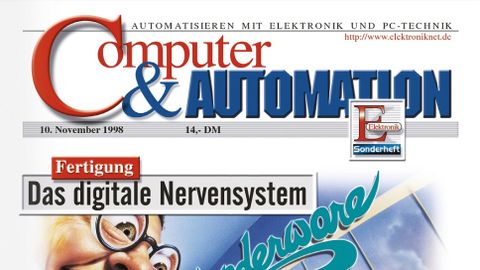
"Computer" - with this element in our magazine name in 1998, we wanted to take account of the IT influence in automation technology that was already emerging at the time. However, the expected IT influence took much longer than we expected at the time.

Meinrad Happacher, Senior Advisory Editor of Computer&Automation.
© WFMFor a very long time, the industry persisted in preserving its sinecure and got bogged down in sideshows such as the fieldbus war. While pioneers paved the way for computers in industrial control technology quite early on - such as Hans Beckhoff in 1986 with his first PC-based machine controller (see page 46 in the e-paper) - the widespread introduction of the associated IT technologies was a long time coming. It was not until the politically-triggered Industry 4.0 hype from 2011 onwards that IT technologies in automation technology set off a wave that has since flooded the broad field of automation with increasing speed and amplitude.
A striking example of IT-driven evolution: the further development of the programmable logic controller. Long based on special and proprietary hardware, the software-based PLC followed with the advent of the IPC - and today we are experiencing the transition to the virtual PLC in the cloud. You can read about the benefits of such a cloud-based PLC - including a cloud-based safety PLC - from page 40 onwards.
However, putting all control functionality in the cloud is not the end of the story: in the interview on page 44, Stefan Schönegger explains why he sees the future of control equally on site at the machine, at the edge and in the cloud. And in essence, it's not even about where the control or automation functionality is ultimately provided. Essentially, users like Dr. Henning Löser from Audi are concerned with separating the software applications from the hardware in general. Löser describes the advantage of this approach as being that "all applications can then be provided with 100% identical hardware." Whether on site, at the edge or in the cloud(page 42). Löser formulates his vision even more concretely: "I would like to see all hardware on the store floor disappear. I would like functionality on site and functionality is software." He justifies his wish with a requirement that he himself is confronted with: "How are we supposed to manage 15,000 Windows PC changeovers in our plants if this has to be done during a 20-minute shift break?" By way of comparison, he points to the way data centers work: "The problem is solved differently there than it has been for us in the factory so far!"
Löser is thus describing a path of automation that we are currently also experiencing in higher-level ERP systems: the shift towards "composable software". As with Lego, each component of a composable solution is a reconfigurable building block that digitally maps a core requirement. In this way, companies can build a truly individual IT solution, even in automation.
The arrival of Docker and Cybernetes technologies, the emergence of automation app stores - these are all indicators that point the way to automation that is decoupled from hardware.
Ultimately, IT and automation will no longer be clearly separable. In a deep-rooted symbiosis, they could form the technological basis for getting to grips with the problems facing humanity. Visionaries such as Rahman Jamal(page 10) and Rainer Brehm(page 98) hint at the role and importance that automation could play in the future in the interviews we conducted with them.
We are convinced that automation is only at the beginning of its "product life cycle"!
Your opinion on the subject: Write to Meinrad Happacher


You might also be interested in
The editorial team on 25 years of Computer&Automation
Statements by the editorial team on the occasion of the 25th anniversary of Computer&Automation.
 read more...
In a celebratory mood
It's not just Computer&Automation that has reason to celebrate this year - numerous companies in the industry are also celebrating anniversaries in 2023. And whether it's ten, 50 or even 100 years - they all share a sense of pride in what they...
read more...New Automation Management Board strengthened
New Automation, the training association for industrial companies in the field of automation technology, has expanded its board and set up new projects for young talent.
read more...Staufen study from the industry
Bosses must be coaches and mentors
The role of managers in industry is changing. Above all, managers need strong communication skills and empathy. What is the specific list of requirements for a modern manager today?
read more...The e-paper for the special issue
Communication & networking 09/24
Communication and networking form the backbone of industrial automation. It enables flexible production processes and creates the basis for innovations and new business models. The news is now available in this e-paper.
read more...Automated detection of damage to trains
No more overlooked damage: A project team at TH Wildau has optimized the inspection of passenger trains using AI-supported computer-visual techniques. The results of the "ESPEK" project are summarized by the research partners.
read more...The top 10 articles in August 2024
The top 10 articles from Computer&Automation in August 2024. Readers were most interested in these reports.
read more...The e-paper of issue 9/2024
The hype surrounding AI is inspiring, but the reality requires a sober approach to the technology. Computer&Automation 9/24 looks at topics relating to AI & security, the EU AI Act, secure IIoT projects and OPC UA FX "From the cloud to the...
read more...Robots become human
The World Robot Conference 2024 showed the world new versions of humanoid robots. The exhibition areas were dedicated to the topics of "Industrial Robots", "Service Robots", "Special Robots" and "Artificial Intelligence".
read more...