
Power supplies
UPS systems with secondary protection
UPS systems are actually intended to guarantee the availability of processes and systems. Nevertheless, users often report prematurely tripping fuses or system parts that switch off completely. What can be done?

Power outages have become rare in Germany. Despite sluggish grid expansion, the average interruption duration (System Average Interruption Duration Index) has fallen to less than 13 minutes in recent years. However, this does not take into account short-term interruptions of less than three minutes.
However, in the industrial sector in particular, power outages can quickly lead to high economic losses, even if they are short-lived. A reset control system interrupts or stops production sequences or entire processes, resulting in defective plant components, rejects in production and ultimately enormous downtime costs. Even a power interruption of just 10 ms may mean that AC consumers can no longer be operated.
Against this background, many companies use uninterruptible power supplies (UPS) in the AC range. The aim is to ensure a constant energy supply - even in the event of a power failure. If the power fails on the mains side, these systems ensure uninterrupted operation supported by batteries.
The UPS system should therefore guarantee the availability of the processes and the system. Nevertheless, there is often feedback from users about fuses tripping prematurely or parts of the system switching off completely. This is due to fuses that have not tripped in the event of a short circuit. This is often due to incorrect design and selection of the protective device in relation to the capacity of the UPS.
Buffer network interruptions
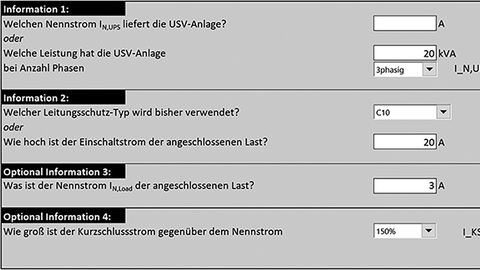
In the planning tool, the user enters data relevant to the application in order to find the right circuit breaker.
© E-T-A Electrotechnical ApparatusUPS systems are a common solution for buffering mains interruptions. However, many system planners and users are not aware of the secondary design for overcurrent protection. This is because it is very important to consider battery operation when planning and installing a UPS application. In addition, there is the design of the power source in relation to the protective device. On the one hand, this involves the relevant standards. For example, VDE 0100-430 requires that "the overcurrent protection device must be able to mechanically isolate any current that occurs, including the unaffected short-circuit current". According to VDE 0100, it must switch off faults in electrical systems before people or equipment are harmed.
Secondly, the current-time characteristic of the protective element must be selectively chosen to match the output characteristic of the UPS. This is often only done very roughly or according to the UPS manufacturer's rather vague information on recommended protection. Unfortunately, this means that the actual function of the fuse protection is not necessarily guaranteed. The user should be aware that a UPS can only provide a limited short-circuit current in both battery and mains operation. Common values using the example of an online UPS are: in battery mode 1.5 to a maximum of 3 x IN, in mains mode 5 to 10 x IN.
Secondary UPS backup
As a rule, circuit breakers are the secondary connected fuse elements for loads and lines in UPS systems. For physical reasons, however, these are often not able to trip in the event of a fault on a UPS. For magnetic tripping within 10 ms (a sine half-wave), circuit breakers with a C characteristic require a very high current - up to 10 times the rated current. Faster tripping characteristics can cope with less current; 5 times the rated current is also sufficient here. However, when operating current-intensive loads such as switching power supplies, this can lead to unwanted false tripping.
Due to the limiting characteristic of a UPS in the event of a short circuit, in the worst case it can take several minutes for circuit breakers to trip. In many cases, they do not trip at all. In both cases, the end result is the complete shutdown of the UPS for its own protection and thus an interruption to processes or production sequences.
When planners recognize this problem, they often solve it rather unconventionally: In order to trigger thermal-magnetic circuit breakers, the UPS systems are oversized. The higher output current comes at a much higher price.
Tripping periods according to VDE 0100
| TN network | TT network | |
|---|---|---|
Distribution circuits | 5 sec | 1 sec |
| Final circuits ≤ 32 A | 0.4 sec | 0.2 sec |
| > 32 A | 5 sec | 1 sec |
Of course, larger systems can provide more power in the event of a fault and trigger the protective elements in the event of a fault. However, such a UPS is not only more expensive to purchase; the annual follow-up costs are also enormous, as larger UPS systems also require a larger battery capacity. This increases the costs - for maintenance and due to the power loss.

As a result of the calculation with the planning tool, the user receives a graphical evaluation. If the electronic characteristic curve (green) is between the load characteristic curve (brown) and the UPS output characteristic curve (red), the EBU type has been correctly selected and dimensioned.
© E-T-A Electrotechnical ApparatusLast but not least, the efficiency inevitably decreases if the UPS is designed too high. Better efficiency reduces the UPS system's own consumption, including the operating costs over the entire service life of the system. The bottom line is that this constellation is unprofitable.
In addition to the cost aspect, it is worth taking a look at the function - because this solution often does not achieve the desired result. For example, little attention is often paid to cable lengths. Long cables cause cable resistances that additionally dampen the maximum short-circuit current of a UPS. Even a distance of 100 m - and therefore a cable length of 200 m - with a cable cross-section of 1.5 mm2 means an attenuation of 2.38 Ω at a 230 V voltage source. The 10 A circuit breaker with C characteristic described above can no longer fulfill its protective function in such a case. To make up for this, the loads are protected with smaller rated currents or more quickly dimensioned miniature circuit-breakers - with the aforementioned risk of false tripping.
Circuit breakers such as the 'EBU10-T' from E-T-A are an alternative. The device for 230 V(AC) is available with rated line protection currents of 4 A, 6 A, 10 A and 16 A and with B and C characteristics. Short-circuit disconnections of up to 10 kA are possible. The intelligent measuring and evaluation unit type 'EBU' enables the selective protection of a UPS system.
Planning steps
So how should the planner proceed? Ultimately, there are four points to consider:
- Measure the loop impedance: The maximum resistance is calculated using Ohm's law from the conductor loop by dividing the voltage and the required tripping current. However, this measurement must be extended for UPS systems, as it can hardly be carried out in battery mode due to the control behavior of the inverter. This is only possible in bypass mode.
- Ensure tripping current with sufficient power: In order for a protection element to trip, the short-circuit current that the UPS can provide must be greater than the required tripping current of the protective device. If a 10 A circuit breaker with a C characteristic is to trip reliably in the event of a fault in an application, it requires a short-circuit current of 100 A in accordance with its characteristic. In the example of a 3-phase system with a short-circuit factor of 150 % - (1.5), this means that the theoretical power calculation of the UPS for tripping a 10 A circuit breaker with characteristic 'C' in battery operation is calculated using the simple formula for power 'power = voltage x current'. In addition, the number of phases of the UPS must also be taken into account:
- For the reliable tripping of a 10 A circuit breaker, a power requirement of 46 kVA is calculated when using a 3-phase supply unit.
- For the function of the electronic circuit breaker 'EBU', it is not necessary to consider only the tripping current. Instead, the rated current of the UPS system can be set on the circuit breaker. This alone reliably triggers the device if the limits are exceeded. The integrated electronic measurement enables a very low tolerance. The simultaneous measurement of current and voltage and their adjustment prevents unintentional faulty tripping of loads with higher current requirements when switching on. The permanent voltage measurement also enables a fast response, especially in battery operation.
- Do not exceed the holding current: For normative reasons, the holding current of the overcurrent protection device should not be exceeded. This ensures fault-free operation and increases the availability of every system. In addition, the holding current of the protective device must be greater than the inrush current of the connected load.
- Observe tripping periods: Disconnection of the residual current within specified time periods is required by VDE 0100. The magnetic tripping range for miniature circuit-breakers and electronic circuit-breakers of the 'EBU' type can be considered here. This is the only way for the circuit breakers to react within the required times. Setting the 'EBU' type to the rated current of the UPS enables fast switch-off times even for UPSs with lower power ratings.
Simplified planning
E-T-A offers a free Excel-based planning aid for planning selective secondary protection for UPS applications. It makes it easier for users to select the appropriate 'EBU' type electronic circuit breaker. It also demonstrates the targeted matching of circuit breakers to the output line of the respective UPS. The program calculates the following information from the data entered: a list of electronic circuit breakers of type 'EBU10-T' that can be used as an alternative; a suggestion for adapting the 'EBU' type electronics to the UPS used and the respective load conditions as well as a graphical evaluation of the current application.
The circuit breaker and planning tool can be used to ensure that the AC UPS systems are correctly protected so that the UPS runs reliably and without interruption, even in battery mode.
Author:
Tobias Prem is Business Unit Manager at E-T-A Elektrotechnische Apparate in Altdorf.


You might also be interested in
Switch-mode power supplies for industrial automation
The compact switching power supplies 'PFA10-T' from E-T-A have been specially developed for demanding industrial environments, both for 24 V(DC) and 48 V(DC) applications.
 read more...
Sensory in view
Intelligent power distribution systems are valuable helpers when it comes to digitalization in the IT rack. Monitoring the IT racks using sensors is a particularly effective measure for increasing system availability.
read more...Collaboration on Open Energy Standards
Weidmüller Joins the EEBus Initiative
Weidmüller has joined the EEBus Initiative. Together, they aim to further promote the international EEBus communication standard for smart grids and intelligent energy management.
read more...AI Platform Aims to Enable Energy Sharing in Industry
As part of the EU project FlexBit, Fraunhofer IFF is developing an AI-powered platform to optimize energy storage systems and manage industrial energy-sharing systems. The concept is being tested in an Industrial Energy Community in Magdeburg and is...
read more...EMC and radio testing in Germany and worldwide
In a world filled with smartphones, connected cars, medical devices and smart appliances, supporting optimal electromagnetic compatibility (EMC) and wireless performance to minimize interference between electronic products is critical.
read more...Marco Geiser becomes new Vice President Secure Power DACH
Marco Geiser has held the position of Vice President of Secure Power DACH since April 1, 2026. In this role, he will strategically develop the Secure Power business in Germany, Austria and Switzerland, strengthen it operationally and focus it on...
read more...Promoting the use of direct current
Current/OS and the Open Direct Current Alliance (ODCA) have agreed a strategic partnership aimed at accelerating the creation of a coherent and interoperable ecosystem for direct current (DC). A Memorandum of Understanding (MoU) has been signed by...
read more...IT Partnership in the Energy Market
CGI and Schneider Electric cooperate
CGI and Schneider Electric are expanding their collaboration in the DACH region. The aim is to support energy suppliers with grid modernization, digitalization and regulatory requirements. The focus is on ADMS-, GIS- and AI-based solutions.
read more...24 V(DC) buffering without batteries
With the 'PMC-0424' capacitive DC UPS modules, Block Transformatoren-Elektronik presents a solution for reliable 24 V (DC) buffering without batteries.
read more...