

Phoenix Contact
Monitor and protect DC microgrids
Sustainable production using renewable energies begins with the establishment of an industrial DC grid. A multifunctional DC switching device is responsible for switching, protecting, monitoring and precharging DC sectors.
At the end of the 19th century, alternating current (AC) technology prevailed over direct current (DC) technology in the so-called electricity war. A decisive factor in the success of AC was the use of the dynamo-electric principle discovered by Wernher von Siemens in the 1860s: the steam produced by heating drives turbines, which in turn generate electrical energy from a rotary motion using alternating current generators. This principle is still used in coal or nuclear power plants, for example. Another advantage of AC results from the simple transformation to high voltages in order to transmit the energy over long distances with low losses.
No lossy AC/DC conversion
Nevertheless, direct current is currently becoming increasingly important. This is because the technological development of power electronics is now opening up the possibility of making highly efficient direct current usable at low cost. For example, essential electronic components such as the transistors used in computers and control systems can only be operated with DC. In industry, many consumers operate on a DC link by using frequency converters. In a DC network, the lossy AC/DC conversion can be dispensed with for these consumers. In addition, a sustainable power supply from renewable energy sources - such as photovoltaics, wind energy or fuel cells - always supplies direct current.
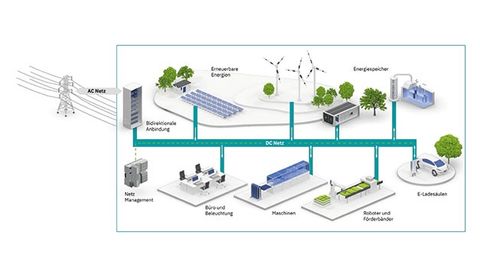
Using the generated electrical energy without rectification from AC to DC increases efficiency and saves the operator costs for raw materials. This eliminates the need for transformers. Furthermore, the amount of copper required to manufacture cables is reduced, as smaller cable cross-sections are required for the transmitted power. All of this proves to be an advantage that makes direct current economical in industrial production facilities. With its "Empowering the All Electric Society" strategy, Phoenix Contact is driving forward the increasing importance of DC technology with corresponding products and system solutions. In this way, the company supports its customers in implementing a sustainable energy supply for their production facilities as a reliable partner and supplier of system solutions.
Control of the standing arc
Switching processes pose a particular challenge when supplying direct current to industrial DC networks. Whereas with AC, a possible arc goes out automatically after 10 ms at the latest when the current crosses zero, with DC a standing arc develops, particularly when switching off, which must be controlled. The 'Contactron ELR HDC' DC circuit-breaker combines modern semiconductor technology with proven DC relays and switches without arcing. The relays in the power path provide galvanic isolation at both poles when switched off. The Contactron ELR HDC is used in DC networks wherever an energy exchange between sources, loads and the network itself is required - on so-called DC feeders(Figure 1).
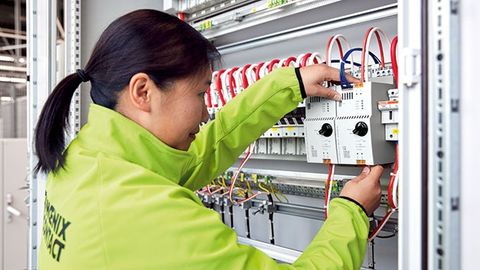
Figure 2: The multifunctional Contactron ELR HDC switching device combines the functions of switching, monitoring and protection in a compact housing
© Phoenix ContactIn addition to switching up to 55 A at up to 810 V, the device performs other tasks that are necessary for the operation of a DC network. For example, the circuit-breaker monitors the most important parameters during operation and also makes them available for operating data acquisition. The device also monitors voltage and current during operation and has a three-stage switch-off function in the event of overcurrent, including very fast switch-off times in the event of a short circuit. In the event of an undervoltage or overvoltage in the input, the device also switches off.
In addition, the circuit-breaker precharges capacitance in the output to the input voltage so that current peaks are avoided during switch-on(Fig. 2).
Parameterization via the network or software

The author: Sascha Garzke is Product Manager Contactron IF, Industrial Components and Electronics, at Phoenix Contact Electronics in Bad Pyrmont.
© Phoenix ContactThe circuit-breaker can be integrated into network environments via a digital input/output and a communication interface. The device parameters can be adapted to the application-specific requirements via the network or with the 'ClipX Engineer' parameterization software; to do this, the circuit-breaker is connected to a notebook via a USB-C interface.

A 100 kW peak PV system that supplies direct current is connected to the DC low-voltage main power distribution of building 60
© Brandstetter ArchitectsIn addition to industrial and building technology, other areas of application for the Contactron ELR HDC include power-to-X systems, data centers and information and communication technology. The expansion of the product family - for example with regard to extended power ranges - is also part of the medium-term planning.
The circuit-breaker is already being used by an automotive manufacturer based in southern Germany, but it is also installed in Phoenix Contact's new G60 building at the Blomberg site. Among other things, the building serves the automation specialist as a blueprint for the industrial revolution in the DC world (see box).
| Building 60 as a prime example of a DC grid |
|---|
|
The industrial DC grid of the new Building 60 is also used to research DC technology. Modules from the 'Charx High Power' series generate the 650 V (DC) grid from the AC grid. The bidirectional connection also enables surplus energy from other feeders to be fed back into the public grid. A PV system with a peak output of 100 kW is connected to the DC low-voltage main power distribution, which supplies direct current. The required DC-DC conversion is carried out simply via Charx power modules in 19-inch format with MPP tracking, as synchronization with an AC grid is not necessary. Intelligent networking of generators and consumers with an energy management system (EMS) integrates the volatile PV energy generation using a battery storage system in such a way that the energy inflow from the public energy supply grid is minimized. A 240-kWh battery storage system is integrated to compensate for longer-lasting power requirements in building 60. It can be used to cover peak loads and also ensures stability and security of supply in the entire DC grid in the event of an interruption in the public grid. The bidirectional connection of e-charging stations to the 650 V (DC) grid allows energy to flow in two directions: Vehicle batteries can be charged and also used as energy storage in the short term. Combined with the intelligent PLCnext Control and an EMS, this helps to cover very high load peaks at short notice and contributes to grid quality. Internally, the 650 V (DC) grid supplies consumers in fixed installations. In addition, final circuits at the 400 V(DC) voltage level are supplied via isolating converters, for example for lighting and connections for mobile devices. Current AC devices at the AC low-voltage level require internal power supply units with rectification and DC intermediate circuits to supply PCs, monitors and LED lighting technology. If these devices are supplied directly from a DC grid, a large part of the weight and volume of the input circuits can be saved. The lower voltage in the final circuits ensures personal protection in accordance with DIN VDE 0100-410. The IT networks are monitored for insulation and are switched off in the event of a fault. |


You might also be interested in
New Automation Management Board strengthened
New Automation, the training association for industrial companies in the field of automation technology, has expanded its board and set up new projects for young talent.
 read more...
The e-paper of issue 08/2024
How can data centers be cooled for AI? How successful is malware programmed with WormGPT? And how can virtualized control systems be integrated into production using TSN? Computer&Automation issue 08/2024 provides answers to these questions and...
read more...Frank Stührenberg hands over to Dirk Görlitzer
Frank Stührenberg will hand over the chairmanship of the Phoenix Contact management board to Dirk Görlitzer at the end of the year. Until then, there will be dual leadership.
read more...Frank Stührenberg hands over to Dirk Görlitzer
At the end of the year, Frank Stührenberg will hand over the position of CEO of Phoenix Contact to Dirk Görlitzer. Until then, there will be dual leadership.
read more...New production facility in Mexico
In order to meet the growth potential of the North American market, Phoenix Contact is planning a new building for electronic and electromechanical production in Mexico. Production is scheduled to start after the first construction phase at the end...
read more...The top articles in April 2024
The most-read articles in April demonstrate the innovative strength of the automation industry and its ability to adapt new technologies.
read more...Phoenix Contact at the Hannover Messe
Strategic technology partnership with Festo
Festo will use PLCnext Technology, the open ecosystem from Phoenix Contact, in future intelligent devices. In this way, both companies want to combine their innovative strength with the aim of taking industrial automation to a new level.
read more...Phoenix Contact at the Hannover Messe
Charging with power
The 'Charx connect universal' CCS vehicle charging sockets from Phoenix Contact now also enable high-power charging with a continuous 375 kW.
read more...Interview with Frank Stührenberg
A question of balance
In this interview, Frank Stührenberg, CEO of Phoenix Contact, talks about the future of energy supply, value-oriented action, competition from China and what excuses he will not accept when it comes to the further development of his company.
read more...