
econ solutions
Energy efficiency for climate-neutral production
It is becoming more important for manufacturing companies to reduce CO2 emissions. This should start with improving energy efficiency. After all, every kilowatt hour saved does not have to be generated or substituted. Energy and production data show starting points.

The greatest potential for reducing energy consumption in manufacturing companies lies in production. There can also be significant efficiency potential in air conditioning and lighting in buildings. But every company is different. That's why transparency about energy flows and consumption is needed first. This is the only way to determine the status quo, define efficiency measures and prevent bad investments in ineffective measures. In addition, the effects of each measure can be measured and quantified immediately so that energy efficiency can be increased in a targeted and sustainable manner.
Most companies already have measurement technology in use, but many read these manually and enter them into Excel or similar tools for evaluation. This is not only time-consuming, but also insufficient for systematic energy management. This is because the measurement intervals are usually too long, the data quality is inadequate and the evaluation options are not meaningful enough.
An energy management system automates this process: the measurement data is transferred via the company network to software that visualizes the data through evaluations and reports. They make efficiency potentials immediately visible. In addition, limit values can be defined so that alarm messages are automatically sent to those responsible if they are exceeded or not reached.
Example of an energy management system

The ABC analysis shows the largest consumers and is therefore an ideal starting point for efficiency measures.
© econ solutionsAt Fried Kunststofftechnik, energy management is also making an important contribution to the company'sCO2-neutral production since 2021. Fried has been ISO 50001-certified since 2014 and has successively expanded its energy management system since then. The company now records the energy data of its entire production with 142 measuring points. The 'econ sens3' from econ solutions is used as the energy and power measuring device. It can be installed in a space-saving manner and measures the central parameters of electrical energy. As it comes with all standard interfaces, including Ethernet, Modbus TCP / RTU as well as analog and digital signals, data from different measuring devices can be integrated in a manufacturer-independent manner and passed on to higher-level systems. Fried uses this to record heat and air volumes as well as temperatures. All data flows into the econ4 energy management software. Gas and water consumption are entered there manually every month. The software provides all standard reports, such as load profile and consumption, but also management and special reports, for example ABC analysis, spectral analysis, cost andCO2 reports.
The first step is usually to determine the largest consumers. The software not only displays these as bars in the ABC analysis, but also uses a pie chart to show the size of each consumer. The evaluations made it clear to Fried how energy can be saved in the automatic painting process by optimizing the control parameters without any loss of quality. The situation was similar for the compressed air system with frequency-controlled compressors: Here, the company was able to use the analyses to determine the minimum system pressure required. Thanks to the energy management system, the company was able to reduce its energy requirements in areas that were not previously on its radar.
Energy management software as a data hub
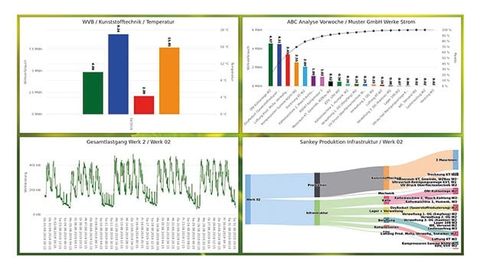
An energy management system brings transparency to energy consumption and energy flows in the company. The data from measuring devices from various manufacturers can be read out and evaluated using the econ4 software.
© econ solutions
All existing data sources can also be integrated into the energy management system at software level, for example from other company systems (e.g. MDE/BDE, ERP). All energy types (electricity, gas, water, heat, compressed air) and status data such as temperature or pH value can also be integrated automatically or entered manually.
Fried Kunststofftechnik has linked the ProSES MDC system with econ4. This makes it possible to determine order-related energy values and create a fact-based foundation for more precise calculations. "The higher the energy prices are, the more important it is to take them into account appropriately in quotations," explains Dr. Andreas Tewald, Energy Management Officer and Head of Work Preparation, Facility Management, Maintenance/Maintenance at Fried. He adds: "There is another advantage of integrating ProSES into econ: the view of our processes has expanded so that we understand them even better, for example by comparing different processes on the individual machines."
The linking of energy, production and other data also enables the automated determination of Energy Performance Indicators (EnPI). Users have also recognized that the data can be used not only for energy management, but also for system monitoring: if consumption is higher or lower than usual and there is no explanation for this, the next step is to troubleshoot.
By looking at the reports, users gain insights that are not primarily related to energy efficiency. This was the case at Fried Kunststofftechnik when the energy consumption of the paint shop increased disproportionately. The search for the cause led to a dirty filter. Fried now uses this fact to replace the filters as required based on the measurement data. Twice a year, the company uses the evaluations to determine the overheads for the production machines and adjust them if necessary.
Rapid amortization through subsidies
The author: Rolf Wagner is an authorized signatory and Head of Sales at econ solutions.
© econ solutionsAn energy management system can involve high costs, especially if extensive measurement technology is required. If existing measuring devices, meters, probes and sensors can be integrated, the necessary investments can be reduced. Energy management systems are also supported by extensive subsidy programs. One of the most important is the EEW (Federal Subsidy for Energy and Resource Efficiency in the Economy). Under 'Module 3: Measurement and control technology, sensors and energy management software', companies can receive up to 40% of eligible investments for the purchase, installation and training, and small companies even up to 50% - up to 15 million euros per project. Experience from numerous projects also shows that an energy management system pays for itself after just a few months thanks to the savings it achieves. In this way, climate protection and economic efficiency go hand in hand.


You might also be interested in
Variety of interfaces for energy management software
The econ4 energy management software from Econ solutions is open for the manufacturer-independent connection of hardware such as electricity meters and sensors as well as the integration of data sources, for example from MDE/BDE or ERP systems.
 read more...
Schneider Electric takes over climate protection consultant EcoAct
With the acquisition of EcoAct from Atos, Schneider Electric is further expanding its range of sustainability consulting services.
read more..."Bureaucratic frustration" in mechanical...
2024 not expected to be an easy year
Germany's mechanical engineering companies do not have high expectations for the coming year. This is not only due to the drop in demand.
read more...Collaboration on Open Energy Standards
Weidmüller Joins the EEBus Initiative
Weidmüller has joined the EEBus Initiative. Together, they aim to further promote the international EEBus communication standard for smart grids and intelligent energy management.
read more...Commissioning of the Balis test environment
The German Aerospace Center (DLR) put the Balis test field into operation on October 28, 2024. DLR is using this test infrastructure to develop and test innovative propulsion systems based on hydrogen fuel cells with an output in the megawatt range.
read more...Machine tools: Demand remains in decline
Order intake in the German machine tool industry fell by 28% in the second quarter of 2024 compared to the same period last year. A stabilization is not expected until the end of the year, as the VDW reports.
read more...Frends Energy Insight 2024" study
German energy sector relies on automation
The current study "Frends Energy Insight 2024" sheds light on the status of digital transformation and automation in the German energy sector. The results show considerable deficits.
read more...Relieving the load on large gearboxes with a new control strategy
The IMA at the University of Stuttgart has developed a new monitoring and control system that detects damage to large gearboxes and provides relief without affecting the overall performance of the system. Unscheduled maintenance is reduced.
read more...Authority wants to regulate industrial discounts on grid fees anew
In view of the changing electricity mix in Germany, the Federal Network Agency is planning to revise the discounts that industrial companies receive for their electricity consumption. The regulatory authority presented a key issues paper on the...
read more...