

Phoenix Contact
Reliable transmission of image data
For developers of modern vision systems, various factors are decisive in product development in order to create reliable systems in an environment of high data transfer rates and miniaturization. Last but not least, the design of the peripheral components is important.
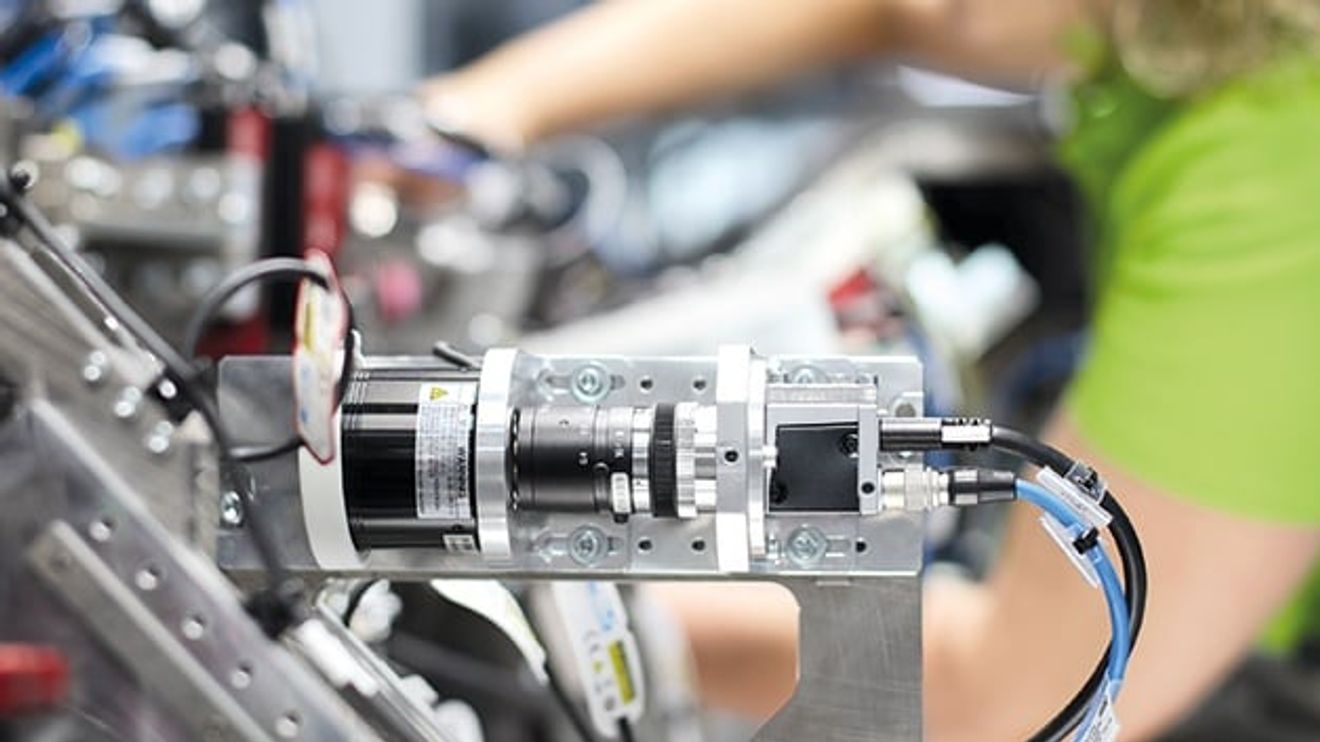
The monitoring and evaluation electronics in modern production processes with the associated quality management, including documentation, produce a wealth of data. These data volumes must be securely transmitted, collected and processed. At the same time, the underlying technical structures must remain fully functional even under demanding conditions such as permanent mechanical stress caused by shocks or vibrations. Data connectors in particular, as important interfaces of the system, must be able to meet these requirements in order to prevent signs of wear on pin and socket contacts (keyword: fretting corrosion). Otherwise, contact interruptions lead to downtime in production or process errors.
Increasingly compact systems in smaller spaces, which follow the trend towards miniaturization, pose additional challenges for device developers of vision systems. Electromagnetic interference pulses can affect the functionality of individual components. The reduced structures in the area of system architecture also jeopardize stable system integrity. The ever closer and ever more powerful components also bring with them a thermal problem that can not only have an impact on sensor operation, but may also make device approval more difficult. Active solutions include miniaturized interfaces and device-integrated connection technology that offer reliable shielding and data transmission. The optimized positioning of components on the circuit board according to electromagnetic and thermal aspects also creates safety. Simulations of heat development, signal integrity and impedance help here, especially when non-standardized components are used.
Standards for image processing
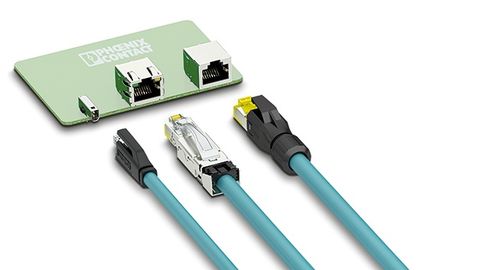
Compared to a standardized RJ45 socket, a SPE-IP20 socket saves around 50 % space.
© Phoenix ContactWhether Camera Link, CoaXPress, GigE Vision or USB 3 - there are various transmission standards to suit the respective vision applications and associated interfaces. Phoenix Contact's portfolio includes data connectors for D-SUB, RJ45, USB, HDMI, coaxial and fiber optic connection technology, as well as solutions for Single Pair Ethernet (SPE) or RJ45 Industrial (RJ45-IND), for example.
RJ45 Industrial
RJ45 Industrial (RJ45-IND) was developed especially for industrial applications. This product family was further developed from the standard RJ45 products on the basis of experience gained in cooperation with customers from different industrial sectors. As a result, Phoenix Contact has developed a product range with an optimized 360° shielding concept. The housing shield springs and shield pins to the PCB have been increased to prevent EMC interference, which also improves the mechanical strength of the socket on the PCB.
When connecting RJ45-IND connectors or patch cables and RJ45-IND PCB sockets, the so-called 'perfect match' of the connector system counteracts shocks and vibrations: For this purpose, the mating depth of the PCB socket was increased from 8.3 to 9 mm, which enlarged the contact zone of the connector system. There were also improvements to the tolerances in the connection of the socket and plug, so that the contact connection is better coordinated. On the connector side, the contact pressure was additionally increased with a pressure spring. Thanks to a reinforced housing using glass fiber technology, temperatures of -40 to +105 °C are possible for the PCB socket. The RJ45-IND patch cables are suitable for both robots and drag chains. With the IDC quick connector, the one-piece connector can be assembled without the use of a special tool.
Single Pair Ethernet
The IEEE 802.3 working groups have developed the transmission standards for Single Pair Ethernet (SPE) and the standards 10Base-T1, 100Base-T1, 1000Base-T1 and MultiGigBase-T1 have been defined. The first SPE standards mentioned enable data rates of 10 Mbit/s to 1 Gbit/s over distances of 15 to 1000 m. The MultiGigBase-T1 standard even allows data rates of up to 10 Gbit/s over distances of up to 15 m. The power transmission for the SPE standards 100Base-T1 and 1000Base-T1 are defined by the IEEE 802.3 bu standard (PoDL - Power over Data Lines). The power consumption of the end devices (power devices) is subdivided into ten power classes from 0.5 to 50 W.
With regard to industrial image processing, SPE offers an exciting field of application, not only because of the possible data and power transmission. The SPE portfolio from Phoenix Contact is interesting here due to its compact and 50 W universal design. For example, the SPE IP20 socket saves around 50% space compared to a standardized RJ45 socket. All components in Phoenix Contact's comprehensive SPE product portfolio are matched and tested. Both compact IP20 connectors (in accordance with IEC 63171-2) and IP67-protected M8 connectors (in accordance with IEC 63171-5) are available. A new addition to the portfolio is the SPE-M12 hybrid connector from the 'Onepair' series.
The advantages of SPE connection technology are the uniform mating face and the possibility of achieving a high degree of common part usage. This makes adapters superfluous and eliminates additional costs.
Various SPE components are available for developers of vision sensors: For example, there are new semiconductors (SPE-PHYs and PoDL controllers), SPE magnetics, connection technology in accordance with IEC 63171-2 and -5 as well as SPE-capable cables in accordance with IEC 61156.
Board-to-board connectors
Contact systems are particularly suitable for demanding applications - such as industrial image processing - instead of simply designed pin and socket connectors, as they are delicate but robust at the same time. With its board-to-board connectors, the 'Finepitch' product series provides a contact system with which PCB connections can be realized in a space-saving manner. Flexibility for developers is provided by different numbers of poles and stacking heights.

The authors: Verena Neuhaus works in Product Management Data Connectors, Business Unit Field Device Connectors and Thomas Schulze works in Product Management Board-to-Board Connectors, Business Unit PCB Connectors, both at Phoenix Contact in Blomberg.
© Phoenix ContactThe system supports data transfer rates of up to 52 Gbit/s. The ScaleX double contacts (FP 0.8) are designed as a hermaphrodite, creating vibration-proof connections in a very confined space. An optionally available shielded version also prevents EMC interference.
Services include support during the entire design-in process as well as design-in support. Device developers of vision systems can thus quickly obtain pre-configured 2D/3D data for their CAD software. Individual thermal or housing simulations based on the finite element method (FEM) are also possible, as are simulations for data and signal integrity.


You might also be interested in
New Automation Management Board strengthened
New Automation, the training association for industrial companies in the field of automation technology, has expanded its board and set up new projects for young talent.
 read more...
Monitor and protect DC microgrids
Sustainable production using renewable energies begins with the establishment of an industrial DC grid. A multifunctional DC switching device is responsible for switching, protecting, monitoring and precharging DC sectors.
read more...The e-paper of issue 08/2024
How can data centers be cooled for AI? How successful is malware programmed with WormGPT? And how can virtualized control systems be integrated into production using TSN? Computer&Automation issue 08/2024 provides answers to these questions and...
read more...Frank Stührenberg hands over to Dirk Görlitzer
Frank Stührenberg will hand over the chairmanship of the Phoenix Contact management board to Dirk Görlitzer at the end of the year. Until then, there will be dual leadership.
read more...Frank Stührenberg hands over to Dirk Görlitzer
At the end of the year, Frank Stührenberg will hand over the position of CEO of Phoenix Contact to Dirk Görlitzer. Until then, there will be dual leadership.
read more...New production facility in Mexico
In order to meet the growth potential of the North American market, Phoenix Contact is planning a new building for electronic and electromechanical production in Mexico. Production is scheduled to start after the first construction phase at the end...
read more...The top articles in April 2024
The most-read articles in April demonstrate the innovative strength of the automation industry and its ability to adapt new technologies.
read more...Phoenix Contact at the Hannover Messe
Strategic technology partnership with Festo
Festo will use PLCnext Technology, the open ecosystem from Phoenix Contact, in future intelligent devices. In this way, both companies want to combine their innovative strength with the aim of taking industrial automation to a new level.
read more...Phoenix Contact at the Hannover Messe
Charging with power
The 'Charx connect universal' CCS vehicle charging sockets from Phoenix Contact now also enable high-power charging with a continuous 375 kW.
read more...