

Harting
On the road to self-sufficiency
Harting wants to be climate-neutral by 2030 and also reduce its energy dependency. For this reason, the company is investing in a biogas plant and renewable energies.
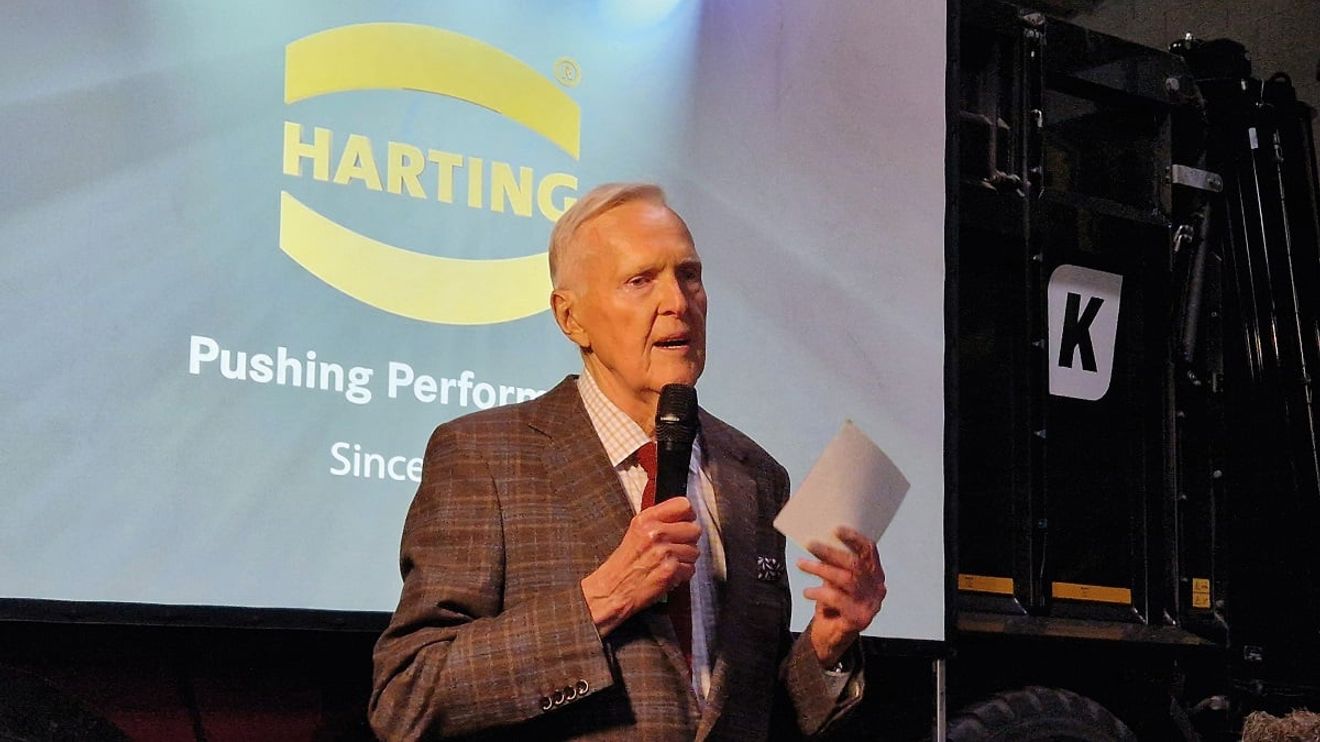
It actually started with Dietmar Harting's passion for agriculture: in addition to running the family business, Harting bought a farm in 1996 and managed it with a team. When the Renewable Energy Sources Act was passed in 2000, he started there with a pigsty and the construction of a 0.5 MW biogas plant, which was used to generate electricity for the farm. In 2011, Dietmar Harting then founded the company ZEA Green Energy and bought a plot of land directly next to a local gas pipeline in Uchte, where he built a biomethane plant with gas processing. 90% of the biomass used in the 3 MW plant comes from the company's own cultivation. The natural gas-quality biomethane produced and processed from it is fed directly into the local gas pipeline and is also used by Harting at its Espelkamp site 30 km away. Since 2019, the entire production there has been heated with biogas, even though this is more expensive than natural gas, as Dietmar Harting says. Under the leadership of Philip Harting, the connector specialist continues to rely on biomethane.
Due to the Russian war of aggression against Ukraine, there has been public discussion in Germany about a possible gas shortage. In such a case, the Federal Republic could confiscate gas from the public grid. The biogas produced in Uchte would also be affected - and this would have an impact on Harting production. To ensure security of supply and production, the Group therefore invested a double-digit million euro sum in its own biogas plant at the Espelkamp site at the beginning of this year. Gas will then no longer be supplied via the public gas grid, but via a direct pipeline. The locally produced biomethane will be used in the energy centers of plants 2 and 3 to generate electricity and heat and, in future, also to operate the aluminum smelting furnaces. The liquid aluminum is needed for the die casting of the connector housings. In addition, the public swimming pool in Espelkamp is to be heated with the help of the local biogas plant.
Biomethane is just one step Harting is taking towards climate neutrality and self-sufficiency. The electricity supply is also to be largely provided by renewable energies. Here, the Group is working together with the company Dietmar Harting Windkraft. The company plans to replace six old wind turbines with 500 kW each with three wind turbines with 4.2 MW each in 2024. The forecast annual yield: 27 million kWh. According to Dietmar Harting, a ground-mounted PV system is also to be built on an area of 14.5 hectares within the next three years. The forecast annual yield here is 14.5 million kWh. The advantage of the wind-sun combination is that the yield curves can be synchronized. The highest wind yield occurs from fall to spring, while the highest solar irradiation occurs in summer.


You might also be interested in
New management for Asia-Pacific business
Mabel Low takes over the position of Managing Director and Corporate Regional Manager at Harting Singapore Pte. Ltd.
 read more...
Setting up a Global Headquarters in Switzerland
The Harting Technology Group, a provider of industrial connection technology, has announced that it will be bundling supra-regional top management positions in Switzerland to drive forward global management.
read more...Establishment of global headquarters in Switzerland
The Harting Technology Group, a provider of industrial connection technology, has announced that it will be bundling supra-regional top management positions in Switzerland to drive forward global management.
read more...Connection technology for fuel cells
The Harting Technology Group presents connection technology for fuel cells and hydrogen production as well as the AI-supported development of connectors in order to actively shape the All Electric Society.
read more...The top articles in July 2024
Innovative spirit and entrepreneurial thinking characterize the most-read articles from July. Find out more about competitive advantages through AI, click through award-winning developments and read more about model-based design and quantum sensor...
read more...New management for Asia-Pacific business
Mabel Low takes over the position of Managing Director and Corporate Regional Manager at Harting Singapore Pte. Ltd.
read more...Establishment of global headquarters in Switzerland
The Harting Technology Group, a provider of industrial connection technology, has announced that it will be bundling supra-regional top management positions in Switzerland to drive forward global management.
read more...Connection technology for fuel cells
The Harting Technology Group presents connection technology for fuel cells and hydrogen production as well as the AI-supported development of connectors in order to actively shape the All Electric Society.
read more...Chief Technology Officer leaves technology group
Dr. Kurt D. Bettenhausen, Chief Technology and Development Officer, is leaving the Harting Technology Group by mutual agreement. He will relinquish his office on March 1, 2024.
read more...