

Ethernet plug
Miniaturization is the order of the day
The path in automation is leading to an end-to-end Ethernet system from the cloud to the furthest corners of industrial production. This requires a suitable infrastructure that has to shrink due to ever smaller end devices. - Three examples.
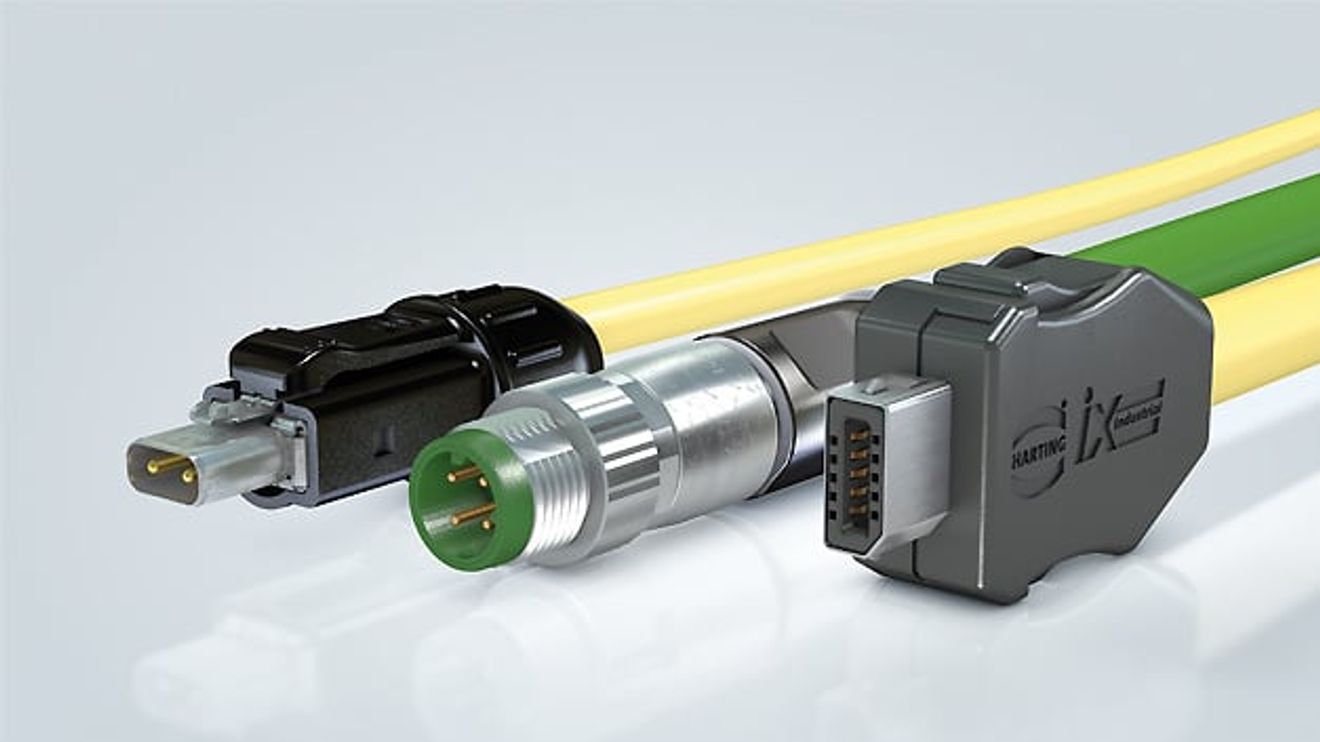
The requirements for the synapses of tomorrow's industry are clearly defined: Device interfaces must become smaller, more powerful and at the same time more robust. To date, the RJ45 connector has been the epitome of the Ethernet interface in an IP20 environment. This connector is the most widely used worldwide and is therefore highly valued by users. However, in view of the lack of robustness due to broken latching levers or occasional contact problems, many users have a love-hate relationship with the RJ45. With a view to ever smaller devices, the size of the RJ45 also limits the possible miniaturization.
Against this background, Harting has entered into a cooperation with the Japanese company Hirose Electric with the aim of advancing the miniaturization of components and interfaces in connection technology. The result is the so-called 'ix Industrial'. The size of the sockets in this new connector concept has been reduced by 70% compared to the RJ45, allowing device manufacturers to use it in much smaller devices. These can be ever-shrinking camera systems, where a conventional RJ45 socket already takes up most of the space in the housing, or control units and small industrial computers, switches, WLAN access points, routers and other network components.
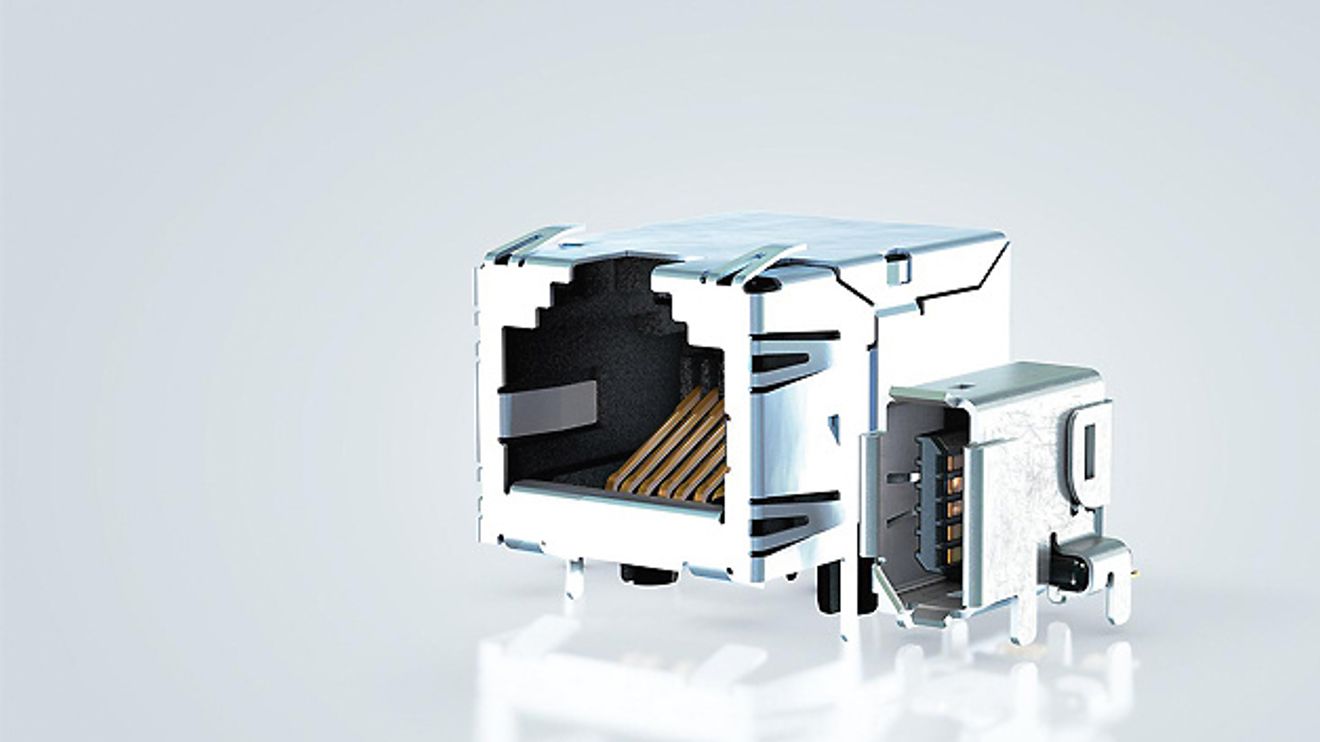
Compared to the RJ45, the size of the sockets in the ix-Industrial concept has shrunk by 70 %.
© HartingA small yet robust socket with five THR shield contacts is provided on the PCB for device integration. The data contacts are designed as SMD contacts. The pitch between the sockets is just 10 mm. In the foreseeable future, the socket will also be available in a flat angled design for very flat devices, and even wall bushings will be added to the ix portfolio in the future.
As both components and system housings are constantly shrinking, space for cabling is correspondingly limited. As a result, flexible and thin system cables with a small bending radius have also been designed for ix Industrial. These are designed with the ix connector face on both sides or with a mix of ix and RJ45 connectors. The third variant is equipped with an X-coded M12 on one side.

With the aim of making the ix-Industrial a standard across manufacturers, Hirose and Harting have disclosed and standardized the new Ethernet interface in the already published IEC/PAS 61076-3-124.
© HartingSmaller is usually equated with more delicate, finer but also more sensitive. However, as it is precisely these negative characteristics of the RJ45 that have often led to problems in an industrial environment, the ix Industrial has a much more robust design. The connectors have a stable latching mechanism via two metal hooks, which guarantee an absolutely secure and vibration-proof connection from the cable to the PCB. This makes them just as suitable for industrial applications as for applications in railroads, robotics and anywhere else where high mechanical loads occur. Finally, in order to absorb the forces acting on the cable, a strain relief was implemented, which forms an absolutely robust connection from the five THR shield contacts via the two snap-in hooks in the mating point to the cable.
In times of more and more data suppliers, transmission bandwidths play an important role. High-frequency transmission is always exposed to the problem of interference. Harting counters this with continuous 360° shielding. This means that from the cable to the connection point, there are no more unprotected wires that could influence an error-free high-frequency signal. The cable shield is crimped with the crimped ring directly on the connector housing and therefore has strain relief and a continuous shield transfer. A particular challenge with this small design with very closely spaced contacts is to effectively minimize crosstalk between the individual data pairs. For this purpose, a shield plate is 'hidden' between the two rows of contacts in the socket, which prevents crosstalk between the two opposing rows of contacts.
Furthermore, the ix Industrial has not eight, but ten contacts. In each contact row, the center contact serves as a shield between the two wire pairs. For this purpose, this center contact on the PCB is connected to the ground potential. The shield plate and the earthed contacts result in an arrangement of the signal-carrying contacts similar to that of an x-coded M12 circular connector. Each pair of wires is well shielded from its neighbors in its own cable or connector quadrant.
Twisted-pair - The dead live longer
When the team around David Boggs and Robert Metcalfe developed Ethernet at the Xerox Palo Alto Research Center (PARC) in the 1970s, it was not foreseeable that this transmission method would develop so dynamically and still dominate data transmission worldwide today. The original 10BASE5 Ethernet still used coaxial cables as the common medium. And even though wireless technology and optical cables have been hailed by many as the transmission technology of the future, twisted pair cables, which have often been declared dead, are still the most commonly used transmission media today.
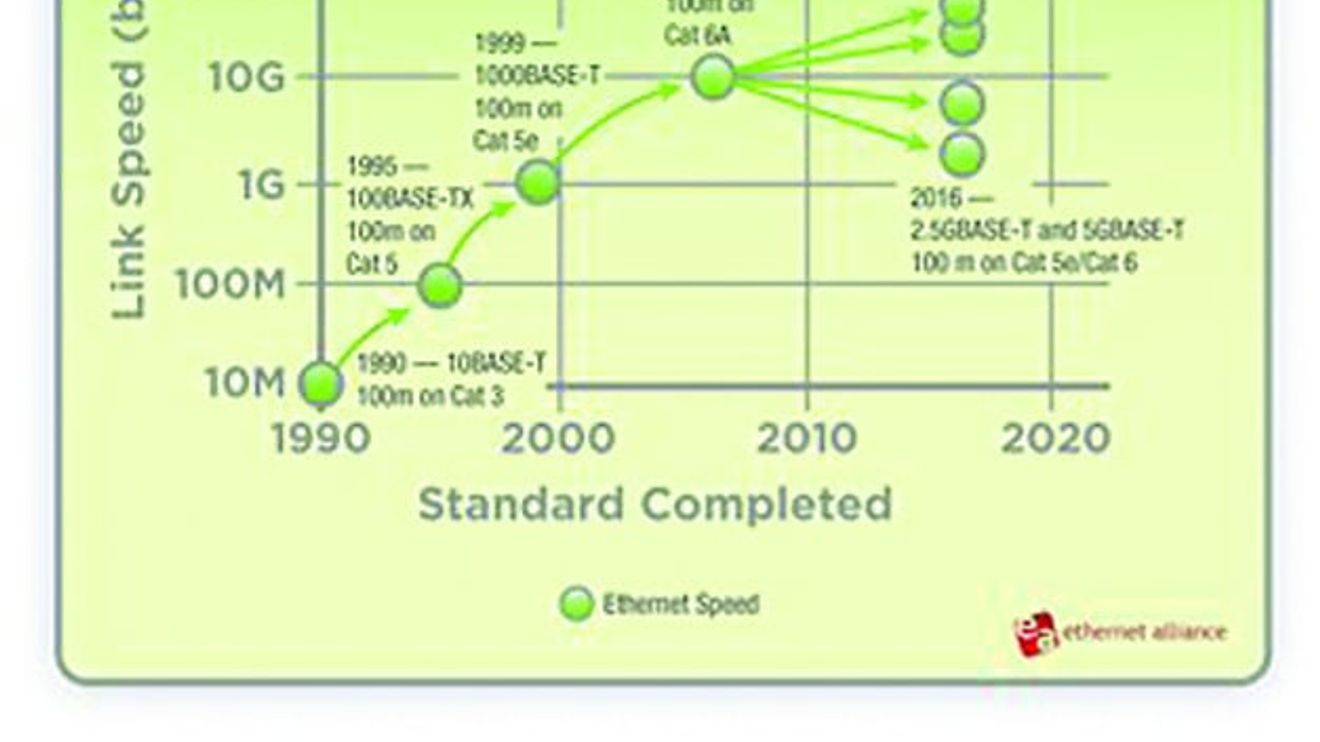
Beginning in 1990 with 10BASE-T, the data transmission rate of the IEEE standards increased tenfold every five years or so via 100BASE-TX and 1000BASE-T up to 10GBASE-T. Although this series could not be continued for the leap to 100GBASE-T, four new IEEE standards were completed in 2016. 2.5GBASE-T and 5GBASE-T were specified in order to make already installed Cat.5/(5e) and Cat.6 networks fit for higher data rates - especially for connecting data-hungry WLAN access points. All of these standards can be used for transmission lengths of up to 100 m and are therefore predestined for classic building and industrial cabling. For high-performance cabling in data centers, 25GBASE-T and 40GBASE-T were added for transmission lengths of up to 30 m. The next steps will be 50GBASE-T and certainly 100GBASE-T1 in the near future.
Up to 100BASE-TX, data is transmitted via two twisted wire pairs. One pair is used for transmitting and the other pair for receiving. With 1000BASE-T, the transition was made to parallel, bidirectional data transmission via all four wire pairs - i.e. 250 bit/s per wire pair. BroadR-Reach technology from Broadcom uses this bidirectional data transmission to transmit 100 Mbit/s Ethernet over just one twisted pair of wires.
This technology initially attracted a great deal of interest from the automotive industry, which requires a cost-effective replacement for the still dominant CAN bus, particularly for driver assistance systems and future autonomous vehicles, but also for infotainment systems. Ethernet via just one twisted pair of wires is ideal for this. It is cost-effective and virtually weight-neutral compared to the CAN bus. Accordingly, the IEEE 802.3 working groups have specified the new 100BASE-T1 (IEEE 802.3bw) and 1000BASE-T1 (IEEE 802.3bp) standards.
In contrast to the multi-pair Ethernet standards with the clearly defined RJ45 connector (the correct designation is actually 8P8C modular connector), the single-pair standards for T1 Ethernet do not, however, contain any specifications for the design of the connector interface. If vehicles are regarded as self-contained systems, this approach makes sense, as even today different interfaces are installed in vehicles from different manufacturers. For the use and distribution of T1 Ethernet in industrial applications or building automation with a large number of market participants, however, a clearly defined connector standard is just as necessary as for 4-pair Ethernet. This applies all the more to the new 10BASE-T1 standard currently in development, which is intended to enable the transmission of 10 Mbit/s Ethernet over distances of up to 1000 meters and even longer. This new standard therefore has the potential to replace all fieldbus systems currently in use in the long term. This is all the more true as a power standard called 'Power over Data Line' (PoDL) is being specified for single-pair Ethernet in the same way as PoE (Power over Ethernet).

The standardization of a uniform T1 mating face for plug-compatible IP20 or IP65/67 versions is therefore the aim of an IEC standards project just submitted by Harting. The starting point for this design is a shielded two-pole connector with an active and robust metallic locking mechanism. Precisely this mating face can be found in two round IP65/67 mating faces. A plastic snap-in locking mechanism is proposed for one variant, similar to that standardized for M8 connectors in accordance with IEC 61076-2-104. The second variant is even more robust and is based on a metal push-pull latch.
Another group of experts is working on a corresponding IEC standard for T1 cables and a technical report will deal with the question of how T1 Ethernet cabling should be constructed. Last but not least, the supply of the necessary PHY chipsets will increase rapidly - particularly under the influence of the automotive industry - and will be available at low cost. This means that the two lifelines - data and power - can be realized up to a power range of currently 60 W with one wire pair. And with Time Sensitive Networking (TSN), the last problem of Ethernet's lack of determinism will also be eliminated in the foreseeable future.
Big data through the eye of the needle

To ensure that the new version of the M8 retains its roots as a universal solution, the D-coded version is also standardized in accordance with IEEE 802.3 and PAS IEC 61076-2-114.
© HartingAs already mentioned several times: The devices used in automation technology, such as camera technology, sensor systems, switches, I/O boxes or decentralized industrial PCs, are not just getting smaller. They also have to meet the increased demands of digitalization and now generate significantly more data than they did a few years ago.
To enable devices to communicate right down to the last corner of the field level via Ethernet-based systems, there are actually only two IP67-protected solutions: an RJ45 additionally protected in a housing or an M12 circular connector. These connectors are small, but are now too large for many applications. To give an example: Some modern industrial cameras are now so small that the connection for power and data limits the miniaturization of the housing and takes up most of the space in the application.
Harting wants to meet this challenge with a new D-coded solution for the M8 plug-in connector. The so-called M8ty has a robust metal housing with continuous shielding and contacts modified to a diameter of 0.8 mm, enabling it to supply end devices with 100 Mbit Fast Ethernet. To avoid taking up additional space with additional power interfaces, the M8 in D-coding is also PoE-capable and can supply data and power to field devices simultaneously.
At this year's Hannover Messe, which also marked the start of series production, an end-to-end solution consisting of overmolded cables and PCB connections was already on display. On the PCB, the M8 solution is around 30% smaller than the previous M12 solution. This may not seem like much at first, but if you combine various M8 sockets on an I/O box, the reduced pitch adds up to a considerable space saving. On the device side, the user has a choice of two flange sockets in heights of 9 mm and 13 mm. This means that the installation heights of other connections can be compensated for and there are no distance problems.
In the first step, the M8 D-coded will have the screw connection familiar from circular connectors. However, as Harting has already had good experience with a push-pull locking mechanism on its larger M12 counterpart, the M8 will also be available with this quick and easy locking mechanism in the not too distant future. This solution promises easier handling, especially in very tightly spaced connections next to each other. Finally, there will also be developments in the area of connection technology for the cable side. Here, Harting will follow up with its own insulation displacement terminal known as Harax, a connector that can be assembled in the field.
Authors:
Jonas Diekmann is a technical editor at Harting Electronics;
Matthias Domberg is Product Manager at Harting Electronics;
Matthias Fritsche is Product Manager at Harting Electronics.


You might also be interested in
The top articles in July 2024
Innovative spirit and entrepreneurial thinking characterize the most-read articles from July. Find out more about competitive advantages through AI, click through award-winning developments and read more about model-based design and quantum sensor...
 read more...
New management for Asia-Pacific business
Mabel Low takes over the position of Managing Director and Corporate Regional Manager at Harting Singapore Pte. Ltd.
read more...Establishment of global headquarters in Switzerland
The Harting Technology Group, a provider of industrial connection technology, has announced that it will be bundling supra-regional top management positions in Switzerland to drive forward global management.
read more...Setting up a Global Headquarters in Switzerland
The Harting Technology Group, a provider of industrial connection technology, has announced that it will be bundling supra-regional top management positions in Switzerland to drive forward global management.
read more...Connection technology for fuel cells
The Harting Technology Group presents connection technology for fuel cells and hydrogen production as well as the AI-supported development of connectors in order to actively shape the All Electric Society.
read more...Chief Technology Officer leaves technology group
Dr. Kurt D. Bettenhausen, Chief Technology and Development Officer, is leaving the Harting Technology Group by mutual agreement. He will relinquish his office on March 1, 2024.
read more...Industrial Ethernet cable length soon also with SPE
Single Pair Ethernet is on the verge of a breakthrough - and is also being expanded with new solutions for longer cable lengths and higher transmission rates. Marian Dümke, Global Product Manager Harting T1 Industrial Single Pair Ethernet...
read more...New Managing Director for Harting Customized Solutions
Jörg Scheer was appointed to the Management Board of Harting Customized Solutions on October 1, 2023.
read more...Digital twin - concrete!
A defined standard for the asset administration shell is crucial for the interoperable and efficient exchange of digital twin data - so much for the theory. Nine partners showed what a specific use case looks like at the Hannover Messe.
read more...