

Fraunhofer ICT and CEMEP
Up to 140 TWh of Electricity Savings Possible with Frequency Converters
The targeted use of frequency converters could save up to 140 terawatt-hours of electricity per year in the EU. Researchers at Fraunhofer see significant potential especially for pumps, fans, and compressors with variable loads.
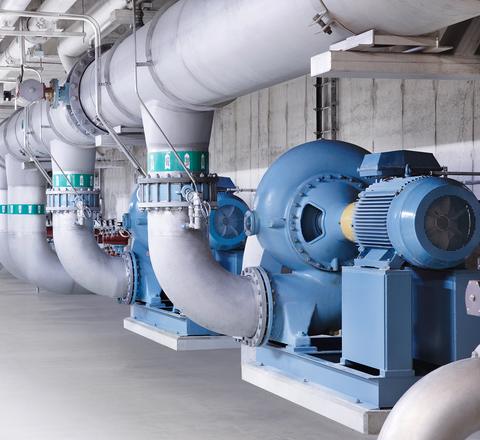
In 2021, electric motors accounted for around 46% of total electricity consumption in Europe, with 70% of that used for pumps, fans, and compressors. Many of these applications run at a constant speed, even when the load varies. Two studies by the Fraunhofer Institute for Chemical Technology ICT, commissioned by CEMEP (the European Committee of Manufacturers of Electrical Machines and Power Electronics), show that demand-based speed control using a frequency converter could save up to 140 TWh of electricity annually — equivalent to about 5% of the EU’s total electricity demand.
A frequency converter adjusts an electric motor’s speed precisely to match actual demand. According to Fraunhofer ICT, the savings potential depending on device and load profile ranges between 10% and 70%. The studies examined electric motors for pumps, fans, and compressors in power classes according to EN standards from 0.37 to 1,300 kW, in applications such as water and wastewater pumps, heating and air-conditioning systems, ventilation, and industrial heating and cooling processes.
Highest potential for fresh water pumps
Researchers see the greatest potential in freshwater pumps, where energy savings of 18% to 24% are possible. Currently, around 50% of pumps and 40% of fans still run at fixed speeds. For some constant-load applications — such as swimming pool pumps or wastewater transport — speed control does not provide an immediate benefit.
In addition to direct energy savings, frequency converters allow the use of smaller, more efficient devices that can deliver the same performance at higher speeds. One of the studies confirmed this also applies to constant-load applications such as swimming pool and wastewater pumps.
Additional downstream savings are conceivable in systems where the transported medium contains thermal energy — for example, in warm air supply for buildings. If the flow rate can be flexibly adjusted to demand, less thermal energy is needed overall. However, the studies did not quantify these effects.
According to Fraunhofer ICT, saving 140 terawatt-hours of electricity in Europe would reduce CO₂ emissions by about 38 million tons per year — equivalent to the emissions from burning 14.2 billion liters of diesel fuel.
Further information can be found in the whitepaper:


 2.6 MB
You might also be interested in
Extended three-member Management Board for Deutsche Messe
Deutsche Messe AG is reorganizing its personnel and consistently focusing its Management Board on the further development of the company and the exhibition grounds in particular. With an expanded three-member Management Board, the company is...
 read more...
Strike at the start of the Hannover Messe
On the occasion of the strike announced by ver.di on the first two days of Hannover Messe 2026 (20 and 21 April), which will paralyze public transport in Hanover, the organizer, Deutsche Messe, is expressing clear criticism and great concern about...
read more...Hanover Messe starts
Topics such as digitalization and sustainable production will shape Hannover Messe 2026, and a number of prizes will also be awarded during the trade fair.
read more...High Performance for the Industry of Tomorrow
With the Sinamics S220, Siemens sets new standards in performance and safety. The new multi-axis control unit CU320-3 significantly increases computing power and response speed. As part of the Siemens Xcelerator portfolio, the drive system supports...
read more...The wheel of fortune spins again
The automation industry is counting down the days until the SPS - and we make sure that every visit is twice as worthwhile. Stop by the Pelemedia stand and spin the wheel of fortune: every spin wins and guarantees you an attractive prize.
read more...New Generation of Synchronous Servomotors
With the DIP, AMKmotion is launching synchronous servomotors with high power density, compact design and up to three times the acceleration of comparable drives.
read more...Schwäbische Werkzeugmaschinen relies on Stöber
Longer expected Service Life
For the ‘BA space3’ machining center, which is suitable for large, heavy workpieces, Schwäbische Werkzeugmaschinen relies on Stöber’s ‘PHQ’ servo gearboxes with four planetary gears, with features including high-quality helical gearing and maximum...
read more...Automation for Chip Production
Beckhoff optimizes Semiconductor Processes with precise Control Technology
Semiconductor production is one of the most complex manufacturing processes in the industry. Beckhoff shows how precise automation, flexible control systems and open communication standards accelerate production processes and equip manufacturing for...
read more...Owner Family re-enters the Operating Business
For the first time in almost 20 years, the Lenze Group's owner family is returning to the operational side of the business. Lena Günther and Dr. Moritz Belling take on management roles and are to help shape the automation specialist's future program.
read more...