

SEW-Eurodrive
Four robots, one unit
Handling pipes is a major challenge. Especially when they are up to four meters long and space is limited. An application-specific handling and transfer unit with four Scara robots solves the problems.
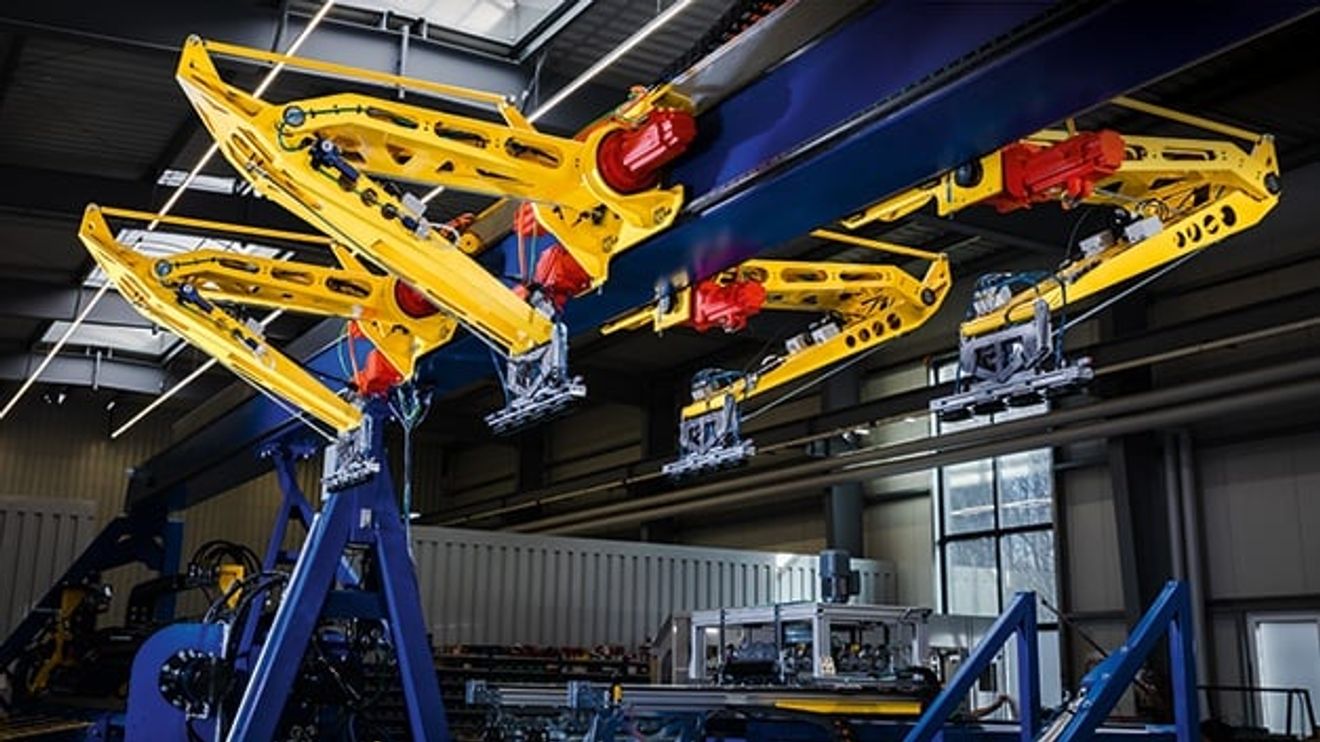
Four Scara robots work on one axis, two robots on each side of the linear axis. The reach of a Scara arm is 2.2 m.
© SEW-EurodriveThe requirements were complex: the company was looking for an automated handling solution that could remove standpipes with a length of 250 to 4000 mm and a maximum weight of 30 kg from the cutting machine after the cutting process, bundle them and transport them to the storage area on pallets. However, the space required on site is limited.

Image 1: Each of the four Scara robot arms is fitted with a vacuum gripper that reliably picks up the sheet metal tubes. Each suction plate can handle a load of 40 kg.
© SEW-EurodriveSpecial machine manufacturer RTT Robotertechnik-Transfer from Zittau developed and manufactured a handling and transfer unit with four Scara robots specifically for these requirements. Two robots at a time are mounted on two parallel guide rails under the hall ceiling and can move along the linear axis over a distance of 12 meters. Due to the arrangement, the gripper arms can be flexibly positioned according to the length and geometry of the different articles. The central elements for the Scara robots are precision servo geared motors, inverters and the Movikit Robotics software solution from SEW-Eurodrive's Movi-C modular automation system.
Designed with specific robot kinematics
As the robots are suspended from a guide, the weight of the individual arms had to be kept low. In addition, the task requires a special design with specific kinematics. For this reason, the upper and lower arms of the Scara robots are designed in an optimized lightweight construction. At the load pick-up point, a vacuum suction plate grips the tubes and transports them onwards for bundling and packaging on pallets(Fig. 1).

Figure 2: Two precision servomotors with gearboxes from the ZN series are installed on each Scara arm. All motor data is transmitted in real time to the application inverter and the associated networks. This allows all operating data to be recorded in detail and maintenance forecasts to be created.
© SEW-EurodriveThree drives are used for each robot arm: a servo bevel gear motor is used to feed along the carrier (Fig. 2). The other two drives are used to move the upper and lower arm. Servomotors are used here in combination with gearboxes from the ZN series, whose characteristics include zero backlash and precision at extreme acceleration torques. The torsional and tilting rigidity of the gearboxes enables the exact positioning and rapid movement of large loads with repeat accuracy and also offers the possibility of absorbing high torques. In addition, the compact design of the drive units enables installation even in small installation spaces. The motors are lubricated for life ex works, ready for installation and available in twelve sizes.
The Movi-C modular automation system offers a scalable system with engineering software, control and inverter technology as well as the appropriate motors. The configurable multi-axis system 'Movidrive modular' was used for the handling system described (see box).
Individual removal kinematics

Figure 3: The controller as a control cabinet installation device ensures optimum interaction between the automation components.
© SEW-EurodriveThe kinematics were completely simulated during the project planning phase and the drives were optimized based on the results. Movikit Robotics was used to parameterize the kinematics; the motion sequences were defined with just a few commands in SEW Robot Language. During commissioning, the system was operated using the 'RobotMonitor' user interface: the program displays the complex functions using a clear and intuitive user interface. It also displays the kinematics in three dimensions and shows the paths traveled. This process saves time and enables flexible adjustments in the event of innovations.

The software module is operated on a 'Movi-C-Controller progressive' (Fig. 3). All calculations of all four kinematics are carried out on the powerful controller. The result is an automated robot system for smooth interlinking of the separating machine with the downstream pallet stacking system.
Two systems working in parallel
As a result, two removal systems can pick up the tubes on both sides independently of each other and engage in the working area of the other kinematics. RTT carried out the project together with SEW-Eurodrive: The system was delivered within six months of development and construction time. It has been in use at the manufacturer of roof drainage systems since summer 2020 and follows the cycle of the separation system.
The Movi-C modular automation system with real-time bus

The compact 'Movidrive modular' multi-axis system with its intelligent mains power and energy management consists of supply modules, regenerative modules as well as single-axis and double-axis modules and is controlled via the Movi-C controller. Commissioning is carried out via the electronic type plate or the electronic catalog. Unknown motors can also be commissioned using the measurement function. All motor data is transmitted in real time to the application inverter and the associated networks. This allows all operating data to be recorded in detail and maintenance forecasts to be created. The automatic identification and provision of type designations, serial numbers and logistics data for the motors makes it possible to automatically create an inventory of all drives in a system at the touch of a button.


You might also be interested in
Robot lab aims to allay fears of digital technology
Digitalization will continue to advance, with the result that robots will be used even more in the future than they are today. To overcome the fear of new technology, the University of Vechta now has a special laboratory.
 read more...
Communication with visible light
Cooperative AGVs cannot reliably exchange data via WiFi channels alone. If visible light is also used for this purpose, the susceptibility of communication to interference is significantly reduced.
read more...Smooth processes ensured
With Movitrac advanced, SEW-Eurodrive is launching a compact control cabinet inverter that is particularly suitable for material transport and handling technology in the beverage industry.
read more...New Spiroplan gearbox series
SEW-Eurodrive is expanding its Spiroplan gear units with a new series.
read more...Hans-Joachim Müller, SEW-Eurodrive
Interdisciplinarity is crucial
A higher degree of digitalization leads to a greater volume of data - also in the drive system. This creates new challenges. Hans-Joachim Müller from SEW-Eurodrive on the advantages and disadvantages of digitalization.
read more...Drives precisely synchronized
Manufacturing processes in the food industry are very complex and require intelligence in the machine. The example of a belt-synchronized cutting system shows what an automation system for the production of Maultaschen can look like.
read more...New board member for production and quality management
Bosch Rexroth appoints Dr. Christina Franke (49) to the Management Board with responsibility for Production and Quality Management as of April 1. She succeeds Reinhard Schäfer (60), who is retiring.
read more...Integrated measurement technology for condition monitoring
There are new variants of the high-precision motor feedback system 'EDS/EDM35' from Sick. Variants with additional sensors for monitoring vibration behavior and humidity supplement the standard variants.
read more...Drive controller with high-current variant
As a high-current variant, the 'SD4B' drive controller from Sieb & Meyer extends the range of possible applications: as a servo amplifier for operating rotary and linear low-voltage servo motors or as a frequency inverter for high-speed...
read more...