
Work 4.0
Is this what the desk of the future will look like?
The Fraunhofer Institute for Industrial Engineering (IAO) has developed workplaces of the future together with industry partners. A look at the prototypes.
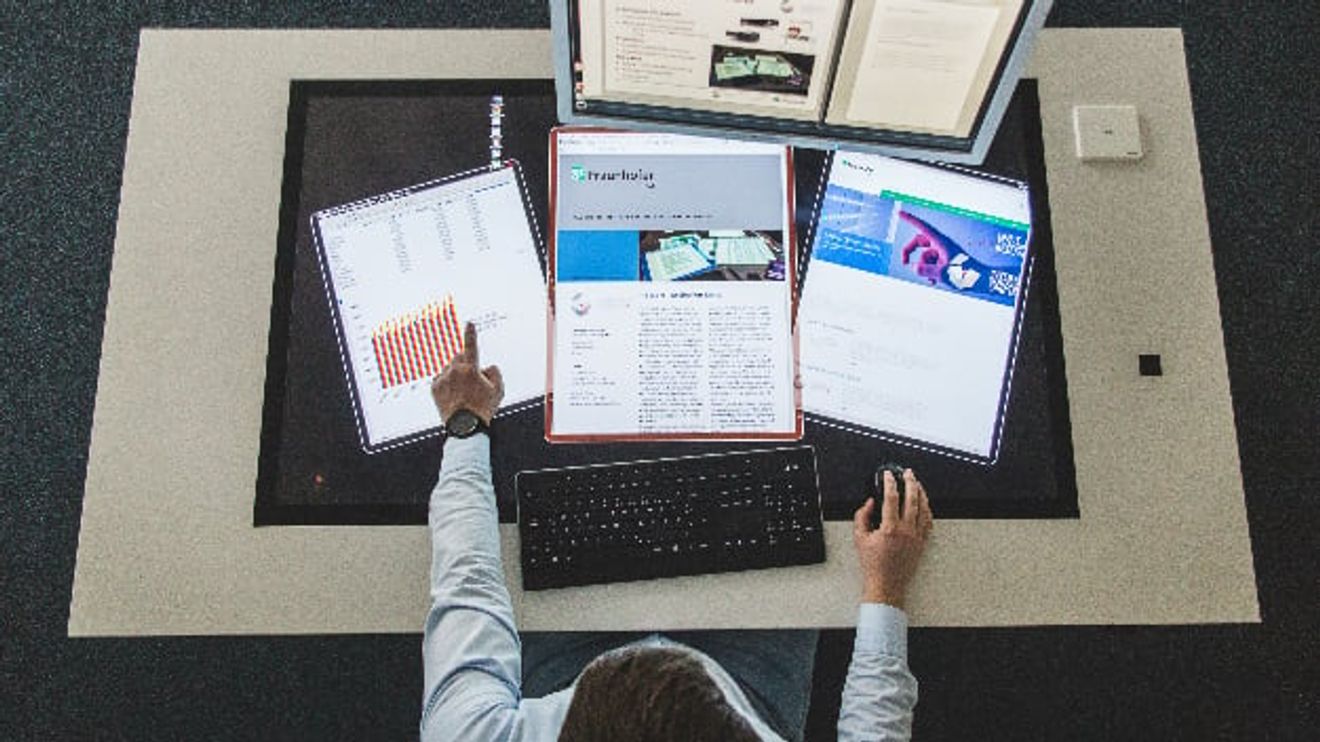
The Fraunhofer IAO presented the project at Orgatec, the leading international trade fair for modern working environments, in Cologne at the end of October 2016. The motto of the trade fair this year was "Rethinking work". The prototypes were created as part of the 'Office21 innovation offensive', which has been working under the scientific direction of the Fraunhofer IAO for 20 years. At the heart of the idea: digitalizing work processes, making work organization more flexible and promoting innovation and creativity processes. The classic desk is being expanded into a digital workspace, with cables and papers disappearing to make room for a work scenario that ranges from the generation of creative ideas to their further processing at the workplace:
At the 'Wirefree Workstation', knowledge workers can use all devices at the workstation wirelessly - from the tablet to the screen and the task light. The completely wireless power and data supply is provided via various wireless technologies that are integrated into the tabletop.
The 'Extended Workdesk' uses OLED and multi-touch as a digital work surface. There will be no more mountains of paper here: In future, interaction with data and documents at the workplace will no longer take place exclusively via mouse and keyboard, but also via touch. Almost the entire desk is to become a digital work surface.
In the exhibit on show at Orgatec, the desk surface essentially consists of a 55" OLED display with multi-touch in UHD resolution, which enables access to all applications with free positioning, scaling and rotation of the windows via the Fraunhofer IAO's VD1 software.
Fraunhofer IAO will also be presenting a new solution at the trade fair for converting analog workshop results (e.g. in the form of sticky notes) into a digital form for seamless further processing. This can take place on interactive work surfaces using visual collaboration tools, for example. Here too, existing components have been combined to create a new functionality for the digital work process.
The realization of the described work scenario with the two new prototypes was a team effort. The Office21 project partners involved included :
- Drees & Sommer
- Fujitsu Technology Solutions
- Haworth
- Herbert Waldmann
- Intel Germany
- Interstuhl Office Furniture
- Kyocera Document Solutions Germany
- Nurus GmbH
- Schulte Electrical Engineering
- Soennecken
- Trilux


You might also be interested in
Workplaces of the future
How will people work and live in the future? Scientists at the Fraunhofer IAO are researching this in the "Workspace Innovation Lab". Among other things, they are investigating the effects of different environmental situations and working methods on...
 read more...
Software developers in high demand
There are currently 51,000 vacancies for IT specialists in Germany, an increase of almost 20 percent compared to the previous year. At that time, 43,000 vacancies were counted. Where are they looking?
read more...Industry 1.0 meets Industry 4.0
What is a lathe from 1887 doing at a high-tech automation trade fair like SPS IPC Drives 2016? Find out at the Bosch Rexroth stand!
read more...What managers earn in 2016
Managers in Germany earn an average of 3.2% more than in the previous year, and their average salary this year is 122,000 euros. This and the factors that influence salary levels are revealed in a recent study by HR and management consultants...
read more...Vision of the world of work 4.0
Microsoft introduced trust-based working hours in 1998, and two years ago compulsory attendance was abolished. At its new German headquarters in Munich, the company has now also abolished offices. Instead, there are cafés and co-working spaces. Here...
read more...Data security solutions no longer sufficient
According to a recent study, a majority of companies believe that their current data security solutions will not be sufficient for the future. Action is needed now, as data loss costs companies almost 900,000 euros per year.
read more...International Federation of Robotics
The three top trends in industrial robotics
According to the IFR, two million new robots will be installed in production facilities worldwide by 2022. Three trends stand out in particular.
read more...Grid operators under pressure to act
The high investment costs for the expansion of the 5G network are causing problems for network operators. The technology consultancy BearingPoint assumes that network operators therefore need to reposition themselves - now!
read more...New series: Three questions for ...
What will 2020 bring?
Under the title "Three questions for ...", computer-automation.de is publishing short interviews with the leading figures in the automation industry on a monthly basis this year.
read more...