

Sick
Positioning hoeing tools when weeding
Mechanical weed control in the crop row by humans is laborious - and mechanical alternatives have so far been slow. The use of pesticides against weeds is also not a sustainable alternative. Modern agricultural machinery is proving to be helpful.
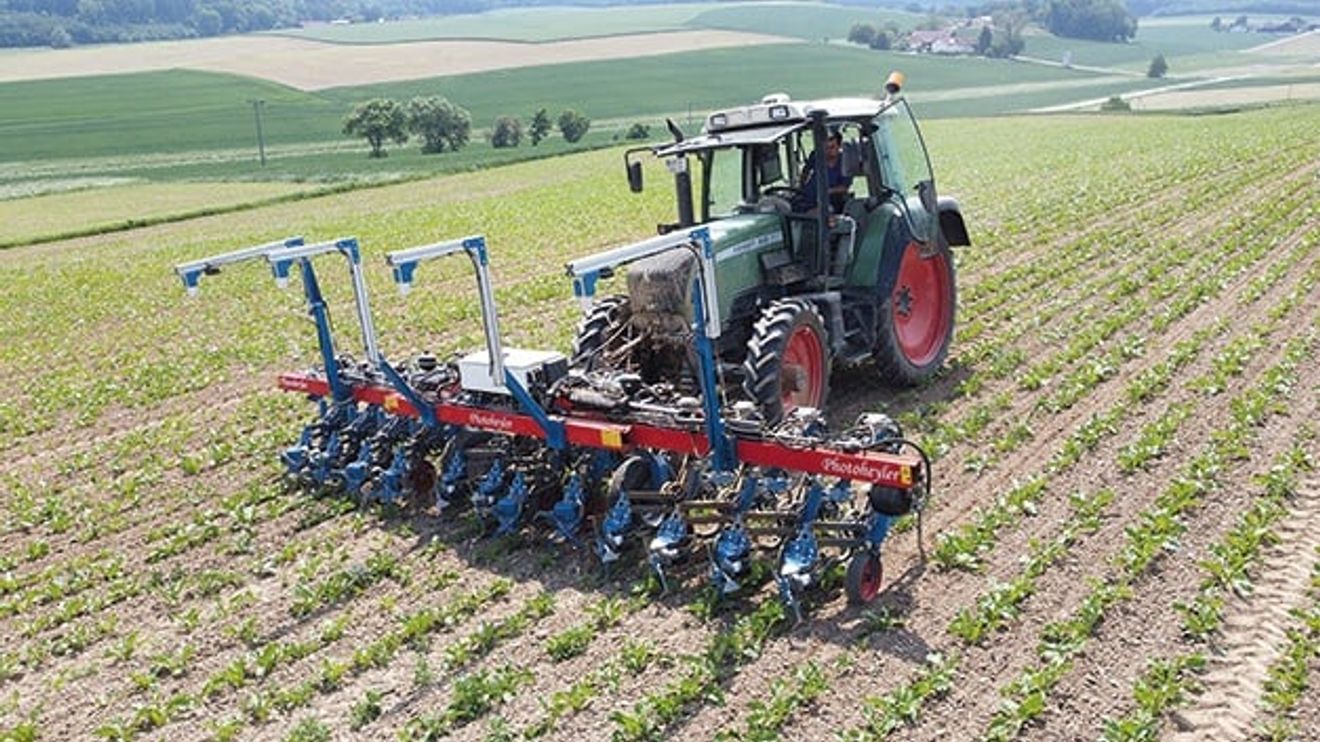
With the 'Photoheyler' hoeing system, Planungsbüro Heinrich has established a new 'hoeing order' in the mechanical weed removal market: With an area output of more than one hectare per hour, crops can be hoed from the two-leaf stage to the beginning of row closure. The hydraulically driven rotors, which remove the weeds from the plant row, compensate for the driving speed of the agricultural machine in such a way that the crops - for example sugar beet - are not damaged or buried by soil moving in the direction of travel during vertical plant cutting.
Absolute encoders from Sick's 'AFS60 Ethercat' product family support the dynamic position detection and speed recording of the twelve individually path-controlled hoeing rotors on the attachment. For this purpose, the encoder was adapted from its original industrial purpose to the agricultural application of the photoheller.
Prepared for field work
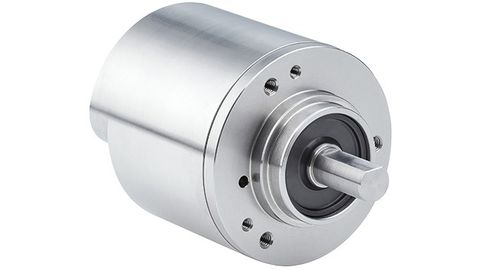
Inox encoders from the AFS60 Ethercat product family with IP67 protection are perfectly designed for agricultural applications.
© SickIn order to consistently design the sensor for field work on the photoheyler and possible other applications in the agricultural environment or other heavy-duty applications, Sick redesigned the sensor together with the customer: The aluminum housing gave way to a stainless steel housing. The socket/plug connection was also modified to achieve better sealing efficiency. The protection class of the flange side of the housing was also changed to IP67 to prevent moisture from penetrating via the encoder's ball bearings. This is how the 'Agrar-AFS60' was created.
Weeding made to measure
Depending on the version, the Photoheyler can hoe more than a dozen rows of plants simultaneously and thus remove weeds. In order to distinguish between the two, a traveling image processing system was developed which, according to the Heinrich planning office, achieves detection rates of over 98%. At the same time, the cameras measure the distance between the crop plants for each planting row, as different planting distances can occur during the course of growth, even with uniform mechanical sowing.
To ensure that the weeds can be removed accurately, each individual rotor must be controlled in an individual path curve. This in turn requires a separate encoder for each hydraulic drive on the attachment, which provides fast and precise position and speed measurement values for controlling the hoeing rotors. With a singleturn resolution of 18 bits, the space-efficient absolute encoders from Sick provide the accuracy required for 360° position detection and precise control. In the Ethercat version, they also enable cycle times of 4 ms in order to achieve the necessary control dynamics for the individual braking and acceleration of the rotors.

The author: Martin Hummel is Product Manager Encoder / Motion Control Sensors at Sick in Donaueschingen.
© SickThe example of this encoder shows that products and systems from the existing portfolio can be modified for a wide range of new applications through customizing. This means that encoders are available for the technology and automation of agricultural machinery that can measure the rotational speed and speed of moving, mostly rotating parts of agricultural machinery. They can also detect the position of movable components and attachments and thus optimize soil cultivation or harvesting processes, for example, and are able to support the control of autonomous steering and driving systems.
| Sensors for mobile automation |
|---|
| Farming 4.0 - the digitalization of agriculture - places specific demands on the sensors used, which Sick can map in terms of sensor and system technology. Numerous sensors offer intelligent diagnostic functions for condition monitoring or enable process-optimized operation of agricultural machinery: for example, combine harvesters that navigate collision-free along mowing edges, harvesting robots that only pick really ripe fruit, booms that only spray pesticides specifically on weeds, transfer trailers that automatically detect their fill level or storage facilities and silos that automatically determine and report the harvest volume brought in. Sick's portfolio ranges from standard sensors with different physical operating principles to intelligent encoders, inclination sensors, sensors for environment detection with integrated application algorithms and complex systems as well as IoT and cloud-based solutions. All sensors relevant to agricultural technology are designed to withstand the requirements in terms of tightness, temperature effects, EMC resistance as well as shock and vibration resistance in their typically harsh operating environments, either ex works or by customizing. |


You might also be interested in
Technologies for precise data and analytics
From June 9 to 11, 2026, Sensor+Test once again brought together trade visitors from the fields of sensor technology, measurement, and testing in Nuremberg. With its focus on these core technologies and the wide range of application areas, the trade...
 read more...
Increased revenue and expanded production capacity
The Fraba Group, a manufacturer of sensors for industrial motion control, looks back on a successful 2025, during which both revenue and the number of employees increased.
read more...From sensor to intelligent system
Sensors, measurement technology and artificial intelligence are merging to form intelligent systems. From June 9 to 11, 2026, Sensor+Test in Nuremberg will showcase the most important trends in a changing industry.
read more...Dr. Volker Frey becomes CTO
On May 1, 2026, there were personnel changes in the top management of the ifm group of companies. Dr. Volker Frey succeeds Benno Kathan as CTO, who has retired.
read more...Self-learning sensor systems monitor industrial manufacturing processes
In the 'GenSATIOn-Edge' project, the Fraunhofer Institute for Microelectronic Circuits and Systems IMS is working with partners to develop intelligent sensor systems for the continuous monitoring of industrial processes. AI models run directly on...
read more...Sales growth in a turbulent market environment
Thanks to innovations and a focus on strategic industrial markets, Sick was able to moderately increase its sales in the 2025 financial year. In a turbulent market environment, the company was able to maintain its position and gain market share with...
read more...Networking identification systems at field level
'IdentChain' is a platform from Leuze with which identification systems can be networked at field level.
read more...Successful year despite geopolitical challenges
According to the company, 2025 ended on a very positive note for the ifm Group. Adjusted for currency effects, turnover increased by 10 percent to EUR 1.47 billion.
read more...Human-like sense of touch for robots
The sense of touch is one of robots' greatest weaknesses. Researchers have now developed a miniaturized tactile sensor that could give robots something much closer to the human sense of touch.
read more...