
Flow measurement
Hygienically flawless for the pharmaceutical industry
Hygienic conditions must be maintained when cleaning containers in the pharmaceutical industry. It is ideal if the flowmeters used for this purpose do not require contact between the sensor element and the medium.

The hygiene regulations in the production of pharmaceuticals are high for a reason - life and health depend on the correct composition of active ingredients and the avoidance of contamination with undesirable substances. Consequently, production facilities and containers must be meticulously cleaned at prescribed intervals after every product change, in sometimes quite complex processes, according to precisely specified recipes.
L.B. Bohle Maschinen + Verfahren, headquartered in Enningerlohr, Westphalia, is a specialist in this field. With machines and systems for the pharmaceutical industry - from weighing, granulating, sieving and mixing to film coating of tablets and the corresponding cleaning systems - it is established worldwide.
The Pharma Universal Cleaning System PUR, for example, is specially designed for cleaning containers and vessels of different sizes. All components for conveying and treating the cleaning water are housed inside a stainless steel cabinet. This means that the compact unit fits into the washroom; washing processes are recipe-controlled and automatically documented. A touch panel directly on the system ensures on-site operation.
One sensor for flow and temperature
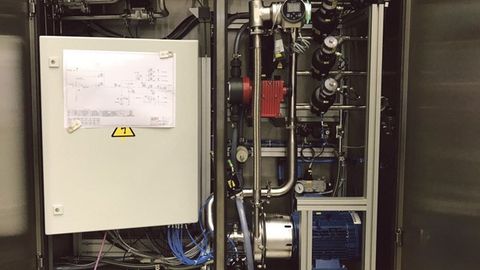
'Flowave' is easy to install in the switch cabinet. It can be installed in any position.
© L.B. BohleThe recipes for the various cleaning processes and steps specify the ratio of water and the alkaline or acid-based cleaning agents. The mixing ratio is usually between 1 and 3 %, with cleaning solutions of all pH levels being used. At the same time, the recipes also specify certain temperature values for many cleaning steps so that the process can run optimally. This means, on the one hand, that the amount of water in the 'PUR' systems must be continuously recorded in order to regulate the detergent pumps according to the recipe specifications and, on the other hand, that the temperature must also be measured and, if necessary, readjusted accordingly in order to comply with the minimum or maximum values specified in the recipe.
The 'Flowave' flow meter type 8098 from Bürkert performs both tasks. They work according to the Surface Acoustic Waves (SAW) method, i.e. they use surface waves for measurement. As they also have an integrated temperature sensor, one sensor can be saved in the PUR system.
The Surface Acoustic Waves method
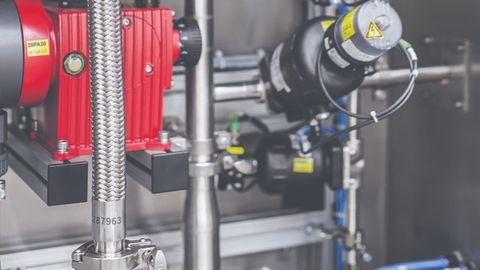
The stainless steel flowmeter works according to the SAW method (Surface Acoustic Waves) and measures the volume flow with an accuracy of 0.4 % of the measured value.
© L.B. BohleThe SAW method uses wave propagation for flow measurement, as occurs during seismic activities (e.g. earthquakes). The main part of the sensor consists of a measuring tube, on the surface of which interdigital transducers are arranged, which start the wave propagation when electrically excited. Four interdigital transducers can each operate as transmitters and receivers - if one is active as a transmitter, the two furthest away operate as receivers. The surface waves generated on the pipe surface also couple out into the liquid. The decoupling angle depends on the liquid or the speed of the wave propagating in it. On the other side of the measuring tube, the waves couple back into the measuring tube and travel to the next interdigital transducer. In this way, the excitation of each interdigital transducer leads to a sequence of received signals at two others. Two interdigital transducers transmit in the direction of flow, two in the opposite direction. The volume flow rate is proportional to the time difference between the duration of the wave propagation in the forward and reverse directions. In this way, measured values can be determined by passing the liquid once or several times and comparing all the received signals. With the appropriate mathematical evaluation, they provide information about the fluid.
The SAW method is particularly suitable for hygienic applications as there are no installations or constrictions and therefore no dead spaces in the measuring tube. In addition, the measurement takes place without any contact between the sensor elements and the medium. This means that there are no fluid effects on the sensor elements and the medium cannot be contaminated by them. As the measuring tube does not differ from any other straight piece of pipe in the system in terms of flow, there is also no pressure drop. The measurement works with stagnant liquids as well as with fast flow or flow changes.
The small size and low weight also allow installation in the control cabinet. With a nominal width of 50 mm, for example, 'Flowave' weighs only around 3.5 kg and can be installed or replaced by just one person. It can be installed in any position so that the display is easy to read and the flow meter is easily accessible for configuration during commissioning. During operation, the flow meter consumes significantly less energy than Coriolis flow meters, for example. The temperature range is designed so that both CIP and SIP cleaning processes can be carried out.
In addition to measuring volume flow and temperature, Flowave can also determine measured values such as the density factor (for liquid detection) and the acoustic transmission factor (for gas bubble detection).
Authors:
Thomas Klinger is Area Sales Manager at Bürkert Fluid Control Systems in Ingelfingen;
Martin Schramm works as Field Segment Manager Key Application Sensors and Sensor Systems at Bürkert Fluid Control Systems in Ingelfingen.


You might also be interested in
Higher Accuracy for Pressure Transmitter Series
Yokogawa introduces the "EJX S" series of pressure transmitters, featuring a silicon resonant sensor, ±0.025% accuracy, IP68 rating, SIL2 compliance, and support for HART and Profinet.
 read more...
Changes to the Endress+Hauser Executive Board
Three new people will strengthen the top management level of Endress+Hauser in the future: The Board of Directors has appointed Dr. Mirko Lehmann, Prof. Dr. Katja Windt and Helena Svensson to the Group's Executive Board.
read more...Expansion into the global measuring device market
Hikmicro, a subsidiary of Hikvision, has officially introduced Coriolis and ultrasonic flowmeters to the global metering market. The strategic expansion is a step towards the company's goal of offering an industrial platform that combines process...
read more...Industrial AI at SPS | Endress+Hauser
"AI will become a natural functional component"
Industrial AI is also becoming increasingly relevant in process automation: although field devices themselves still make little use of it, it is already proving helpful in evaluation and peripheral devices as well as control systems. Christian...
read more...Flow meter for conductive liquids
The 'Flowtrans MAG H20' from Jumo measures conductive media with high precision - even drop by drop - and can be used flexibly in a wide variety of processes.
read more...Indian flowmeter producer acquired
The Baumer Group has acquired Manas Microsystems, a supplier of flow meters in India.
read more...Largest construction project in the company's history launched
The Endress+Hauser Group's oldest and largest production site in Maulburg is being extensively modernized and expanded. To this end, the provider of measurement technology and automation solutions is investing more than 100 million euros in the...
read more...Endress+Hauser Liquid Analysis
New managing director from October 2024
Dr. Thomas Buer will become Managing Director of Endress+Hauser Liquid Analysis on October 1, 2024. He succeeds Dr. Manfred Jagiella, who is retiring at the end of September after 17 years at the helm of the competence center for liquid analysis.
read more...Good figures crown the anniversary year
Endress+Hauser celebrated the Group's 70th birthday in 2023, initiated a change at the top and posted good figures for incoming orders, sales, profit and employment in its anniversary year. The audited figures have now been presented at the annual...
read more...