

Siemens
The tool-supported proof of safety
The relevant standards for functional safety in the process industry - IEC 61508 and IEC 61511 - are over 1000 pages long. For users, calculating and creating standard-compliant safety verifications is a challenge. Special tools offer assistance.

Explosion protection and functional safety are two fundamental areas of responsibility for plant operators. Both topics are regulated in detail by national laws, standards and regulations - IEC 61508 and IEC 61511, for example, are decisive for functional safety in the process industry.
The aim of functional safety is to demonstrably minimize potential hazards for people, plant and the environment by means of technical equipment. Safety instrumented systems (SIS) are designed to bring plants or processes into a safe state if necessary. It is essential for plant operators to set up a state-of-the-art safety management system. If the safety-related system does not comply with the specified standard in the event of an accident, the operator would be held liable for neglecting the appropriate safety guidelines.
Since systems or system components pose different risks, the requirements for the SIS used vary. For this reason, the IEC 61508 and IEC 61511 standards define four safety levels that describe the measures for risk control of the corresponding components - the so-called Safety Integrated Level (SIL). The achievable levels result from the determination of the safety-related availability, which is expressed by the probability of dangerous failure on demand (PFD) and the probability of dangerous failure per hour (PFH). Other parameters to be determined in this context are the hardware fault tolerance (HFT) and the safe failure fraction (SFF). In order to determine the required SIL of each individual safety function, various methods are listed in the standards in addition to the determination of the characteristic values already mentioned. The SIL verification is mandatory for the commissioning of systems or subsystems.
The same applies to the verification of so-called intrinsic safety in the context of explosion protection: As soon as process-related Ex zones are designated - i.e. if explosive atmospheres are created by gases or dusts - operators must provide verification of the intrinsic safety (Ex i) of circuits as a prerequisite for the operating permit. This type of protection is based on the fact that the voltages, currents and power available in circuits are reliably reduced to values at which neither ignitable sparks nor impermissibly high surface temperatures occur.
Calculated security
For both SIL and Ex i verifications (in accordance with IEC 60079-11), the interaction of all equipment involved must be taken into account. As a result, the calculation of the corresponding classifications is usually very complex, meaning that the necessary expertise is often purchased as a service.

The 'Basic Process Control System' (BPCS) - the 'Siemens Simatic PCS7 System' - enables the implementation of the control and safety application.
© SiemensWith 'Safety Lifecycle Services', Siemens offers the necessary expert knowledge for such safety verifications. The safety specialists have completed a training program organized and implemented in close cooperation with TÜV and have certified qualifications. These training programs are available not only to Siemens employees, but also to employees of operators and solution partners (system integrators). These training programs provide the necessary specialist knowledge as well as advanced tools and methods. One of these tools is a Microsoft Excel-based SIL verification tool.
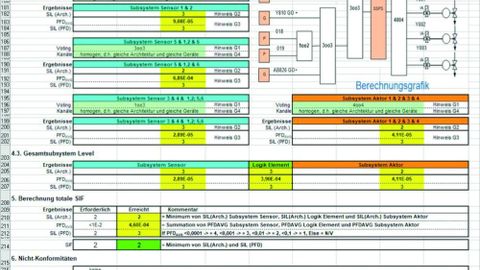
Safety verification according to IEC 61511 of a complex 'Safety Instrumented Function' (SIF) in the process industry.
© SiemensAll standard formulas - including the specification of IEC 61511 for German-speaking countries, the VDI/VDE guideline 2180 "Safeguarding of process engineering systems using process control technology" (PCT) - are stored in this tool, as are the device-specific values such as PFD or failure rates of Siemens safety-related systems, such as controllers, peripheral devices or process instruments. Any additional project or customer-specific products required can be easily entered into the tool. The block diagrams of the SIL circuits - called Safety Instrumented Function (SIF) in the standards - are created and integrated using 'Microsoft Visio'. The tool calculates the SIL for each SIF taking into account the applicable standards and allows the selection of different architectures for each of the subsystems of the SIF, for example 1oo1, 1oo2, 2oo2, 2oo3 et cetera. It is also possible to calculate complex configurations containing different architectures.
The tool generates test reports that are accepted by authorities such as TÜV Süd or TÜV Rheinland. The logic diagrams of the SIS architecture can be included in the test reports. Siemens takes over the basic maintenance of the tool and also uses it itself for engineering tasks or safety consulting services. System integrators who have qualified as part of the Siemens Solution Partner Program or as a Siemens Functional Safety Professional (SFSP) are provided with the tool free of charge. These Solution Partners can then use the calculation tool for customer projects and supplement it with the required device data.
Comprehensive functional expansion
One of these Solution Partners is Kiel Engineering, a company of Kiel Industrial Services. Kiel Engineering has been a certified Siemens Solution Partner since 2001 and a Siemens Safety Specialist for the process industry since 2008. The Oberhausen-based company specializes in plant and power plant planning, electrical and instrumentation and control planning, automation and process control technology. For EI&C engineering, the employees use a Microsoft Office add-on developed in-house, which stores all device data and measuring points in an Access database and guides them step by step through the calculation of the verifications. The application uses the Excel tool from Siemens and extends the range of functions to include the generation of Ex i certificates. When the user creates new SIL circuits, all details are logged to ensure complete traceability.
System-specific typicals, i.e. device type-typical architectures of the SIL circuits, can be created manually or added by importing existing lists or databases. The user has access to the individual PCT points via the system structure mapped in the database. Each SIL circuit is connected to all available data via a sensor measuring point. The calculation of the SIL certificates and the document structure of the generated report file are based on the Excel tool created by Siemens. Thanks to the Typicals functionality and the connection to the Access database, Kiel Engineering was able to significantly expand the tool in terms of functionality and user-friendliness.
Lean cost structure
The calculation and management of Ex-i and SIL certificates in a tool that only requires Microsoft Office components and an Adobe Acrobat Reader is convenient for users and reduces costs; after all, Office packages are standard equipment for engineering workstations. The system is based on the so-called top-down-buttom-up approach, i.e. the principle of 'operational proof'. This means that the statistical evaluations of the fault data, including the accompanying documentation of a large number of installed SIL circuits from databases, can be used directly by plant operators.

The list of devices stored in the system now includes over 1500 sensors and actuators as well as over 500 typicals. With the help of these specifications and the reuse of device data once entered, input errors are avoided when calculating verifications, and the calculation is largely automated. This significantly reduces the workload for users when creating and documenting standard-compliant verifications for operational and plant safety.


You might also be interested in
Sensorless speed monitoring simplified
With the Safeone DN3PD2 speed monitor, Dina Elektronik simplifies sensorless speed monitoring. According to the manufacturer, installation and maintenance are simple.
 read more...
Connecting Siemens controllers with IoT applications
With version v1.20 of the edgeConnector Siemens from Softing Industrial, Siemens controllers can be connected to industrial IoT applications.
read more...Drive system for conveyor applications
Sinamics G115D is a compact drive system specially designed for horizontal conveyor applications, comprising motor, frequency inverter and gearbox in a single unit and is available in two versions - wall-mounted or motor-mounted.
read more...Siemens as official partner of SPS Connect
The program for SPS Connect from 24 to 26 November has been announced. Mesago Messe Frankfurt is also presenting Siemens as an official partner.
read more...The reality of Industrial 5G
5G has developed into hype. However, with 5G, many of the promised functions are either not yet available or the assumptions about possible applications are based on unrealistic conditions. The status quo.
read more...Siemens and UL Solutions digitize certification process
For the first time, an industrial product was certified for the USA after some of the required tests were digitally simulated and the results confirmed by physical tests. This was made possible with the help of the digital twin.
read more...Strong finish to the 2023 financial year
According to Siemens, revenue and order intake increased by 10% and 6% respectively on a comparable basis in the fourth quarter of 2023. In the Industrial Business, Siemens recorded its highest earnings and profitability figures ever.
read more...Security test suite for industrial networks
Siemens has expanded its industrial cybersecurity portfolio by launching an all-in-one security test suite for industrial communication networks.
read more...Innomotics launches as a Siemens subsidiary
Siemens is bundling its range of motor and large drive systems under the name Innomotics. The company was launched in Germany on July 1, 2023 as a wholly owned Siemens subsidiary.
read more...