
Assembly
Robots for demanding processes too
To date, the degree of automation in assembly has been relatively low. The potential to carry out the tasks at hand with the support of robots is therefore correspondingly high.
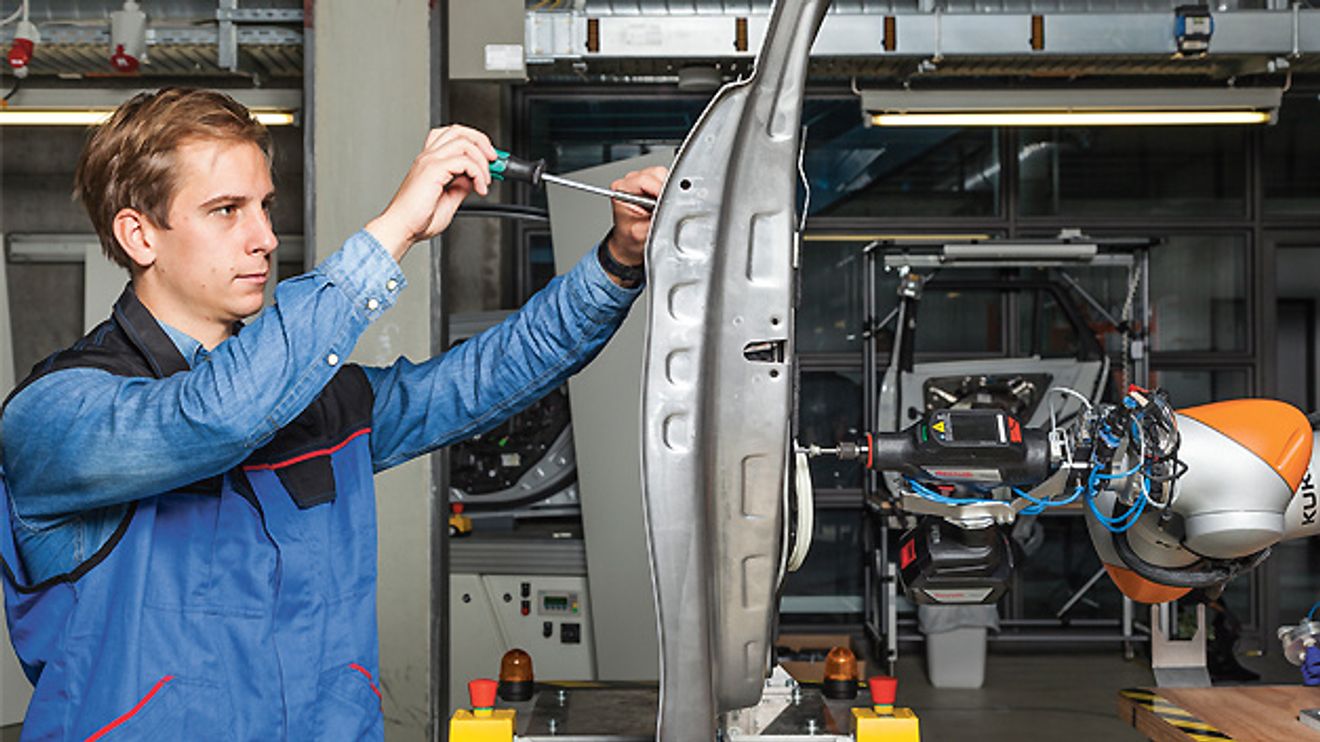
Automation with industrial robots has been on the rise for years, as the annual growth figures from the International Federation of Robotics (IFR) show. In 2015, around 15% more industrial robots were sold than in the previous year. The sales value also increased by 9%, reaching a total of 11.1 billion US dollars worldwide. However, assembly has not been the main driver here so far, as only one in ten of the industrial robots sold is currently used for joining processes, albeit with an upward trend. This is due to the dynamic and diverse challenges of assembly processes, such as small batch sizes, many product variants and short cycle times. In addition, assembly processes are often complex in that the connection between the motion sequence and contact force must be precisely coordinated or access points for plug-in connections, for example, are difficult to reach. If cables or other objects also have to be fed or threaded, this further increases the susceptibility of a process to errors.
With the appropriate expert knowledge, however, even such demanding assembly tasks can be automated. This is demonstrated by various developments and solutions that are currently being created at Fraunhofer IPA for assembly processes with robotics. If processes are suitable for partial automation, it will increasingly be a matter of efficiently distributing the tasks between humans and robots - keyword: human-robot cooperation (HRC). In addition, the focus must always be on the safety aspect. A tool is currently being developed for this in order to be able to carry out risk analysis in a partially automated manner. In any case, increasing networking in the context of Industry 4.0 architectures will mean that assembly processes will have to become increasingly adaptable.

Software for force-controlled assembly processes
Currently, only around one in five robot systems is equipped with a sensor-based solution for path guidance. The Pitasc software demonstrates the benefits this can bring for complex assembly processes such as 'clipping' and 'latching'. It provides a large number of ready-to-use program modules for typical process steps, including 'following a target', 'holding a position' or 'applying a force'. System integrators can put these modules together individually when setting up a robot system and use them directly.

Constraint-based programming is used for this software. The basic idea is that the robot system is no longer given the path in advance, but the algorithm calculates it itself at runtime based on target variables and boundary conditions. For this purpose, the process, workpiece and process parameters, such as the ideal dimensions of the workpiece or the robot forces required for assembly, are initially modeled intuitively in general form and independently of the robot type. The assembly task is then available - similar to a typical work plan for manual assembly - as a sequence of program modules. By assigning variant-specific values and using current sensor data, such as contact forces, distances or object recognition, the system calculates how it must move in a controlled manner according to its kinematics and executes the process modules.
This means that once the task has been modeled, it can be transferred to new workpiece variants or other systems: The conditions to be fulfilled remain the same and the system adapts the assembly process using updated parameters. The new technology offers the advantage that the individual program modules can be reused. In addition, basic modules such as the specification of a speed can be composed as required and combined into task-specific groups, sequences or hierarchies. It is also possible to add fulfillment or termination criteria so that, for example, a movement is executed until a contact force occurs.
Create robot programs intuitively
Another trend in assembly is the simpler creation of robot programs. The drag&bot software was developed with this in mind. It enables a new, intuitive form of robot programming. In a graphical user interface, users can define the program sequence by selecting and assembling individual modules that hide the complexity of the program from the user.

The simpler creation of robot programs using intuitive software solutions is a decisive criterion, particularly for medium-sized companies that produce customer-specific products in smaller batch sizes.
© Fraunhofer IPA / Rainer BezThe software offers so-called wizards as operating and input aids that support the user in parameterizing the program. For example, the user sees possible screw holes in a picture taken by the camera. By clicking on the desired hole, the user selects the position to be screwed.
Currently, drag&bot can be used as a simple programming interface for the flexible use of robots. The modules can be used and reused for robots from a wide range of manufacturers. In the future, the software and access to an online store with the wizards or function blocks will be available to system integrators and end users via a license.
The VisualCue solution, which also aims to simplify robot programming, is also based on image processing. With previous methods, the programmer has to determine the individual positions that the robot is to move to using a world coordinate system. To do this, he must repeatedly transfer the spatial arrangement of the robot and workpiece to the world coordinate system. Instead, VisualCue provides an image that shows the programmer exactly what the robot 'sees'. The software's graphical user interface also displays the workpiece to be processed and the programmer can use the mouse to select points or edges for processing.
Systematic planning of HRC workstations
Everyone is now talking about HRC and the ever-increasing range of available lightweight robots is generally well suited to this. However, standard-compliant safety measures are a prerequisite for commissioning the system and may affect its performance characteristics - such as investment costs and the robot's cycle time - and therefore the profitability of the system. It is therefore essential to assess the relevant potential hazards with the necessary expertise at the planning stage and to consider the costs and effects of possible safety precautions.
In particular, the increasing demand for networking and adaptability in production has an impact on the security measures of an application. This is because if it is reconfigured, the safety-related acceptance generally loses its validity and would therefore have to be carried out again. This leads to additional costs and longer commissioning times. To improve this, tools for simple safety configuration and programming, dynamic control and safety structures as well as automated safety analysis and evaluation methods are becoming increasingly relevant.
One example of such a tool was developed as part of the EU project LIAA (Lean Intelligent Assembly Automation), which Fraunhofer IPA is using for efficient safety consulting in companies. With the help of an underlying library of hardware components and potential hazards, it enables a model-based hazard analysis. The more information is stored in the library, the more precisely the potential hazard of an HRC application can be determined. An ontological extension of the analysis makes it possible, for example, to identify hazards that only arise due to a certain arrangement of resources. The aim of the analysis is also to document all safety decisions made.
Among other things, the aforementioned tool was the basis for the development of an HRC workstation for riveting applications. The experts designed two application scenarios: In the first, the lightweight robot moves the riveting tool; in the second, it is fixed and the robot moves the parts to be riveted. If the robot moves the tool, the costs are slightly higher due to the necessary automatic tool, additional sensors for fine localization of the rivet holes and a robot with a higher payload. On the other hand, the cycle time is slightly longer. Compared to a statically mounted riveting tool, the application is more flexible in terms of possible arrangements of the rivet holes on the product. If, on the other hand, the robot moves the parts to be riveted, the costs are lower. However, the application is somewhat less flexible because, for example, the robot cannot position every rivet hole so that it can be riveted. Based on this system, users can ultimately decide which variant better meets their requirements.
In addition to the safety of HRC applications, an efficient division of labour between humans and robots based on the capability and availability of a resource in production is essential to ensure an optimized assembly process. To this end, the IPA experts are currently working on a methodology and numerical optimization processes for assembly planners that can be used to map each work step in an assembly sequence and provide information on its suitability for automation. One of the main objectives here is to require as few transfer points as possible, as these are particularly safety-critical.
Authors:
Ramez Awad is head of the Assembly Automation Group at Fraunhofer IPA;
Martin Naumann is Head of the Robot Programming and Control Group at Fraunhofer IPA.


You might also be interested in
Robotics Institute Germany co-founded
Fraunhofer IPA is a co-founder of the Robotics Institute Germany, which aims to bundle Germany's cutting-edge research into AI-based robotics.
 read more...
"Manufacturing-X data room preliminary study" presented
Manufacturing-X is seen as the next step on the road to Industry 4.0, but how could a data room be designed for the data ecosystem? A study presented by VDMA and ZVEI gets to the bottom of this question.
read more...How companies use data for product development
Where do companies stand when it comes to collecting data from products and using it to develop new products? Researchers from the Fraunhofer Institute for Manufacturing Engineering and Automation IPA have investigated this in a study.
read more...Fraunhofer project determines properties of coatings virtually
In the "PaintVisco" project, researchers at Fraunhofer IPA are modeling the development and processing of paints. The bat was the model for the development of a new simulation program that can be used to virtually determine the exact properties of...
read more...The digital value stream analysis
A research team from Fraunhofer IPA is digitizing value stream analysis together with the Stuttgart-based software provider Ifakt. This should enable this optimization method to be carried out in the future with significantly less effort and almost...
read more...The top articles in January 2022
Obstacles and opportunities characterize the top 10 most-read articles in January. Click through the obstacles in companies and find out what opportunities the year 2022 has in store.
read more...Intelligent sensor detects leaks
To simplify the search for leaks in compressed air systems, a researcher from Fraunhofer IPA is working with Sick to develop an additional leakage service for an intelligent flow sensor. Self-learning algorithms evaluate the measurement data.
read more...Improved safety for service robots
In the S³ research project, researchers from Fraunhofer IPA worked with project partners to develop safety technologies and recognition algorithms for service robots. They were tested on the Care-O-bot 4 service robot in a nursing home application.
read more...Improved safety for service robots
In the S³ research project, researchers at Fraunhofer IPA and their project partners have developed safety technologies and recognition algorithms for service robots. They were tested on the Care-O-bot 4 service robot in a nursing home application.
read more...