

Wago at the Hannover Messe
Automated assembly of switch cabinet components
The shortage of skilled workers and digitalization are also of concern to enclosure manufacturers. Dr. Michael Dörbaum, Head of PM Cabinet Components & Offerings, explains the background to Wago's vision for the future.
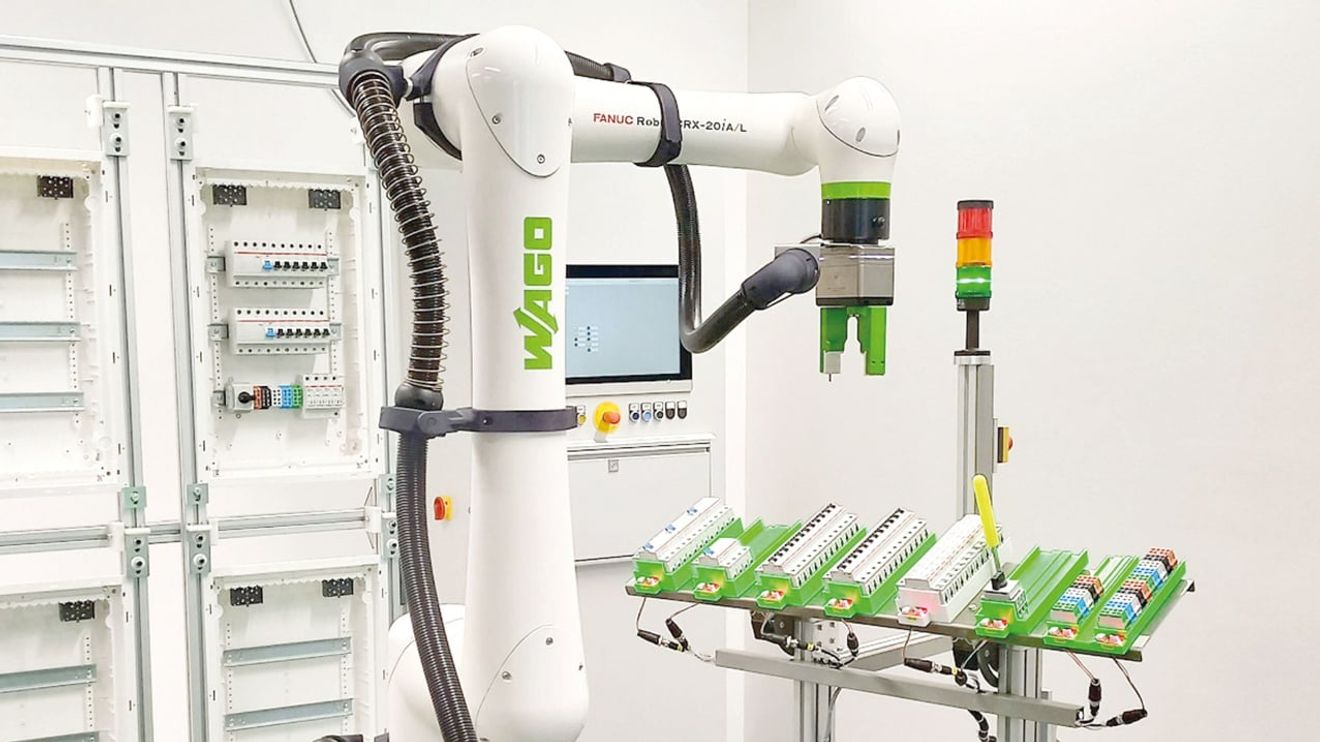
The 'Wago Cabinet Assembly Robot' (WCAR) is a cobot that enables simple integration without protective equipment in the existing workshop environment.
© WagoDr. Dörbaum, one of the demonstrators at the Hannover Messe is called the 'Wago Cabinet Assembly Robot' - what's behind it?
We are working intensively on the requirements of control cabinet manufacturers, and their major issues include the shortage of skilled workers and digitalization. With our 'Cabinet Offerings' - products and solutions for all work steps in the enclosure assembly process - we are already offering concrete solutions to alleviate the shortage of skilled workers and enable digitalization. Our 'Cabinet Assembly Robot' is a concrete vision of the future for the automated assembly of enclosure components: The WCAR flexibly and collaboratively assembles terminals from various manufacturers in our pilot application 'small building distribution boards'.
What are its special features?
Our WCAR is a so-called cobot - a robot that enables simple integration without protective equipment in the existing workshop environment. In addition, the WCAR is basically manufacturer-independent, which means that the relevant data must be provided and the products taught and tested. With this cobot, we increase process efficiency directly at the control cabinet instead of on the mounting rail. Additional assembly steps, which are necessary with similar commercially available solutions, are no longer necessary. We are also already showing the first milestones on the way to digital consistency.

Is it an in-house development by Wago or are partners involved?
Thanks to our complex manufacturing processes, we already have a lot of expertise - including in robotics. In the early development phase, we carried out initial research projects together with the Fraunhofer IPA. We then used the collected results to further develop the solution together with our partner Pro-F Automatisierung to its current state.
Who is the solution suitable for? What do users get out of it?
This solution is not yet available on the market, and we are not planning general availability for 2024. We will first set up individual systems at pilot customers with whom we work closely in order to gain further insights.
The initial focus is on building installation distributors. However, we are working on bringing the topic to other sectors and making the technology ready for industrial series production. Basically, the solution is of interest to every machine and plant manufacturer, because dealing with this topic helps them to check their own readiness for working with robots and to prepare for the future.
Hall 11, Stand C72


You might also be interested in
Administrative shells (AAS) for download
Wago now offers administration shells for more than 18,000 articles for download on its website - and thus supports an industry-neutral and manufacturer-independent standard that stores data in a standardized form.
 read more...
Strengthening cyber resilience
In view of the increasing damage caused by cyber attacks and EU directives such as the CRA, holistic cybersecurity is becoming indispensable. Dr. Christopher Tebbe, security expert, and Kilian Fröhlich, manager in OT security consulting, explain how...
read more...New member of the management board
On September 1, Dr. Sebastian Schatt will take over responsibility for the further development of the electrical connection technology division as a member of the Wago Group's management board.
read more...Partnership for OT security
Wago, a provider of electrical connection and automation technology, and Radiflow, a specialist in OT cyber security, are entering into a partnership and pooling their expertise. Together, they want to strengthen resilience against potential cyber...
read more...The e-paper of issue 05/2024
Strategies for the future are one of the topics covered in the current issue of Computer&Automation. Read about the reforms that associations are demanding from politicians, the opportunities offered by technologies such as ChatGPT and SPE and...
read more...Edge computers for complex applications
To enable complex applications with higher requirements, Wago is expanding its portfolio with two powerful edge computers with 16 Gbyte RAM and 32 Gbyte RAM.
read more...Group continues to grow in 2023
The Wago Group is growing for the third year in a row and will achieve sales of EUR 1.37 billion in 2023. This means that the manufacturer of electrical connection and automation technology has increased its turnover by 2.2% compared to the previous...
read more...These are your winners!
We put 96 products in twelve categories to your vote in December, and now the winners have been chosen! The trophies were presented at a 'Winner's Dinner' at the Seehaus in Munich. These are your "Products of the Year 2024"!
read more...Electromechanics - The winners
Simplicity and flexibility won over the readers of Computer&Automation in the 'Electromechanics' category.
read more...