

Sick
AGV and AMR - quo vadis?
Mobile platforms are more than just transportation solutions. As technology packages, they are also sources and suppliers of data for applications in digitalized process and asset management.

Mobile platforms such as Automated Guided Vehicles (AGVs) and Autonomous Mobile Robots (AMRs) are now the norm in production and intralogistics at many companies. Both technologies have established themselves for the automation of material transportation in industrial production, logistics and warehousing - and will become even more important in the future: according to the 'Trend Report Intralogistics and Plant Transportation 2021' by industrial logistics provider Inform, 76% of respondents from logistics and supply chain management believe that in-house transportation is highly or very highly relevant to the overall success of the company, as it is able to significantly reduce the logistics costs of internal merchandise management.
This importance is in line with the growth forecasts of various market research reports for the global AGV and AMR market, which predict a market potential worth billions by 2025. According to the consulting firm logistic iq, the market for AMRs alone is expected to grow to around 18 billion US dollars.
Increasing challenges
Productivity in use and safety for people and assets in the operating environment have always been the core requirements for AGVs and AMRs. With the advancing automation and digitalization of processes, both terms are being expanded to include new functional content. For example, depending on the application, productivity is also determined by how situationally and dynamically mobile platforms can react to changing requirements, environments and logistics processes.
The trend is moving away from rigid infrastructures and route layouts towards autonomous and decentralized route planning by the vehicles themselves. To achieve this, AGVs and AMRs must be able to localize themselves independently - for optimized navigation or navigation support and also to bring transparency to the material flow as well as the use and whereabouts of vehicles and transport goods.
In order to be able to use this data to control AGVs and AMRs and for digital fleet management, vehicles and vehicle fleets need to be able to integrate seamlessly into existing IT systems and be networked with machines and systems, as well as with each other. At the same time, technologies based on artificial intelligence will enable vehicles to take on increasingly complex tasks.
The safety requirements for AGVs and AMRs are also increasing. In order for mobile platforms to react and navigate flexibly, suitable safety systems are required that enable vehicles to recognize and avoid obstacles on the road and in space. In order to make vehicles more compact and enable cost-efficient series production, leaner safety architectures are also required that meet high safety requirements, including collaborative deployment scenarios. Characteristics of this include more compact drives with integrated safety concepts, fewer control components, less cabling and more decentralized intelligence and communication capability in the on-board safety control system.
Data treasures on board

Avoid collision hazards: With a 3D protective field, mobile platforms can also monitor obstacles in space in a safety-oriented manner.
© SickIn addition to their actual transportation functions, AGVs and AMRs are able to collect vast amounts of operating and environmental data during operation thanks to their sensors, control technology and software. Location, orientation, 2D environment points and 3D environment contours, loading, speed, condition of components and overall systems, load status, diagnosis of vehicle uptime and malfunctions - these are just a few examples of data that are relevant for the digitalization of intralogistics processes. There is also a trend towards connecting AGVs and AMRs to each other in secure networks - and also coupling different secure networks with each other in a security-oriented manner. Technologies such as radio data transmission or industrial WLAN networks are suitable for the required wireless data exchange.
More productivity through localization
Intelligent localization solutions create the conditions for mobile platforms to define routes autonomously, adapt routes if necessary and react to changes in the situation. The technologies used here include laser scanners, optical-magnetic guidance systems or grid localization and contour localization systems. The latter in particular are increasingly being used as they are able to precisely measure the distance and direction of any type of detected contours using the environment measurement data from 2D or 3D LiDAR sensors or from safety laser scanners on board the vehicles. Walls, gates, pillars or shelves in front of or around the vehicle provide a large number of static orientation points that enable precise localization. Changes in the environment, such as temporarily placing a pallet in front of a hall wall, have no influence on the reliability of the localization.
The latest solutions for environment detection are even able to use 3D measurement data to map the environment (Simultaneous Localization and Mapping, SLAM). This enables mobile platforms to independently explore a new environment and create a map of it, which can then be used for self-localization and navigation in productive operation.
Optimize uptime via app
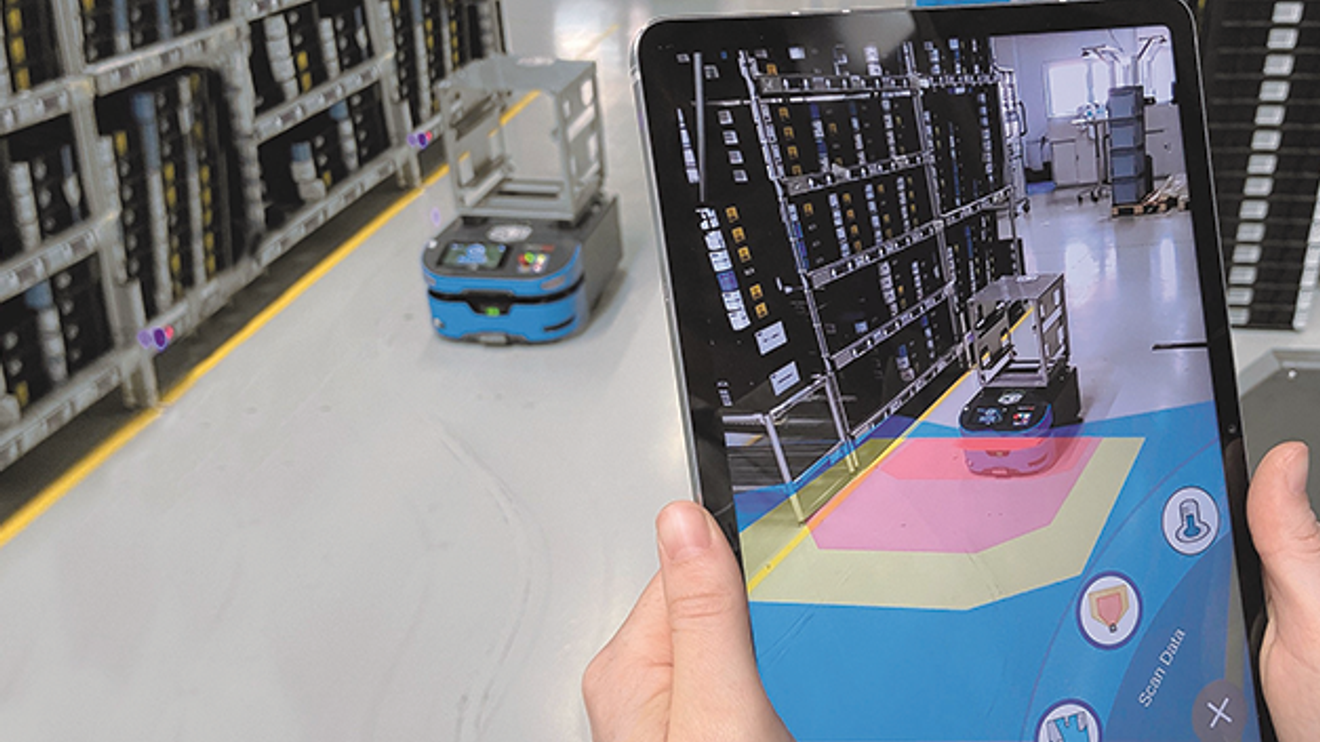
With the 'SARA' app, employees can use a smartphone or tablet to get to the bottom of faults directly on site using augmented reality.
© SickBut what happens if a vehicle stops or if the robot on a vehicle stops moving for inexplicable reasons? To minimize time, production downtime and money spent on root cause analysis and troubleshooting, operators of AGVs and AMRs are increasingly turning to augmented reality apps, such as the 'Sick Augmented Reality App (SARA)'. These apps make it possible to get to the bottom of the causes of faults directly on site using a smartphone or tablet. The app uses augmented reality to merge the sensor's view, for example the size and geometry of the protective fields of a safety laser scanner, with its real environment. The visual overlay of both levels makes the cause of the fault immediately visible on the mobile device. Shopfloor employees can immediately recognize on a smart graphical user interface when, where and how field violations occurred that led to a mobile platform being stopped. This means they can usually rectify these causes immediately without having to wait for specialist personnel.
Safety technology is becoming more versatile
In many intralogistics scenarios, people and mobile platforms share the same workspace. AGVs and AMRs must therefore be able to recognize and perceive their surroundings during the transport process. This prevents collisions with obstacles and people and ensures safe and reliable processes. Personal safety and collision avoidance are therefore top priorities when operating mobile platforms. This is where - in addition to the proven technology of 2D safety laser scanners - safety-certified 3D time-of-flight cameras come into play as a future-proof sensor concept for AGVs and AMRs. Their three-dimensional protective field enables mobile platforms to monitor obstacles in space in a safety-oriented manner. In this way, potential collision hazards can also be detected and localized above the 2D scanning surface of a safety laser scanner installed on the vehicle. Objects that protrude into such a 3D field - crane hooks, for example - are reliably detected. The same applies to side guarding during turning and turning maneuvers of AGVs and AMRs during loading and unloading processes. With the help of the sensor data, the approach or turning speed can first be reduced according to the distance to the obstacle before a safe stop is made to avoid a collision. Depending on the alignment of the 3D protective field, it is also possible to monitor areas below the scan field level of a safety laser scanner and thus protect AGVs and AMRs from tipping and falling hazards on stairs, ramps or floor edges.

The author: Dr. Christoph Reinke is Head of Business Unit Mobile Platforms at Sick in Waldkirch
© SickStreamlining the sensor and control technology safety architecture is another area of innovation for AGVs and AMRs. The aim here is to reduce the number of safety-related components required and thus also the wiring effort and possible failure risks. This means that lean safety concepts for mobile platforms offer a high level of ease of integration - especially as safe control technology is also developing in this direction. For example, modular safety control systems that are specially designed for mobile platforms collect data from all sensors on board the vehicles in a smart way. All signals from sensors and drives - safe and non-safe - are evaluated in the control system. Current safety controllers are also able to receive signals from differential wheel drives via two counter inputs for incremental encoders in the CPU and generate steering angle information from the speed data of the two wheels of the differential drive. This is an easily manageable option for programming and implementing safety solutions for this drive concept, which is a trend in AGVs and AMRs. The reason for this is that differential drives, which generate steering movements and directional changes of the vehicles through different speeds of the two centrally positioned drive wheels, currently account for more than half of the kinematics of mobile platforms. The trend is rising, as this drive configuration is very space-saving and makes the vehicles very maneuverable, not least because there is no need for a separate steering drive.
| Diverse types of mobile platforms |
|---|
|
The term 'mobile platforms' covers a range of different vehicle types. Based on AN-SI/RIA R 15.08, which is the first standard to classify mobile industrial robots into categories and define the corresponding safety requirements, there are the almost 'classic' Automated Guided Vehicles (AGV) - driverless transport vehicles that are often equipped with load handling devices, for example for transporting pallets or containers. The standard also specifies Industrial Mobile Robots (IMRs) as a second type of mobile platform, which in turn are divided into Autonomous Mobile Robots (AMRs) without a body, those with a specific load handling device and those with an integrated robot. This classification of autonomous mobile platforms also applies in principle to service robotics - although there are often significant differences in terms of features such as vehicle dimensions, chassis and drive concepts as well as payloads, superstructures and manipulators. |


You might also be interested in
Continental enters the AMR market
At Logimat, Continental announces the start of series production of AMR for external customers. The automotive supplier founded the Continental Mobile Robots division to distribute the robot solutions.
 read more...
AI for autonomous mobile robots
ABB is entering into a strategic partnership with Sevensense. The start-up will expand ABB's new portfolio of autonomous mobile robots (AMR) with artificial intelligence and 3D mapping technology.
read more...Regulation and safety slow down robotics projects in Germany
QNX has published the study "Inside the Robot: Architecture Benchmark Report". The results of the global survey of 1000 robotics developers show that software and safety requirements are increasingly becoming the central bottleneck for innovations...
read more...Dr. Olaf Munkelt becomes new Chairman
Dr. Olaf Munkelt, co-founder and Managing Director of MVTec Software, is the new Chairman of the VDMA Robotics + Automation Association. He succeeds Dr. Dietmar Ley, former CEO of Basler, who stepped down from the board for statutory reasons.
read more...Change in the VDMA Robotics + Automation Board
Dr. Michael Jürgens, CEO of Kuka Robotics, is a new member of the board of the VDMA Robotics + Automation Association.
read more...Application phase for Innovation Award 2026 begins
How can robotics help to make packaging more sustainable? Kuka is looking for creative and innovative ideas in the new round of the Innovation Award.
read more...International Federation of Robotics
10.7% more robots in the US car industry
The US automotive industry is investing more heavily in robotics and automation: the number of installations rose to a total of 13,700 units in 2024 - an increase of 10.7 %. This is according to preliminary results from the International Federation...
read more...'Roibot Award' goes to inclusion project
The Wittekindshofer Werkstätten are creating a disabled-friendly workplace with a low-cost robot. The foundation has now received the 'Roibot Award' from Igus for this creative inclusion project.
read more...Intralogistics Next Level
Logimat 2025 will occupy all ten halls of the Stuttgart exhibition grounds from March 11 to 13. Global players, medium-sized companies and start-ups will provide an overview of the current state of the art in the intralogistics sector.
read more...