

Machine operation
Intelligent assistance system using the example of a sawing machine
The performance and complexity of machines are constantly increasing. For Homag panel dividing technology, this was the reason to develop an intelligent assistance system with the aim of relieving the operator on the one hand and increasing process reliability on the other.

Homag Panel Sizing Technology manufactures panel sizing saws for the furniture industry and the carpentry trade. These saws are used to cut raw panels for further processing or as finished parts. The entire cutting process is semi-automated. This means that although all processes in the machine are fully automated, individual steps such as parts feeding and panel handling must be carried out manually on standard machines. In other words, the machine operator must feed the correct part to the machine in the correct sequence and in the prescribed orientation. This requires a high level of cognitive attention on the part of the operator. A wealth of experience is also an advantage.
Against this background and also in view of the increasing shortage of skilled workers, Homag has been thinking about how the operation of the machines can be improved or made more 'ergonomic', with the aim of making the processes more fluid on the one hand and minimizing errors and waiting times on the other. Added to this was the topic of Industry 4.0, which involves redirecting the logic in the value chain. This means that the machine no longer 'stubbornly' follows a plan, but in future the logic will come from the workpiece. In other words, the workpiece tells the machine what to do.
These considerations ultimately resulted in the development of a new operator assistance system - called IntelliGuide. Various additional electronic devices, such as LED light strips or a laser projector system as well as an AI-supported image processing system, give the machine - to put it bluntly - a certain intelligence that can automatically respond to and communicate with the operator - and not just via the control panel screen. While the saw has always dictated the production process and expected certain actions from the machine operator, the machine now 'recognizes' what is happening in the operator's handling area, reacts intelligently to the operator's actions and thus guides him through the machining process in the best possible way.
The three versions of IntelliGuide
In principle, IntelliGuide can be thought of as a navigation system for the machine operator - in three expansion stages:
IntelliGuide Basic
With IntelliGuide Basic, an LED strip is fitted along the cutting line. This LED strip visualizes the size of the workpiece and its actual/target position to the machine operator. The status of the workpiece and the required interaction are also displayed using colors and flashing pattern effects:
- The width of the LED light strip indicates to the operator the correct width of the part to be inserted.
- If the LEDs light up yellow, processing can or should start.
- If the LEDs light up blue after processing, the cut workpiece must be set aside for further processing.
- Green means: Part is ready.
- A running light signals: Please move the part in the appropriate direction.
- If the LEDs light up orange, the operator knows: This part is waste.
IntelliGuide Advanced
The next higher expansion stage (IntelliGuide Advanced) also includes a camera. This camera detects, identifies and tracks the workpieces in the handling area. The workpiece-specific position and rotation data is transferred to the machine control system in real time. The machine uses this data to react to the operating situation and, if possible, adapts to it.
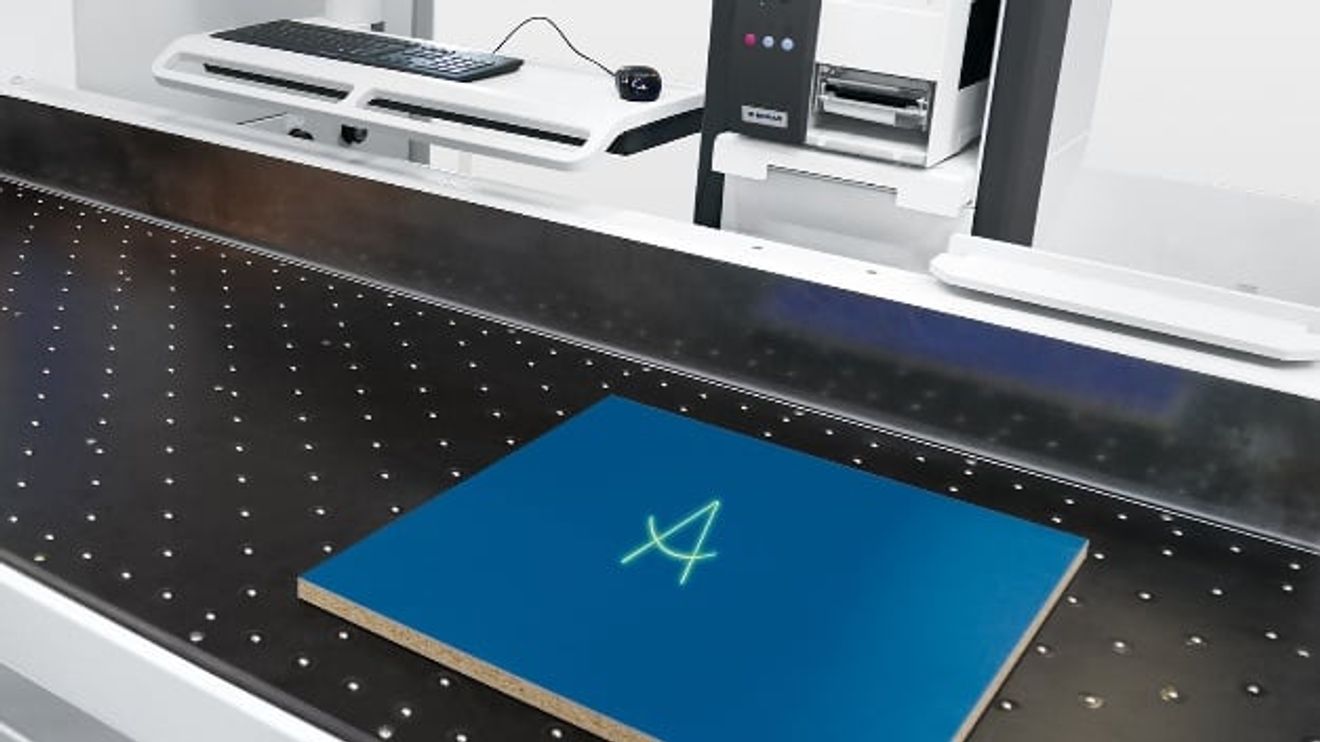
IntelliGuide projects self-explanatory pictograms into the machine operator's work area. The picture shows this: The marked part receives a mitre cut. The operator must feed it to the mitre cutting unit accordingly.
© HomagIf the machine operator inserts the wrong part, for example, the machine either does not start working (LED bar lights up red, machine stops) or - if this is feasible - the saw still starts cutting by simply retrieving the appropriate information and assigning it to the part. For example, the operator can swap the order of the strips when cross-cutting (by mistake or on purpose) - the saw reacts to this and cuts the dimensions belonging to the inserted strip. If the saw splits two strips simultaneously with the 'Power Concept', the operator does not have to pay attention to the order in which the pair is placed against the fence; the control system automatically adjusts to the selected order, provided the widths allow it. If the alignment of the inserted part is not correct, the saw will not cut until the operator has inserted the part correctly.

Multitasking: Even if two strips are cut to length at the same time, the LED light clearly indicates each work step for each strip and each part.
© HomagIn short, the assistance system reacts intelligently and interactively to the operator's actions from the 'Advanced' configuration level upwards. To make this possible, artificial intelligence and machine learning (ML) came into play at this point in the development of IntelliGuide, because: The enormous variance in different decors, colors as well as workpiece dimensions and their combination with different environmental influences would have pushed classic image recognition and evaluation to its limits during development. Firstly, because it is impossible to record and maintain all material data, and secondly, because influencing factors such as hand movements, soiling, labels, foreign objects or even concealment of the parts to be processed make it difficult to define what constitutes a 'workpiece' using conventional programming.
To enable the machine to teach itself what a workpiece is, the Homag engineers used an open-source AI, which they adapted to their needs, as the basis for their programming. To understand artificial intelligence, an analogy can be drawn with humans: In our childhood, we were taught over a long period of time and with many case studies to recognize, identify and classify objects based on unique features. We also learned to assign these objects spatially. This is exactly what we now need to do with AI. In principle, artificial intelligence is an imitation of human thinking: simple algorithms are used to simulate intelligent behavior. The major advantage of this is that the use of ever-increasing computing power and the generation of artificial training data means that this process can be significantly accelerated compared to human learning.
IntelliGuide Professional
The third and highest expansion stage is IntelliGuide Professional. Here, the image analysis is additionally expanded to include a laser projection system: The camera already included in the 'Advanced' expansion stage first provides the images of the machine table, which IntelliGuide then evaluates. This means that the saw always knows where and how the operator is inserting a workpiece. The additional laser projection system then displays self-explanatory pictograms with clear instructions for the operator directly on the workpiece: For example, directional arrows indicating where to move the part or how to turn it if necessary.
Finally, after cutting, laser icons appear with instructions on where to take each part: to the waste garbage can, to a specific stack, to the manual remnants store or whether it needs to be recut.
What happens next?

If storage locations are predefined, numbers appear on the finished workpieces. The operator simply stacks the part on the corresponding pallet.
© HomagWith IntelliGuide, the saw specialists ventured into the field of machine learning for the first time. They took the first steps with an interdisciplinary team. The aim was to quickly go into practice in order to gain important experience. The group also sought external help from AI experts, which proved to be very helpful, especially in the early days.
Machine learning is now one of many tools at Homag that the developers use as a matter of course when required. In addition to pure parts handling, other tasks that need to be performed on the saw will come into focus in the future - including maintenance, tool changes, parameter settings for materials and much more.
The overriding aim is always to simplify the interaction between man and machine to such an extent that the operator is guided through the cutting process in a pleasant, intelligent and efficient manner.
Author: Manuel Friebolin is the developer and project manager of IntelliGuide at Homag.


You might also be interested in
SPS Connect 26.11. - 15:10 - 15:30
DC-Industry@HOMAG
The session presents the Homag company and its contribution to the "DC Industry" project.
 read more...
Project 'DC Industry' - Part 4
From research to application
Part 4 of the series of articles on the 'DC industry' project deals with the question: What needs to be done to transfer the topic of DC grids from research to industrial application?
read more...Project 'DC Industry' - Part 1
DC instead of AC in the production grid
Research and industry are working hard to redesign the power supply for industrial systems via a smart, open DC grid. The article describes the challenges of the 'DC Industry' project and the system specification developed so far.
read more...IUNO research project - Part 4
Security aspects in customized production
The fourth and final part of our series of articles on the IUNO research project deals with the question: How can the issue of security be reconciled with the requirements of batch size 1 production?
read more...Hans Seifert to Become Chief Sales Officer
Sigmatek has appointed Hans Seifert as Chief Sales Officer (CSO). His area of responsibility includes international sales, marketing, application engineering, and support.
read more...High Performance for the Industry of Tomorrow
With the Sinamics S220, Siemens sets new standards in performance and safety. The new multi-axis control unit CU320-3 significantly increases computing power and response speed. As part of the Siemens Xcelerator portfolio, the drive system supports...
read more...For Multi-Monitor-optimized Production Processes
R. Stahl offers two methods when companies need a solution with multiple screens: Dual Monitor or Shared Keyboard.
read more...Safe Wireless HMI for Profinet/Profisafe
The 'KeTop T150/T155 Safe Wireless' mobile handheld control units from Keba are suitable for mobile machine and robot operation.
read more...Remote front ends for Modbus
For use on Modbus systems, Display Visions offers displays from the 'EA HMI' series in four sizes from 2.8 to 10 inches.
read more...