

Symate
AI-based quality assurance at DLR
Symate, a provider in the field of optimizing manufacturing processes using artificial intelligence methods, is developing an AI-based soft sensor for the German Aerospace Center.
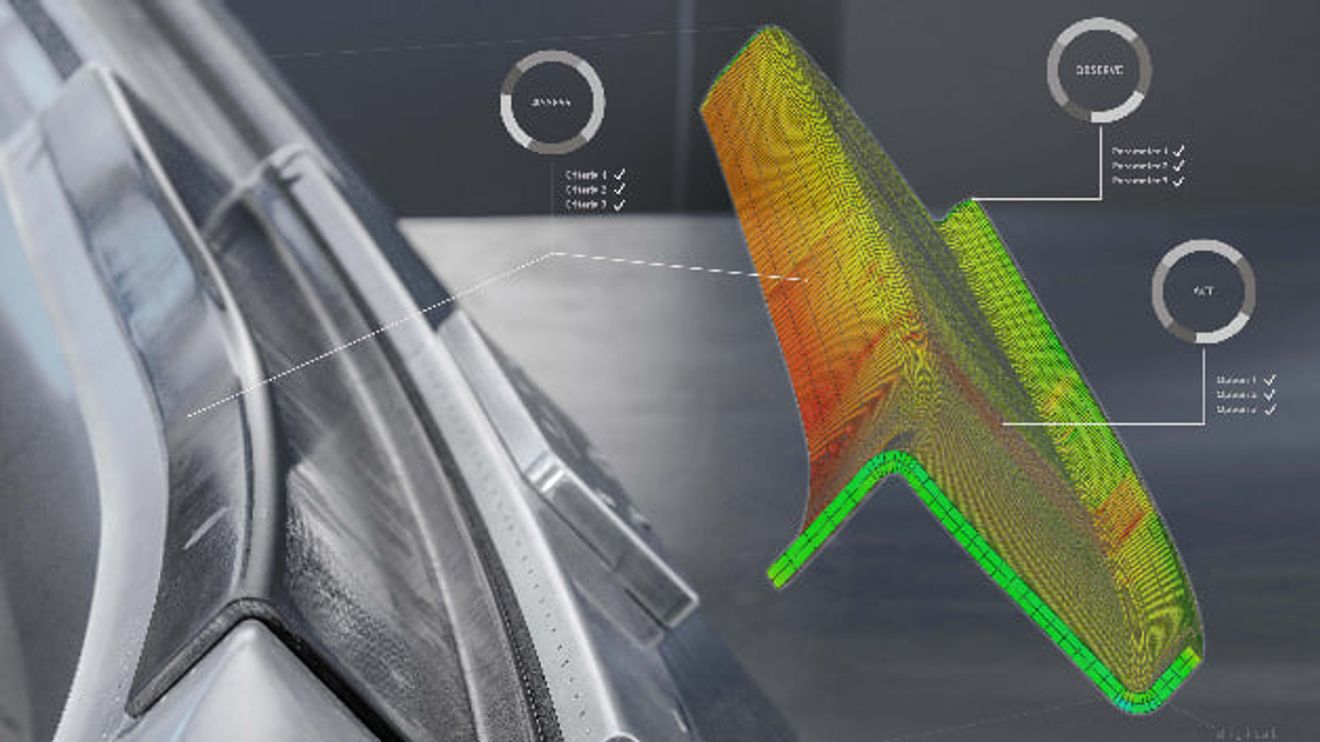
With the help of the soft sensor, DLR is researching lightweight multi-material construction under near-industrial conditions. The focus is on the development of an automated fiber placement (AFP) process for the production of large-area, high-integrity multi-material lightweight components. AFP is used, for example, to produce the nose and cockpit area of Boeing's Dreamliner 787, as well as the wing and fuselage structures of the Airbus A350.
The soft sensor solution works with data from the quality assurance of fiber composite lay-up processes and simplifies the decision-making process with regard to repair and rework in the manufacture of aircraft structures. DLR will connect the soft sensor to the existing Manufacturing Execution System of the so-called GroFi facility at the Stade site. Here, the soft sensor will support the quality assurance process.
In the AFP process, special laminate tapes just a few millimetres wide (known as 'tows') are placed 'side by side' and 'on top of each other' layer by layer by robots and then pressed and cured in an autoclave. The final component geometry is created during these process steps. However, the AFP process has one critical point: due to the individual shape of the components, the individual tows cannot always be positioned exactly. If necessary, for example, an arc-shaped arrangement is also required. This inevitably results in gaps, overlaps or twists. These and other possible deviations have a decisive influence on the quality of the components and can have dramatic consequences, especially in aircraft construction. Production processes in the AFP method must therefore be monitored very closely and deviations corrected at great expense.
Falk Heinecke, part of a research group in the field of automated fiber placement, comments: "The AFP process offers unique possibilities in the production of large lightweight components. But deviations when laying the individual tows cannot be avoided. The high quality requirements in the aviation sector require precise testing, frequent manual inspection and, if necessary, reworking and correction of these deviations. In the production of a large fuselage segment, for example, the time required for inspection, repair and reworking of non-tolerable deviations can account for more than 30 percent of the total production time. This is precisely where our soft sensor comes in as an assistance system in the area of quality assurance. Our aim is to save costs by reducing machine downtime and simplifying the decision-making process with regard to repair and rework. [...] The Detact soft sensor that Symate is currently developing for us will be an additional source of information during our quality assurance process. The new soft sensor will compare our simulations with the data from actual production in real time. This will enable us to predict the quality of the components while the process is still running and intervene at an early stage."
The tasks of the soft sensor
With the soft sensor, which is based on the Detact AI system, DLR is implementing an intelligent assistance system in the quality assurance process. This system links data from simulations with in-process measurements. A large amount of information is analyzed fully automatically. Symate's AI specialists have already begun programming the soft sensor according to DLR's specifications so that it can be linked to the existing optical measurement system and the simulation data from the DLR database. As soon as all preparations have been completed, the sensor can be used as an online monitoring tool at the research facility and calculate the DLR-specific target values from the existing data in real time.
Dr. Martin Juhrisch, Managing Director of Symate, explains: "Thanks to its artificial intelligence, the Detact soft sensor will take DLR's quality and tolerance management to a new level and implement fully automated inline quality prediction. DLR will be able to make valid quality predictions during ongoing production and monitor the discarding processes in a predefined window. In doing so, the researchers will become increasingly familiar with the limits of realistic process windows and will be able to store tolerable deviations in the system."
Using the data obtained, the soft sensor will gradually build up its own AI model, which contains both internal and external influences on component quality.
"With the Detact soft sensor, we are implementing quality assurance in automated fibre placement along the lines of Industry 4.0, although the focus is still on humans as the decision-makers. We will initially use it to simplify the decision-making process with regard to repair and rework in the manufacture of aircraft structures. Similar solutions can easily be implemented for other industries at a later stage," concludes Falk Heinecke.


You might also be interested in
ChatGPT in the industry - Part 8
Evaluate and improve code structures
Are gpt-4o and Google Gemini also suitable for evaluating code quality and code structures? Or would developers be better off using traditional software tools? Questions that are worth a closer look.
 read more...
Test digital simulation live
On September 26 and 27, students at Amberg-Weiden University of Applied Sciences will be able to find out how computer simulation can be applied directly to research and development projects. CADFEM and Ansys invite you to the big live simulation...
read more...Sabine Scheunert is Chairwoman of the Eurocentral Management Board
Sabine Scheunert has been appointed Chairwoman of the Executive Board Eurocentral at Dassault Systèmes. She is actively involved in promoting more women in STEM and IT professions.
read more...The e-paper of issue 05/2024
Strategies for the future are one of the topics covered in the current issue of Computer&Automation. Read about the reforms that associations are demanding from politicians, the opportunities offered by technologies such as ChatGPT and SPE and...
read more...Rittal, Eplan, Cideon, German Edge Cloud
In partnership for more added value
At Hannover Messe, Rittal, Eplan, Cideon and German Edge Cloud demonstrated the opportunities that arise from combining software and hardware solutions across entire ecosystems. They wanted to show that more value creation can be achieved through...
read more...Working in partnership to create more added value
At Hannover Messe 2024, the four companies Rittal, Eplan, Cideon and German Edge Cloud will be demonstrating the opportunities that arise from combining software and hardware solutions - across entire ecosystems.
read more...AR app connects switch cabinet with digital twin
Eplan presents new functions of the "eView AR" app: By overlaying a real control cabinet with its digital twin, the virtual world is linked to the real world.
read more...Intelligent software systems for intralogistics
System developers are increasingly focusing on the integration of artificial intelligence. At Logimat 2024, they will be showcasing their new developments to demonstrate how AI algorithms can be used to further automate many processes and increase...
read more...Matheus Bulho becomes Senior VP Software & Control
On April 1, Matheus Bulho will take over the position of Senior Vice President Software & Control at Rockwell Automations.
read more...