
P3 Group
Store floor simply digitized
Data forms the backbone of modern production: it helps to optimize processes, increase efficiency and visualize production processes. However, this is only possible with transparency on the store floor. Creating this digitally does not have to be complicated.

Data from the store floor and the cross-plant supply chain form the basis for their transparency and robustness. Agile and well-founded decisions, which are necessary to maintain a company's competitiveness, require the information transmitted from networked systems to be of high quality and as close to real time as possible. These stringent requirements for the data itself are complemented by the need for solutions that are as immediately effective as possible.
Integration of plants and systems
The P3 Group has developed the 'P3 NeXonic Suite' based on its experience with this area of conflict at various companies in the automotive, mechanical engineering and food industries. This enables fast, lean and needs-based networking of systems and the establishment of digital store floor management.
The P3 NeXonic Suite uses a cloud-based back end for consolidation and a purely web-based front end to provide the information. The data pool in turn is fed from both human sources, in the sense of interaction with the workers themselves, and automatic sources, such as the plant control systems or interfaces to the company's existing systems.
The P3 IoT connector is used for direct access to the plant control system as a data source: the edge hardware records and selects the desired parameters of the machine control system and transmits the data to the cloud. The IoT connector can use the company's own network - for example LAN or encrypted WLAN - and it is also possible to combine several IoT connectors using a network switch. If integration into the company network is not desired or not possible due to the age of the machinery, for example, the IoT connector sends the system information via 4G or, if required, 5G mobile radio. The installation of the edge hardware can also be adapted to the conditions in production: If the production environment is characterized by high dust exposure and other environmental influences, the IoT connector can be placed on the machine as a self-sufficient unit protected in a case with protection class IP67. Alternatively, it can easily be mounted on the top-hat rail of the control cabinet.
The edge hardware is integrated into the system network via CAN bus or Profinet interfaces, for example. In older control systems, communication is implemented via I/O modules that tap switching signals directly. Regardless of the type of connection, the IoT connector always works without writing to the network, which prevents it from influencing the exchange of messages between the system components from the outset. Another degree of freedom in the design of the connection is the integration of additional sensors, which are connected directly to the IoT connector and thus enable parameters to be obtained via previously non-digitalized system components. This makes it possible to connect production machines that are not restricted by the type or manufacturer of the control system or other framework conditions of the individual store floor.
In addition to the IoT connector as a source of plant data, existing systems in the company can also be used. PPS and ERP are obvious examples, but interfaces to company-specific systems can also be designed.
Another large part of the data basis for the P3 NeXonic Suite comes from direct interaction with the worker on their digital end device. To make such entries on the purely web-based front end of the NeXonic Suite, the device only needs to have a browser. However, in order to make optimum use of all functions, the use of industry-compatible tablets is recommended. These have a sufficient screen size to allow the worker to operate them comfortably and also offer the option of photo documentation of component faults in quality gates, for example, using the integrated camera.

Cloud-based backend
The combined information from IoT connectors, inventory systems and input from the worker flows together in the cloud-based backend. The use of MQTT on the IoT connectors implemented in accordance with IEC 62443 keeps the resulting network load low. Furthermore, TSL/SSL encryption ensures the protection of transmitted data in both edge and other communication.
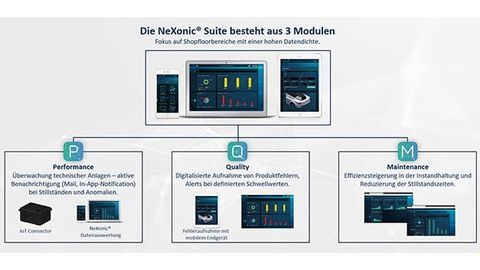
The modules of the P3 NeXonic Suite use the data collected to provide the user with information on production performance, quality and maintenance.
© P3 GroupThe data pool itself can be hosted individually or on-premise in a customer-specific cloud operated by P3, such as AWS or Microsoft Azure. Finally, the data flow flows into the front end, which presents the key figures and evaluations determined by the transferred information to the user. As already described, this is web-based and therefore independent of the hardware used. It can therefore be used as a dashboard on screens for the entire store floor or on individual end devices. In addition, the integrated role concept allows functions and types of dashboards and reports to be adapted to suit the task at hand. Furthermore, the worker can directly access the documents appropriate to their field of activity, for example for on-the-job training, via NeXonic. At the core of the P3 NeXonic Suite's functionality, however, are three modules that shed light on various aspects of production.
The modules of the digital store floor
These three modules of the NeXonic suite are Performance, Maintenance and Quality.
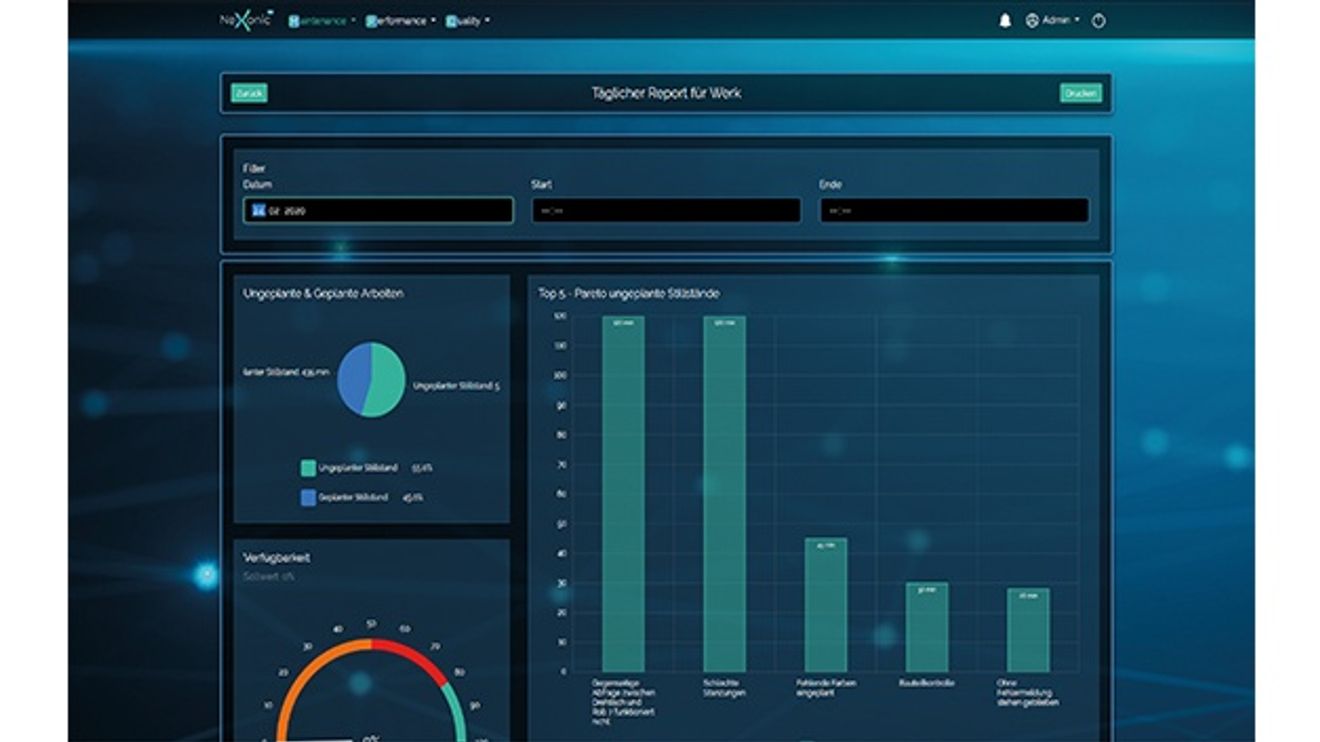
The dashboard of the P module provides transparent access to key values for production control and the current performance of the store floor.
© P3 GroupThe Performance or P module is used to directly monitor system performance, i.e. it uses the data communicated via the machine control system and sensors and actuators to determine key figures in real time, from classic OEE to customer-specific KPIs such as melting furnace fill levels. The aim of the P module is to make what is happening in production transparent and, based on this, to identify potential for improvement. To this end, users can access customizable dashboards and reports and thus see directly how the efficiency of their production varies across different shifts or whether there is an increase in production downtime with the same cause.

Using CAD models, the Q module clearly displays defect types and locations for quality managers.
© P3 GroupThe component faults that are documented by workers at the quality gates equipped with NeXonic are processed in the quality module, or Q module for short. The employees record defects, including the type and location of the defect, on their end device using a component model and photo documentation. Various tools for evaluation, such as Parteo analyses or heat maps and the ability to track components in production, allow the exact location and cause of faults to be narrowed down.
In the case of one supplier, for example, characteristic defect patterns on the edges of painted visible parts identified the application to the load carrier as critical. Furthermore, the images of the components recorded in the Q module could be used as photo documentation and thus as a safeguard against customer complaints.
The third module, Maintenance or M module, is geared towards the optimized elimination of machine faults. If a machine fault occurs, the operator can use it to forward it to the responsible colleagues in maintenance. The latter document the type and nature of the fault and its rectification on their digital end devices and thus maintain the company's own knowledge database. On the one hand, this serves to visualize downtimes and error histories. On the other hand, employees can fall back on this experience base if errors occur again and have a means of rectifying the error more quickly thanks to the documented procedure from the past.
In addition, an independent alert system is included in every module. This means that if an assembly machine is running low on sheet metal or certain types of error are increasingly being detected in the final inspection, the relevant responsible persons are informed via push or e-mail notification with predefined recommendations for action.
In addition to the functional scope of the modules, the aggregated data forms the ideal basis for sustainable process optimization and efficiency improvements alongside operational store floor management. To this end, NeXonic is installed in the specific process steps in order to precisely analyze their behavior. Corrective measures are defined and implemented in the process for the identified potential for improvement and supplemented by further steps such as training. In a real implementation project, for example, this approach was used to reduce the reject rate of an automotive supplier by 85% and improve capacity and cycle times by more than a third. The complete set-up of KPI dashboards took just two weeks.


You might also be interested in
Individuality with standard tools
iTAC offers MES and IIoT solutions for transparent, automated production processes and provides various services for networking, automating and analyzing manufacturing processes.
 read more...
All for One acquires stake in BrightFlare
All for One acquires a minority stake of 25.1% in the Austrian company BrightFlare. BrightFlare is a cybersecurity services provider for the protection of industrial plants and critical infrastructures.
read more...Belden cooperates with Chicago Quantum...
Networks for the quantum age
Belden, a provider of connectivity solutions, has announced a partnership with the Chicago Quantum Exchange (CQE), a center for quantum science and engineering. The aim is to prepare network infrastructures for the challenges of the quantum age.
read more...Call for the European Robotics Hackathon
Robots and drones rehearse an emergency at a nuclear power plant together. As part of the European Robotics Hackathon (EnRicH 2025), robotics experts from all over the world will meet near Vienna in early July at the Zwentendorf nuclear power plant,...
read more...Germany is top 3 target for ransomware attacks
A recent report by the Var Group sheds light on the cyber security situation in Europe. The so-called Y-Report shows a significant increase in security incidents; the manufacturing industry is particularly affected.
read more...4.5 billion euro fine in six years
The GDPR turns six. Spain, Italy and Germany are the frontrunners when it comes to breaches of the General Data Protection Regulation. The individual data protection authorities have identified 2072 infringements, resulting in fines amounting to 4.5...
read more...New management in DACH region
Trend Micro bundles its business in Germany, Austria and Switzerland: Hannes Steiner is the new Vice President DACH, Nicholas Pook takes over responsibility for channel sales in the region.
read more...AI and ML in focus at the European Data Protection Day
January 28, 2024 is European Data Protection Day. Reason enough to raise awareness of privacy and data protection and sensitize people to relevant IT security issues. Here is a commentary by Carla Roncato, Vice President of Identity, WatchGuard.
read more...Whitepaper on protection against ransomware
Check Point has published a new white paper and a brochure on the topic of "Protection against ransomware across all attack surfaces". It is clear that a multi-layered security approach is urgently needed. CISOs are now challenged.
read more...