
Data analysis
Processing plastics with structure
A seamless retrieval of process data: this is how Lenzing Plastics wants to maintain an overview of production. When implementing the 'GE Historian' data acquisition system, T&G Automation placed particular emphasis on high availability.

For over 40 years, Lenzing Plastics has been producing films, tapes and yarns, fabrics and laminates with high strengths - mostly made from polyolefins and fluoropolymers. In addition to a large number of standard products, specialty products are developed and manufactured. Due to the wide variety of niche products on offer, the Lenzing Plastics production plant must be able to act very flexibly. The constantly changing product portfolio and the correspondingly small individual batch sizes challenge production by constantly having to modify machine settings and production processes.
In addition, deliveries to customers all over the world have to be processed 'just in time'. The prerequisites for a smooth, efficient and adaptive production process are seamless recording and analysis of all process data.
"The goal of seamless retrieval of our process data has certainly been on our minds at Lenzing Plastics for around ten years. As we operate a very varied production in four-shift operation, the machine settings for the different products are constantly changing. It was therefore of great interest to us to be able to access reliable, seamlessly recorded process data in order to determine, for example, how we had made the machine settings for a particular production process or to be able to quickly identify any errors that may occur in the event of a complaint. In addition, we wanted to be able to document product development trials as elegantly and error-free as possible in order to find the optimum machine settings more quickly," explains Alexander Grafinger, Process Engineer at Lenzing Plastics, and continues: "The prerequisite for all these requirements was therefore essentially that we could generate our material numbers, which specify our products, as well as the piece and order numbers for production from SAP in order to link them with our process data."
Reinhard Schafleitner, in his capacity as Head of IT at Lenzing Plastics, adds: "Several years ago, we started to set up our own database to collect our process data - but this was not optimal in terms of its stability or reliability of data recording. In addition, we were unable to carry out a proper data evaluation - the database always crashed in all attempts. The resulting data gaps were then lost for ever and ever and were a massive hindrance to our machine settings in production planning. We then became aware of the GE Historian data acquisition system due to an application report in a trade journal." There were several reasons for using this system: Because GE Historian is optimized for recording large volumes of process data from a wide variety of data sources. It compresses data and at the same time offers fast read and write speeds up to real-time acquisition in the microsecond range. In addition, the software's special compression algorithms enable secure data storage for years - without active maintenance or back-up routines.
The connection

Various filter functions can provide a better overview and help to highlight certain operating situations.
© T & G AutomationThe decision was then made to implement the system: with the help of T&G Automation, the data acquisition system was installed and filled with all the historical data already available in the company.
S7A drivers/OPC servers were used for the communication connection of the controllers and various control systems, as these are one of the most powerful I/O drivers and OPC servers for the Siemens S7 product family and the Profibus DP/FMS protocol. The I/O drivers receive the data from the machine controllers and the control systems and pass it on to the GE Historian process data archive. The GE Historian analysis tool is then used to evaluate the data for a wide range of scenarios and make it available to authorized users via a web browser.
Redundancy creates availability
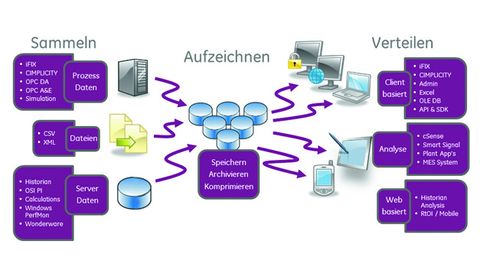
With the GE Historian software, all data can be collected, stored and then distributed to the various systems.
© T & G AutomationThe aim of the project was to be able to meet future availability requirements. GE Historian covers three areas for this purpose. Firstly, as with a relational database, clustering can be carried out in the data storage. Secondly, there is a further level of redundancy in the collector function - if there are business-critical data collection points, the collectors themselves can be configured redundantly. There is also protection against network and server interruptions: A special save and forward function buffers data in the event of an interruption at the collector. Once the server is back online, a new connection is automatically established and the buffers are uploaded. In this way, data loss can be ruled out.
Historian also allows higher data security standards to be enforced. Security parameters can be implemented at function group or tag level. Furthermore, almost all changes, including those relating to user access, configuration, security breaches and system alarms, can be tracked automatically. A copy of the original tag values is even saved if they are changed.
Overview thanks to drag & drop
"Our great hope of being able to use older process data to obtain machine parameters or measurement frequency values for currently changed production processes has already been fulfilled after a good six months," says Alexander Grafinger. For example, a wide variety of machine data can be recorded together and displayed as a group. In this way, the operator immediately receives all relevant measured values for the machine from the GE web server.

The model-based evaluation of a compressor in accordance with the ISA 95 standard using GE's analysis tool.
© T & G AutomationIndividual data or data packages can then be dragged and dropped into trend areas or placed on a trend chart. In addition, extensive design options enable the individual structure of visualizations. For example, a foreman can see whether all machines are running at full speed without interruption during his four shifts, or to what extent a breakdown or delay is justified.
All authorized persons can access these so-called analysis ports via a web browser and generate text/figure values or meaningful diagrams themselves according to their intentions. If, on the other hand, reports on individual machines are required for a meeting, these can be exported to a Word or Excel file - this way, the necessary documentation is also available in paper form.
If an employee is not at the plant, they can generate a connection to all data recordings via VPN using their home PC, tablet or smartphone. It is also possible, for example, to determine the cause of a fault remotely and suggest a remedial scenario. In this respect, the maintenance service could also benefit from GE's data archive.
Author: Martin Toth is a project manager at T&G Automation.


You might also be interested in
Hans Seifert to Become Chief Sales Officer
Sigmatek has appointed Hans Seifert as Chief Sales Officer (CSO). His area of responsibility includes international sales, marketing, application engineering, and support.
 read more...
Rethinking disaggregated infrastructure
Dell Technologies presents innovations for disaggregated data centers. They cover the areas of storage, cyber resilience, software and integrated partner systems. These infrastructures combine computing, storage and network resources in pools and...
read more...Autonomous AI shapes the future
The latest edition of "Accenture Technology Vision" predicts a new era of digitalization: AI systems are increasingly acting autonomously and thus transforming the reality of work in companies. The key success factor here is the trustworthiness of...
read more...Zebra Technologies at Vision 2024
Deep learning tools for image processing
Zebra will showcase end-to-end machine vision solutions with AI at Vision 2024. It will demonstrate how industrial manufacturers can equip their engineers, programmers and data scientists with flexible deep learning machine vision solutions - on...
read more...ChatGPT in the industry - Part 8
Evaluate and improve code structures
Are gpt-4o and Google Gemini also suitable for evaluating code quality and code structures? Or would developers be better off using traditional software tools? Questions that are worth a closer look.
read more...Software from the cloud conquers industry
Software from the cloud is becoming the standard in industrial companies. This is shown by the current study "Spotlight Future 2024" commissioned by PLM provider Aras.
read more...Test digital simulation live
On September 26 and 27, students at Amberg-Weiden University of Applied Sciences will be able to find out how computer simulation can be applied directly to research and development projects. CADFEM and Ansys invite you to the big live simulation...
read more...New Managing Director of Proalpha Switzerland
Stefan Inderbitzin took over the management of the Swiss branch of ERP software provider Proalpha on August 1, 2024. With his expertise in the technology sector, he will further strengthen the company's position on the Swiss market.
read more...New threat to industrial control systems
FrostyGoop is the name of a new malware variant that specializes in industrial control systems (ICS). It poses a threat to critical infrastructures worldwide. OT cyber security expert Dragos has identified FrostyGoop.
read more...