
Bavaria
Center for Artificial Intelligence opened
Fortiss' Bavarian AI center was opened in Munich on October 9. Among other things, the institute focuses on the manufacturing environment - as some interesting projects show.
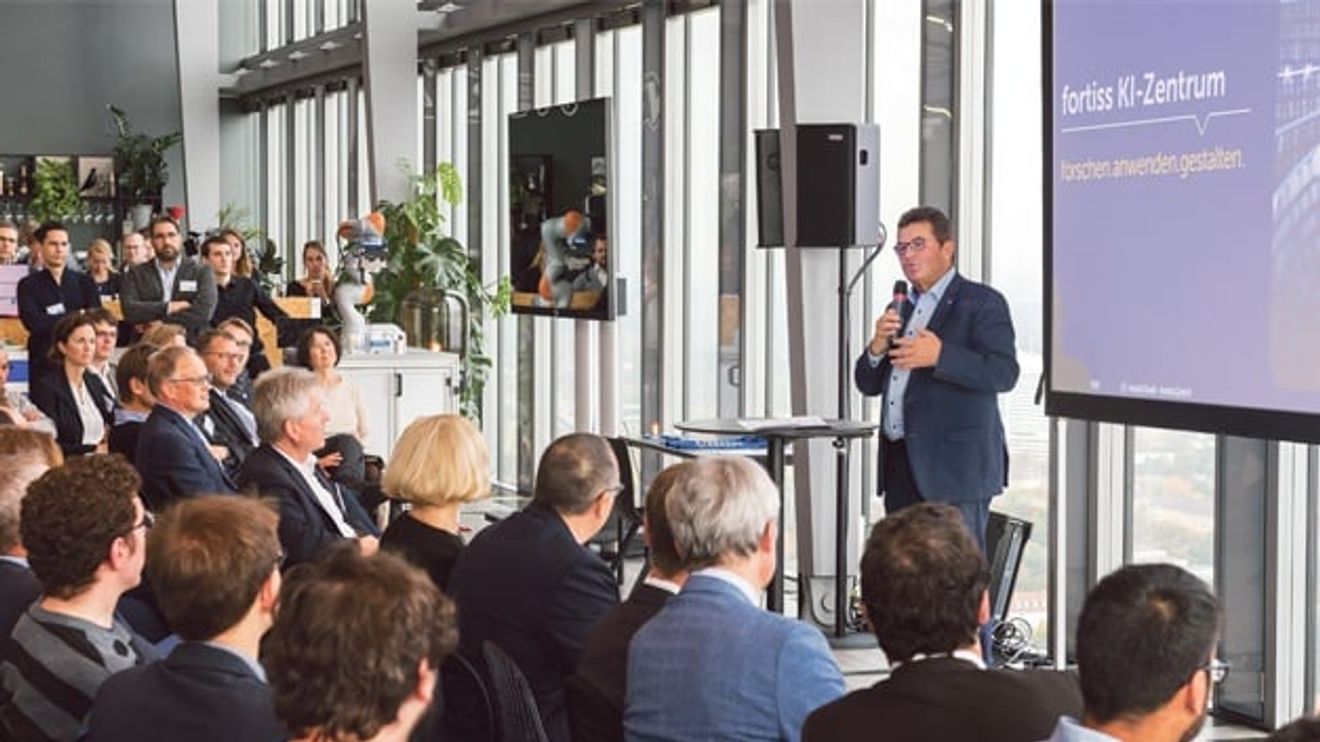
Up to 70 researchers and partners from industry and public administration will work together in the new Fortiss AI center in the 'Highlight Towers' in Munich-Schwabing. Fortiss is the research institute of the Free State of Bavaria for software-intensive systems and services. The focus of the new AI center is on researching reliable and secure AI methods and developing solutions that control and monitor business-critical processes and systems. This includes embedded decision-making and control systems such as software for autonomous, interacting vehicle fleets, service drones and air cabs, cloud-controlled production facilities, energy and supply infrastructures as well as new digital services for public administration.
Projects at a glance
The center is starting with two lead projects. In the lead project 'AI potentials', researchers support companies in finding ideas and work with them to develop the AI potential for products, business models and services. Companies can use the existing infrastructure and hardware to build initial prototypes. They also have the opportunity to take part in application-related training courses on selected AI technologies.
In addition, the computer scientists in the lead project 'Robust AI' are developing reliable, secure and self-learning software systems that make prompt, reliable decisions in uncertain environments or in unpredictable situations. In particular, these should meet the requirements of the EU General Data Protection Regulation when processing personal data and process the ever-increasing amounts of data in companies and organizations without compromising confidentiality and data protection.
Industrial focus
During the opening, interesting ongoing Fortiss projects relating to automation technology were also presented - such as 'SMErobotics', which aims to introduce industrial robots into the production facilities of SMEs. To achieve this, work is being carried out on the development of robot systems that support intuitive programming. In particular, this robot system should be able to work together with an averagely qualified worker. In one demonstrator, for example, it was sufficient to show CAD software which parts belong together and how, whereupon the robot program was automatically generated and a lightweight robot assembled the parts correctly.
In another project, Fortiss wants to counteract the increasing complexity of software in industrial automation. Eclipse4DIAC provides an environment for the development of new methods and tools that are intended to significantly reduce the workload for software developers and at the same time support them in creating control programs of a higher quality and evaluating them in an industry-oriented manner. The work is based on the IEC 61499 standard for distributed adaptive control systems.
It is also important for software development to correctly assess the quality of software code. The 'Center for Code Excellence' (CCE) provides support here with a corresponding contact point. The project aims to enable companies to develop outstanding, sustainable and future-oriented software.


You might also be interested in
Edge AI HPCs for Vision AI and GenAI
Advantech has announced the 'AIR-410' and 'AIR-420', next-generation compact Edge AI high performance computers (HPCs). Combining AMD Ryzen 7000/8000/9000 series processors, scalable GPU support and Advantech's 'Edge AI SDK' software, the systems...
 read more...
Siemens presents technologies to accelerate industrial AI
At CES, Siemens presented technologies to accelerate industrial AI: new digital twins, AI co-pilots, an Industrial AI Operating System and applications in manufacturing, energy and life sciences.
read more...Hitachi takes over Synvert
Hitachi Group has signed an agreement to acquire Synvert, a Germany-based company, as a wholly owned subsidiary of its US subsidiary GlobalLogic from Maxburg, a private equity fund focused on founder-led technology companies in the German-speaking...
read more...Proalpha takes over Insiders Technologies
The Proalpha Group, provider of business applications for SMEs, acquires Insiders Technologies and significantly expands its 'Industrial AI Platform' with AI applications and services for digital document processing.
read more...Industrial AI at SPS | Endress+Hauser
"AI will become a natural functional component"
Industrial AI is also becoming increasingly relevant in process automation: although field devices themselves still make little use of it, it is already proving helpful in evaluation and peripheral devices as well as control systems. Christian...
read more..."People always remain at the center"
Sick now considers artificial intelligence to be a central component of industrial applications. Phil Krumbein, Market Product Manager Logistic Solutions at Sick in Düsseldorf, reveals exactly where the company relies on AI.
read more...How AI and the cloud are challenging sustainability
The rapid rise of artificial intelligence is driving up the energy consumption of data centers and jeopardizing global sustainability goals. Schneider Electric presents six practical solutions to meet the new requirements.
read more...Critical Manufacturing takes over Convanit
Critical Manufacturing, a provider of Manufacturing Execution Systems (MES) solutions, has announced the acquisition of Convanit - an artificial intelligence company specializing in image-based analytics in high-tech manufacturing.
read more...Technical University of Munich
AI chip developed for decentralized use without the cloud
A new type of AI chip developed at the Technical University of Munich (TUM) works without the otherwise necessary connection to the internet or cloud servers. The 'AI Pro' chip is modeled on the human brain. Its neuromorphic architecture helps it to...
read more...