
Operate
Alexa, Cortana & Co on the machine
Are completely new control elements such as Alexa, Google, Siri and Cortana moving into the factory? This can only succeed if open IT platform solutions become established in factories.

An IT sector has established itself in German-speaking countries, which is described under the collective term Manufacturing Execution System (MES). The emergence of the MES market dates back to the 1990s, since when hundreds of providers have established themselves. The aim was and is to provide companies with the most seamless production data acquisition (PDA) possible, thus enabling faster and more efficient production.
The objectives are therefore very similar to those of modern IIoT (Industrial Internet of Things) solutions.
However, despite Industry 4.0 being propagated by politicians and associations in Germany since 2011 and the internationally established IIoT, the technological spread of the MES market has clearly remained limited to German-speaking countries.
With production data acquisition in a conventional MES, only the applications of the respective MES system house are available to the manufacturing company. In the IIoT age, however, manufacturing companies must continue to develop conventional MES infrastructures in order to remain fit for the future. And IT manufacturers are required to meet new demands for multidimensional flexibility and interoperability of their offerings.
Here is an industry parallel: it was not so long ago that we only used our cell phones to make phone calls or send text messages. Within a very short space of time, the internet-enabled smartphone replaced these one-dimensional phone handsets. Today, the smartphone market shows that there are no longer any providers who only grant their own apps access to the smartphone.
From IT silo to open smart factory platform
We are experiencing a disruptive development similar to the transition from cell phones to smartphones when it comes to factory IT: the age of the Industrial Internet of Things has dawned in the manufacturing industry. Similar to the cell phone market, providers of production-related IT solutions who continue to cling to the idea of conventional MES are likely to soon be overrun by the current developments in the age of Industry 4.0 and IIoT.
The definition of 'Industry 4.0', which is also very popular in this country, focuses on intelligent, digitally networked systems. Conversely, this means that only IT solutions that are able to combine many IT components into digitally networked overall architectures are fit for the future.
This requires technologies that are characterized by flexibility. Firstly, this means creating transparency through comprehensive connectivity, even with historically grown heterogeneous machine parks, and secondly, it means making it possible to integrate new IT modules and programs through open interfaces.
The consequence of this is that modern production data acquisition can no longer be based solely on the collection of data in closed IT systems from a single manufacturer. Instead, flexible, modular and fundamentally open solutions are required in order to exploit the diverse possibilities and opportunities of the networked digital age in manufacturing.
Openness, networking and flexibility

IIoT platforms have comprehensive connectivity and open interfaces for the flexible coupling of existing and new data acquisition systems and applications. IIoT platforms are therefore the further development of conventional monolithic MES structures into flexible and open factory IT architectures for a smart factory.
But which platform technology is the right one? An IIoT solution should combine three competencies on one platform. This 'holy' trinity of digital factory IT is: connectivity, productivity and flexibility.
Connectivity through plug-ins and adapters

Big data to smart data: Current and historical analyses - visualized in a user-friendly way on a dashboard - are an important aspect for the acceptance of a digital transformation.
© ForcamThe IIoT solution must offer multidirectional networking options: firstly, horizontal networking between machines (M2M) and between existing systems for production control (MES), secondly, vertical networking between production and planning, i.e. between store floor and top floor (ERP, enterprise resource planning) and thirdly, including the integration of third-party systems. Plug-ins for connecting heterogeneous machines must be available, as well as adapters for networking with different ERP systems. The important question for IT managers is therefore: How do I digitally connect completely different machines? In most factories, machines from different years and from different manufacturers are the rule. The solution lies in plug-ins, which should be pre-programmed for the most common machine types. For example, connecting three pilot machines using plug-ins should not take much longer than three days - including networking with the ERP level via an adapter.
The right 'key' for networking the systems is also required. To achieve this, the control center for machine communication - the IoT hub - should be able to offer as many open communication standards as possible. Specifically: both the OPC UA (Open Platform Communications United Architecture) standard propagated by associations in Germany and the international de facto standards MQTT (Message Queue Telemetry Transport) and MTConnect (especially for machine tools) should be available.
Productivity through real-time data and pre-installed MES apps
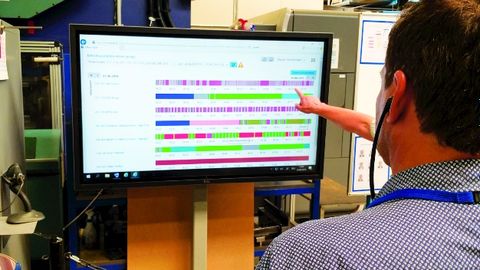
Precise information at all times: Info screen with reports on machine operating statuses in a factory hall - an important component of a standardized production data model, the 'single source of truth'.
© ForcamThe next step is to transform the huge volumes of data from the machines into usable information in real time - turning big data into smart data. This requires a high-performance computer solution for data modeling and data validation, the semantic layer. Such a generator for production data modelling must be programmable for each individual company so that it can create a digital real-time twin on the computer, which the workers can use to virtually analyze the operating conditions and optimize them in real terms - and continuously increase productivity.
High-performance rule data processing (rule engine) is required for this kind of real-time conversion of big data into smart data. A rule engine based on in-memory and CEP (complex event processing) technology, for example, provides the necessary high-performance capability. It is important for such IIoT rule frameworks to be semantically preconfigured, i.e. to be equipped with a comprehensively pre-conceived production meaning.
Companies also need an IIoT solution that does not require them to start from scratch and purchase or reconfigure the required apps from scratch. It is best if the IIoT platform comes with the most important MES solutions as standard. The most common MES applications include performance analysis, detailed planning and traceability.
Flexibility through open interfaces

The IIoT solution world as pursued by Forcam: Programmers can integrate existing IT systems and also third-party systems.
© ForcamBeing smart means being open: The latest criterion for a modern IIoT platform comes from a 'freedom movement' in the USA - the OPEN API Initiative. It has set itself the goal of promoting the free exchange of data between applications and applications from different manufacturers through open application programming interfaces (APIs).
A sub-movement is the 'Force Bridge Community'. Its aim is to establish an open industry standard for smart manufacturing. Industrial companies, software pioneers and universities have come together in this specialist community. The result is the first open interface for smart manufacturing - the Force Bridge API, now in its second version.
This interface gives companies great freedom: programmers can seamlessly integrate existing IT systems as well as third-party systems such as applications for tool data management, quality assurance or predictive maintenance.
Alexa, Cortana & Co.
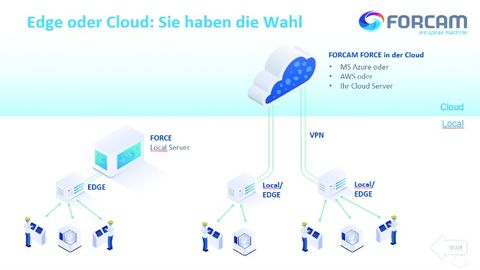
Edge or cloud: a flexible IIoT platform must enable the user to take both paths. The ultimate goal must be a solution that can be used without limits.
© ForcamThe future belongs to open interfaces: we are currently getting used to voice recognition systems and chatbots in our private lives. Alexa, Google, Siri, Cortana and co. - it is foreseeable that these systems will soon also determine many areas of everyday working life. The technological possibilities are now available for the manufacturing industry.
IIoT platforms with open interfaces for smart manufacturing make it possible to integrate any MES third-party application such as tool management or quality assurance. Alexa now also understands factory machines. With an open IIoT platform, this or other voice control systems can provide information about machine statuses on request.
However, it is usually still very loud in factories. This is why other AI systems are also interesting for integration on a factory IT platform, such as chatbot programs. In China, many factory workers already communicate via the local program Wechat, the equivalent of Whatsapp. Cortana works on almost all Microsoft-operated computers and can be integrated into an open IIoT platform.
It is very practical to integrate analyses and alerts into email programs. For example, production managers can integrate fixed info windows for production in programs such as Outlook, which they can use to query the status of production online or display reports directly. Alerts are then also sent by email - for example, in the event of downtimes or when defined process values are exceeded or not reached.
Open IIoT platforms also make it possible to configure your own factory apps for smartphones, tablets or smartwatches quickly and easily without any programming effort. Such an individual factory app informs its users in real time via push message about all important events, such as a defective part or machine downtime.
The topic of security
Openness initially sets alarm bells ringing for many users: How secure will my data be? The answer can only be: as secure as it already is today - depending on the security standards currently selected.
A truly flexible IIoT platform offers either an 'on premise' architecture or a cloud infrastructure. If the solution runs on premise, i.e. within a company's corporate network, then it is an IT application hosted by the company and is subject to the IT standards and restrictions of the company itself.
If the IIoT platform runs in a cloud infrastructure, access to it is secured either by a VPN tunnel (Virtual Private Network) or by a secure Internet protocol based on HTTPS (Hypertext Transfer Protocol Secure).
A solution via the public cloud meets the highest security requirements with the right cloud infrastructure provider. Take the Azure cloud, for example: Microsoft invests around one billion dollars a year in security alone. As a rule, individual companies cannot achieve this level of security with an on-premise solution. If this is not enough for companies, they can also order a private cloud, in which case they have their own separate server area within the cloud solution.
The fact remains: Manufacturing companies need powerful and limitless usable solutions for the third decade, with which they can optimize their productivity today and in the future. To achieve this, they should rely on a high-performance, prefabricated IT house for the factory, which they can easily convert and expand as required.


You might also be interested in
ODVA, OPC Foundation, PI and VDMA
Specification for interoperable energy management published
Precise energy consumption data is needed to achieve climate-neutral production. A consortium has now published a specification for interoperable and efficient energy management in industrial automation and process automation.
 read more...
Manage and secure assets
In today's fast-paced industrial environment, it is essential that production processes run smoothly and efficiently. However, one critical aspect that is often overlooked is the importance of PLC backup and restore procedures.
read more...OPC UA from the cloud to the sensor
OPC UA is also establishing itself as a standard for the exchange of process data between controllers. The next step is now to extend the concepts developed for the controller-to-controller use case for the controller-to-device and device-to-device...
read more...Update brings support for TIA V19
Delta Logic has updated the 'Accon OPC UA Server' software to version 1.4.0.0. The new features include support for TIA Portal projects of version V19 and for the latest firmware for CPUs of the Siemens S7-1200 and S7-1500 controllers.
read more...Automation meets innovation
SPS - Smart Production Solutions will take place in Nuremberg from November 12 to 14. Once again this year, organizers and exhibitors will pick up on the trends in the automation industry and present suitable solutions. The introduction of IT into...
read more...The e-paper of issue 9/2024
The hype surrounding AI is inspiring, but the reality requires a sober approach to the technology. Computer&Automation 9/24 looks at topics relating to AI & security, the EU AI Act, secure IIoT projects and OPC UA FX "From the cloud to the...
read more...The e-paper of issue 08/2024
How can data centers be cooled for AI? How successful is malware programmed with WormGPT? And how can virtualized control systems be integrated into production using TSN? Computer&Automation issue 08/2024 provides answers to these questions and...
read more...TSN in combination with EtherCAT
TSN is an important building block for convergent communication in flexible production. Mastering and integrating existing fieldbus technologies such as EtherCAT is an important part of the transition. An inventory of what is already possible.
read more...TSN - backbone for virtualized control systems?
It is currently a major vision: the virtualization of control systems. This and the next article in this series will address this topic. The decisive prerequisite and content of this article is the connectivity of the control system right down to...
read more...