

Weidmüller
Basis of an open IoT landscape
The boundaries between device classes in automation are becoming increasingly blurred. Provided that the operating system allows for the integration of hardware and software as well as cloud and on-premises solutions. The u-OS operating system from Weidmüller takes this approach.
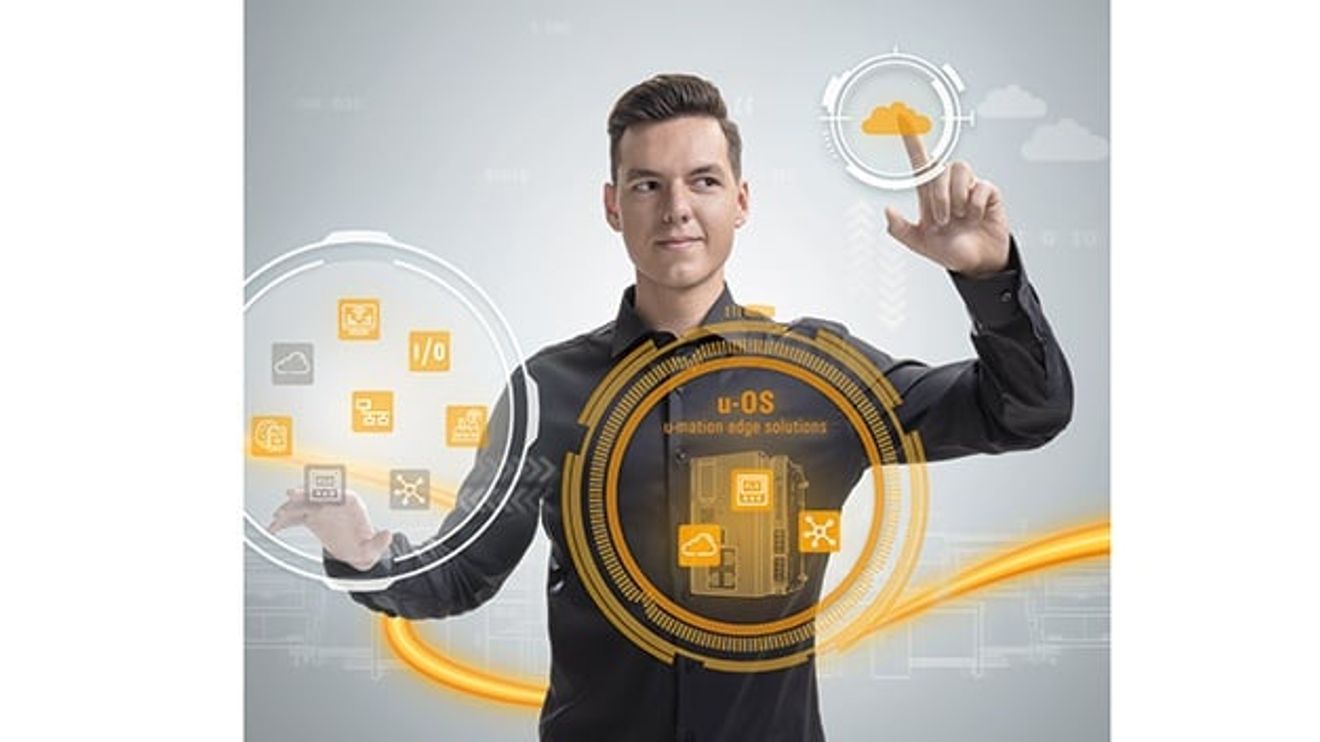
Weidmüller presented the new u-OS operating system at SPS 2022. It already enabled efficient data pre-processing and precise control directly on the machine at that time. The aim of u-OS is to give the user the greatest possible openness and maintain independence. The operating system is therefore based on open, established standards such as Linux and container technology. However, a system is only truly open and independent if it is not exclusively tailored to the company's own products, but is also open to third-party products. This applies to software as well as hardware and the supporting cloud systems. The new operating system will therefore integrate user-specific, Weidmüller or third-party applications - regardless of whether this involves hardware, software or the connection to a cloud or an on-premises system.
Any hardware
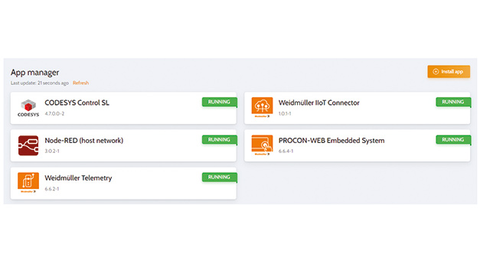
The App Manager provides an overview of all installed apps and offers the option of installing additional apps.
© WeidmüllerThe operating system was launched on the u-control 2000 controller and the IOT gateway from Weidmüller. Weidmüller gradually expanded the device landscape on which u-OS is pre-installed. The newly introduced modular control and edge systems u-control M3000 and M4000 already run with u-OS. It will also be extended to all Weidmüller Edge PCs in the future.
The basis of open standards, such as ARM SystemReady or Intel x86, makes it possible to optimize and adapt the operating system to the requirements of generic hardware. This also applies, for example, to the Raspberry Pi single-board computer. The computer, which enjoys a large fan base in the private sphere, is also frequently used in development and research. For private users, the operating system will be freely available as a Community Edition on the Weidmüller website. In future, this can be downloaded and installed on the Raspberry Pi. The ease of use of the software makes it possible to install applications from a wide range of users on the Raspberry Pi.
The compatibility of the operating system with generic hardware will enable machine builders to implement the multi-supplier strategy. The flexible core of the software will in future integrate hardware from a wide range of providers and thus run smoothly on various devices and device classes, enabling machine manufacturers to set up their own supply chains on a broad basis. This ensures delivery capability and saves costs.
Users who rely on OEM-specific hardware can rely on the support of Weidmüller's development team: The Developer Edition of the operating system represents a variant that machine builders can adapt to the system they use themselves. Support is available from the planning meeting through to installation on the system.
Any Software
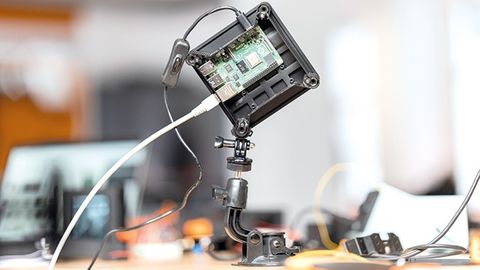
The u-OS operating system will be available for the Raspberry Pi, including the Community Edition for private users.
© WeidmüllerThe collaboration of proprietary systems with other providers is often complicated. Integration is difficult - and basically almost impossible. The u-OS operating system is not just another ecosystem, but rather a platform that connects a wide variety of ecosystems. This makes it possible for users to use a wide variety of runtime environments. Whether Codesys as the largest independent ecosystem for automation or the solutions of Weidmüller's partners, such as the low-code platform for industrial automation Cordis Suite. This creates real added value for the user: the apps work together without any major programming effort. This saves time and reduces costs. Installation is intuitive via the App Manager. There, the user selects the software to be installed, which is installed on the operating system with a click.
The Data Analytics use case from Weidmüller shows how this works: the AutoML automated machine learning tool converts generated data directly into intelligent analysis models. The data is also transferred to an HMI, the Procon web app, which in turn creates charts and graphics. At the same time, the HMI can also be used for control purposes. The basis for the seamless link between the applications is the u-OS Data Hub, which forms the basis for simple data exchange between the individual applications.
The use case described can be intuitively configured via the Data Hub without any IT knowledge. With the operating system, users are not limited to the applications offered in the App Manager. They can adapt their own applications to the u-OS Data Hub via API interfaces. This allows users to integrate their own software into the operating system. Thanks to the existing partner network, users can also access their solutions at any time.
Any Cloud
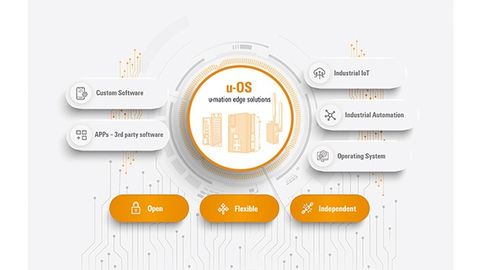
The Linux-based operating system: interface between customer-specific software, industrial IoT and automation technology.
© WeidmüllerAnother prerequisite for openness in the Industrial IoT is that various cloud environments, edge management environments or on-premises systems can also be integrated. With u-OS, users can keep their familiar systems; there is no need to switch. Partner solutions such as Microsoft Azure, Siemens Industrial Edge and Crosser as well as the user's own cloud solutions are easily integrated. This allows users to expand the functions of their cloud or on-premises system with applications at any time.
As the operating system is based on container technology and contains many options for integrating other software via APIs, this creates scope for users to connect their own on-premises system.
The operating system also integrates the easyConnect Industrial Service Platform. It bundles Weidmüller's digital services and provides support throughout the entire product life cycle - from planning and installation to machine operation. The user therefore has a choice: they can use the entire Weidmüller portfolio of software, hardware and cloud, or they can put together their own system that is precisely tailored to their own needs.


You might also be interested in
Dr. Lucian Dold in new position
Omron appoints Dr. Lucian Dold as Senior General Manager for Global Account Business Development.
 read more...
Portal for data exchange in mechanical...
VDMA and Innovalia develop data rooms
VDMA and Innovalia are jointly developing a data room portal for mechanical and plant engineering. It is intended to facilitate the secure exchange of data and accelerate the use of data-based applications in industry.
read more...German Innovation Awards for Schaeffler's Industrial Metaverse
Schaeffler has been awarded the German Innovation Award 2026. The prize was awarded for an industrial metaverse approach that links real production processes with digital simulations and enables AI-supported manufacturing.
read more...Industry 5.0: How FOM Industrie and Lenze are shaping the future of aluminum processing together
In a world where efficiency, sustainability and digitalization are shaping industrial development, FOM Industrie and Lenze are setting standards. Their partnership shows how technological excellence and shared visions can accelerate the evolution of...
read more...Dassault Systèmes takes over Ascon Qube technology
Dassault Systèmes is strengthening its strategy for virtual twins and integrating Ascon Qube technology into its Delmia portfolio. The acquisition is intended to provide companies with more flexible and AI-supported production control.
read more...SMEs drive key technologies forward more than corporations
The digital transformation of German industry is making tangible progress - but it is not onlylarge corporations that are focusing on future technologies such as artificial intelligence (AI), the Industrial Internet of Things (IIoT) and autonomous...
read more...Digital twins and AI in industrial use
Schaeffler and Nvidia launch technology partnership
Schaeffler is cooperating with Nvidia to optimize production processes in the global plant network with the help of digital twins and AI-based simulations. The Omniverse platform plays a central role in this.
read more...Secure data management in the cloud
Bachmann presents new functions of the platform-independent visualization solution 'atvise': Thanks to container operation and a consistent client concept, the solution can now also be used securely as a higher-level IoT (Internet of Things) service.
read more...Drive Portfolio Expanded
Keba is expanding its drive portfolio with the single-axis servo controllers of the KeDrive D5 series, which seamlessly integrate into the open automation platform 'Kemro X'.
read more...