
Object identification
Via WLAN transmitter to the 3D image
Scientists at the Technical University of Munich are working on a holographic process that generates three-dimensional images of the surroundings based on the radiation from a WLAN transmitter. In future, this could be used to automatically track objects on their way through the factory floor, for example.
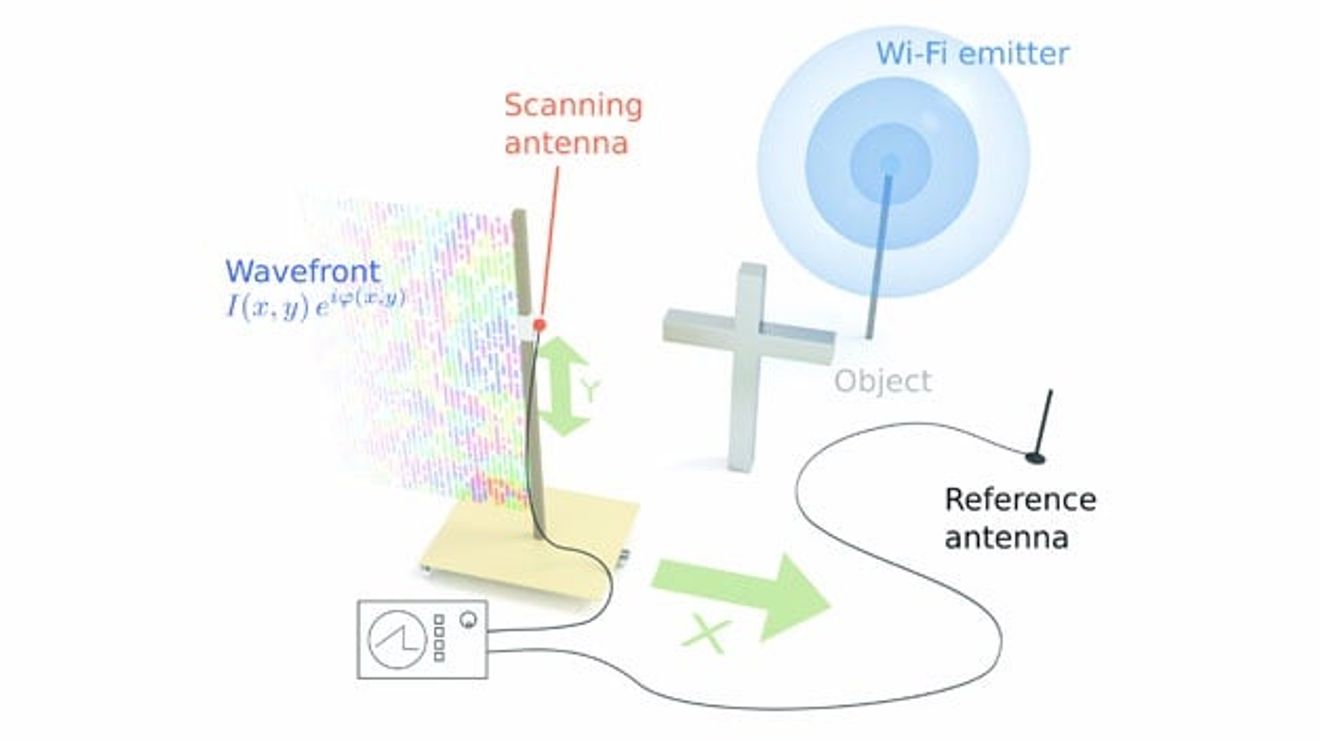
The setup of the laboratory experiment: A WLAN antenna is moved around the room or moved step by step over the entire surface of the wooden construction. The signal is recorded with an oscilloscope and compared with the signal from a fixed reference antenna to determine the phase position.
© TU MunichLike looking through a window, a hologram provides a three-dimensional image. While the optical hologram requires complex laser technology, a hologram of the microwave radiation of a WLAN transmitter can be created using a fixed and a movable antenna. "With this technique, we can create a three-dimensional image of the space in which the Wi-Fi transmitter is located, as if we had eyes for microwave radiation," says Friedemann Reinhard, head of the Emmy Noether Research Group for Quantum Sensors at the Walter Schottky Institute of the Technical University of Munich. The researchers see potential applications above all in the context of the Industry 4.0 concept, i.e. in automated industrial plants, where it is often difficult to localize parts or devices.
WLAN penetrates walls

The cross made of aluminum foil visible in the real image can be reconstructed from the WLAN hologram (image shown bottom right).
© TU MunichMethods in which microwave radiation can even be detected through walls or in which the change in the signal indicates the presence of a person already exist. What is new is that the holographic processing of WLAN or cell phone signals provides an image of the entire room.
"Of course, it's natural to worry about your privacy, because even encrypted signals transmit an image of your surroundings to the outside world," says project manager Friedemann Reinhard, but also adds: "It's unlikely that this method will be suitable for looking into other people's bedrooms in the near future. You would have to move a large antenna around the building, which is unlikely to go unnoticed. There are simpler options."
Until now, special transmitters with a large bandwidth have been required to generate images from microwave radiation. The holographic evaluation of the data enabled the researchers to make do with the very low bandwidth of standard household WLAN transmitters, which transmit in the 2.4 and 5 GHz frequency bands. Bluetooth and cell phone signals can also be used. The wavelength of these devices corresponds to a resolution in the range of a few centimetres.
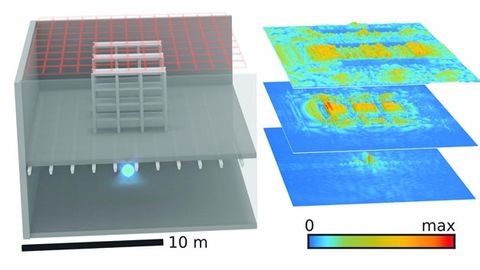
Simulation of a warehouse: The three-dimensional image (right) can be reconstructed from the 'light' of the WLAN transmitter in the basement.
© TU Munich"Instead of a movable antenna that measures pixel by pixel, you could also use a larger number of antennas and thus achieve a video-like image frequency," says Philipp Holl from the Technical University of Munich, who carried out the experiments, and adds: "Future WLAN frequencies, such as the planned IEEE 802.11 standard with 60 GHz, will open up a resolution down to the millimeter range."
Methods for image enhancement known from optics can also be used in WLAN holography: One example is the dark-field method known from microscopy, which makes it possible to better recognize weakly scattering structures. Another method is white light holography: here, the researchers used the bandwidth of the WLAN transmitter to eliminate interference from scattered radiation.
The concept of viewing microwave holograms like optical images also makes it possible to combine the microwave image with camera images. Additional information obtained from microwave images could thus be superimposed on the camera image of the cell phone, for example to directly see wireless key fobs on lost objects.
However, the scientists are only at the beginning of technological development with their work. There is still a lack of research into how transparent which materials are. With this knowledge, opaque paints or wallpapers could then be developed to protect the privacy of microwaves, while transparent materials could be used for factory halls where the path of a component through the plant needs to be tracked.
Researchers hope that the technology developed in this way could also be used in the future to search for people buried under an avalanche or in a collapsed house: While previous methods only allow localization, the holographic evaluation of the signals also provided a spatial image of the destroyed structures. Helpers could then avoid heavy pieces of rubble or use remaining cavities for the rescue and thus find the easiest route to the victim.


You might also be interested in
Connecting Wireless Sensors and Analog Control Systems
Hottinger Brüel & Kjær (HBK) has reintroduced the "WSDA-101" wireless gateway to the market. The wireless gateway is particularly well-suited for applications that require predictable analog signals with low latency.
 read more...
esd electronics at the SPS 2025
Gateway connects Ethercat with CAN FD
With the 'CAN-EtherCAT/2-FD', esd electronics presents a stand-alone gateway that allows a direct connection from CAN FD to Ethercat.
read more...Innovation partner for automation
Bihl+Wiedemann is a medium-sized, owner-managed company - founded in 1992 by Jochen Bihl and Bernhard Wiedemann in Mannheim. It develops and manufactures complete solutions for functional safety and data communication in machines and systems.
read more...IIoT gateway or soft PLC
With 'IndustrialPI', Pilz presents an open and modular industrial PC based on the Raspberry Pi with freely available open source software.
read more...Efficient Modbus gateways
Spectra's tGW-700 series Modbus TCP to RTU/ASCII gateways allow Modbus/TCP hosts to easily communicate with Modbus RTU/ASCII serial devices over an Ethernet network.
read more...Lütze Group is acquired by Amphenol Corporation
The international Lütze Group will be acquired by the US-based Amphenol Corporation on October 1, 2024.
read more...Certified according to IRIS Rev.04
Rail technology specialist Lütze Transportation has successfully completed certification in accordance with ISO 22163:2023 / IRIS Rev.04. The certification underlines Lütze's commitment to meeting the highest quality requirements of the rail...
read more...Industrial routers and gateways
Hy-Line Technology is expanding its portfolio of 5G-capable industrial routers and gateways.
read more...Innovation partner for automation
Bihl+Wiedemann is a medium-sized, owner-managed company - founded in 1992 by Jochen Bihl and Bernhard Wiedemann in Mannheim. It develops and manufactures complete solutions for functional safety and data communication in machines and systems.
read more...