

Drive technology
Ethernet TSN instead of fieldbus?
All signs point to the fact that Ethernet TSN could be a major step towards moving away from proprietary communication protocols in automation technology - right down to field level, for sophisticated drive technology applications.
Time Sensitive Networking (TSN) stands for a series of real-time extensions to the established Ethernet standard, which are specified by an IEEE working group (within IEEE 802.1). Viewed objectively, these mechanisms are old news for fieldbus specialists. Guaranteed real-time and synchronization of controllers, drives or IOs with an accuracy of less than one microsecond have long been commonplace. In technological terms, TSN is therefore not revolutionary, but rather a standardized toolbox for different problems in real-time communication.

Figure 1: Today, the automation pyramid is characterized by a multitude of communication protocols. In the context of TSN, the use of standard Ethernet is conceivable in principle across all layers.
© ISW StuttgartToday, real-time capability is usually achieved via proprietary mechanisms, making the shared use of a network infrastructure by different fieldbuses and IT networks unthinkable. It is therefore all the more remarkable that Ethernet has established itself at the lowest level of fieldbus communication in recent years - a technology that was not driven for or by the automation industry.
There is now a very positive forecast for the potential of TSN in automation technology. Especially as corresponding convergent networks with real-time-capable standard Ethernet promise manufacturer independence, cost savings and new degrees of freedom in networking. In analogy to the takeover of the physical layer by Ethernet, many experts assume that TSN will now take over further classic fieldbus functions. Great expectations are also placed on the link with 'OPC UA', so that the transport and description of data are standardized across large parts of the automation pyramid (Fig. 1). A frequently expressed hope from the machine and plant engineering sector is that this will also reduce the need to support a wide variety of fieldbuses.
TSN - the current status
The standards within IEEE 802.1 developed by the Time Sensitive Networking Task Group, which originally emerged from the audio/video sector, have not yet been fully adopted. However, it is clear in many places what the implementation will look like. The increasing availability of TSN-capable components can therefore be expected in the course of 2017. However, it should be noted at this point that there is no such thing as a TSN-capable device. Just as the functionalities specified by TSN are localized at different locations in a corresponding network, it is also not necessary for individual devices to support all ten sub-standards. Therefore, implementations are already possible and available at this point in time - depending on the requirements in hardware or software. For the application presented below, these are, for example, '802.1AS-Rev: Timing and Synchronization for Time-Sensitive Applications' and '802.1Qbv: Enhancements for Scheduled Traffic'.
It should be noted at this point that many of the established fieldbuses offer more than just data transmission. Over the years, a profile landscape has grown that offers a systematic classification of different device classes and is independent of the transmission channel. A key wish is therefore to continue to use corresponding profiles via TSN Ethernet, without the restriction to a special topology and the respective transmission medium or as a multi-protocol network.
A key feature of corresponding convergent networks is the shared use of the infrastructure for transmissions with high bandwidth as well as those with minimal latency and jitter. An obvious consequence is the reduction of costs, effort and complexity. However, the main challenge here will be the management of corresponding networks with a rapidly growing number of subscribers and different usage characteristics.
Drive via TSN - two example scenarios
One possible answer to the question of what real-time communication in automation technology could look like in the future was presented at SPS IPC Drives 2016 by the Institute for Control Engineering of Machine Tools and Manufacturing Units (ISW) at the University of Stuttgart using a corresponding demonstrator.
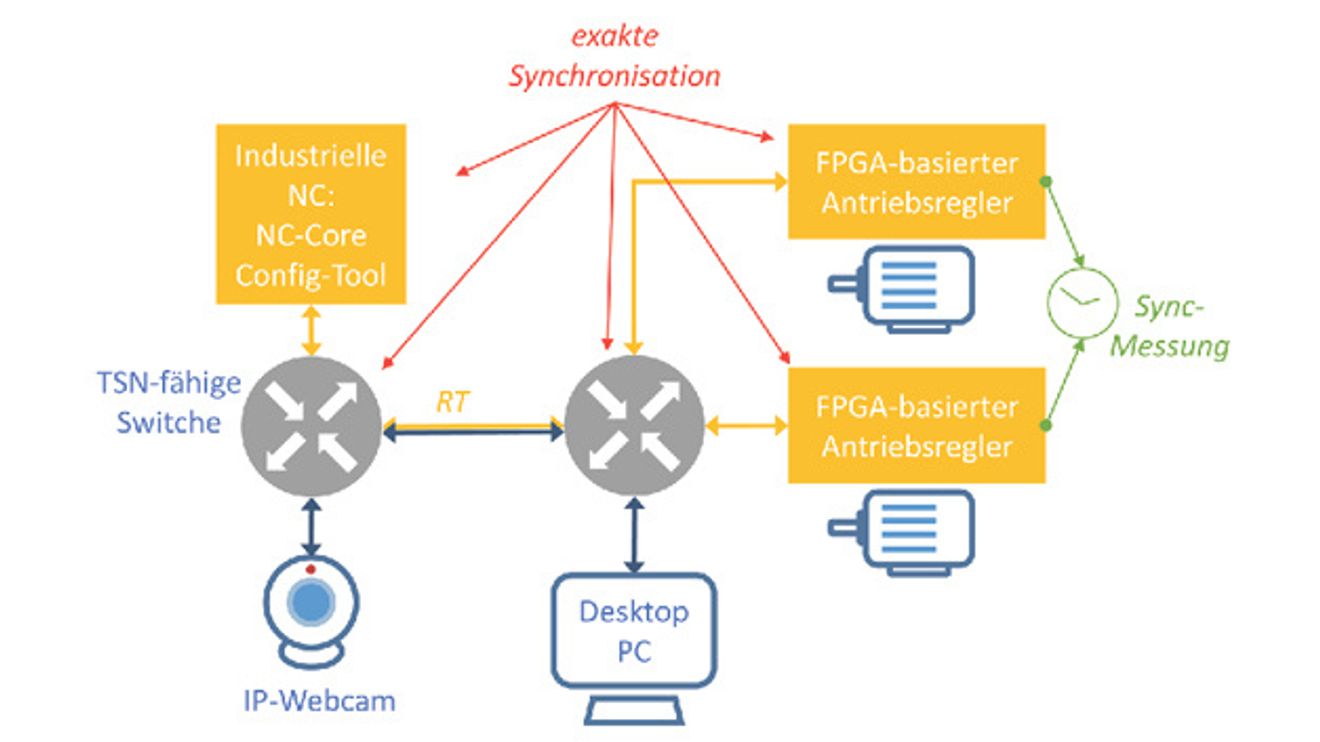
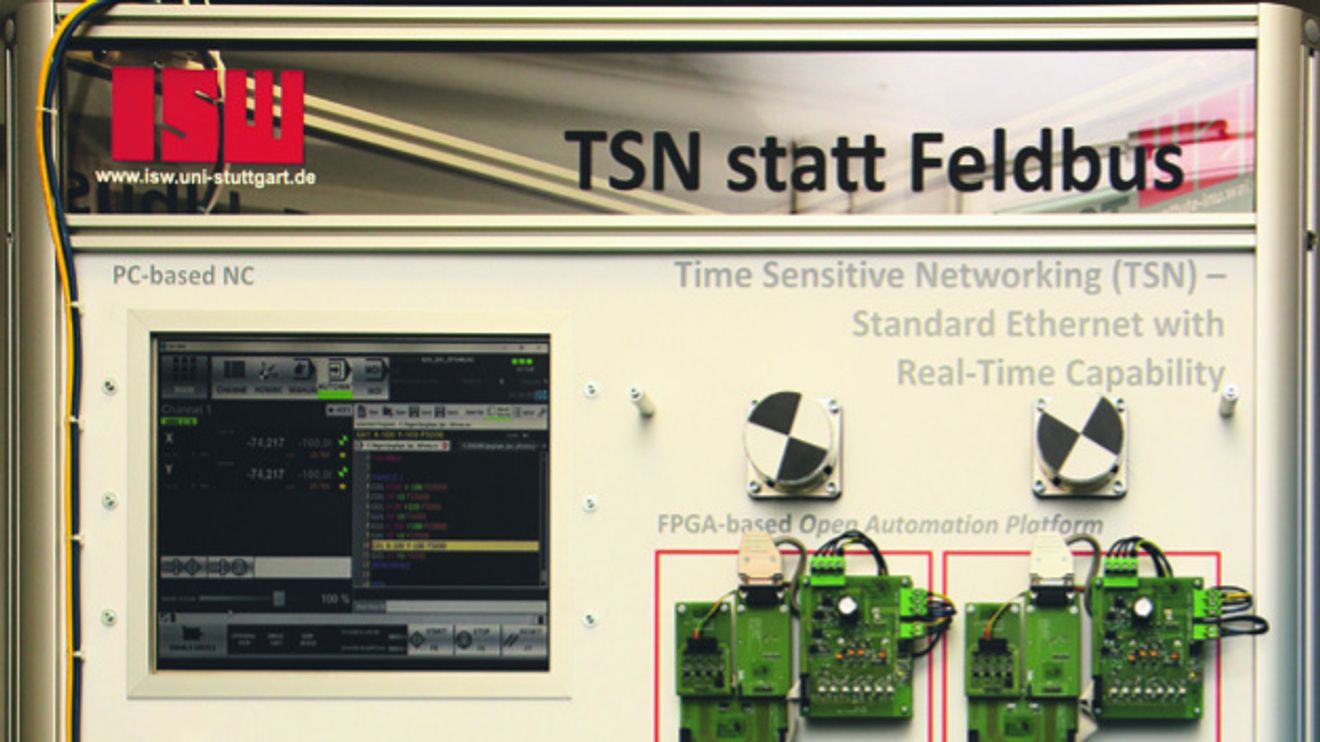
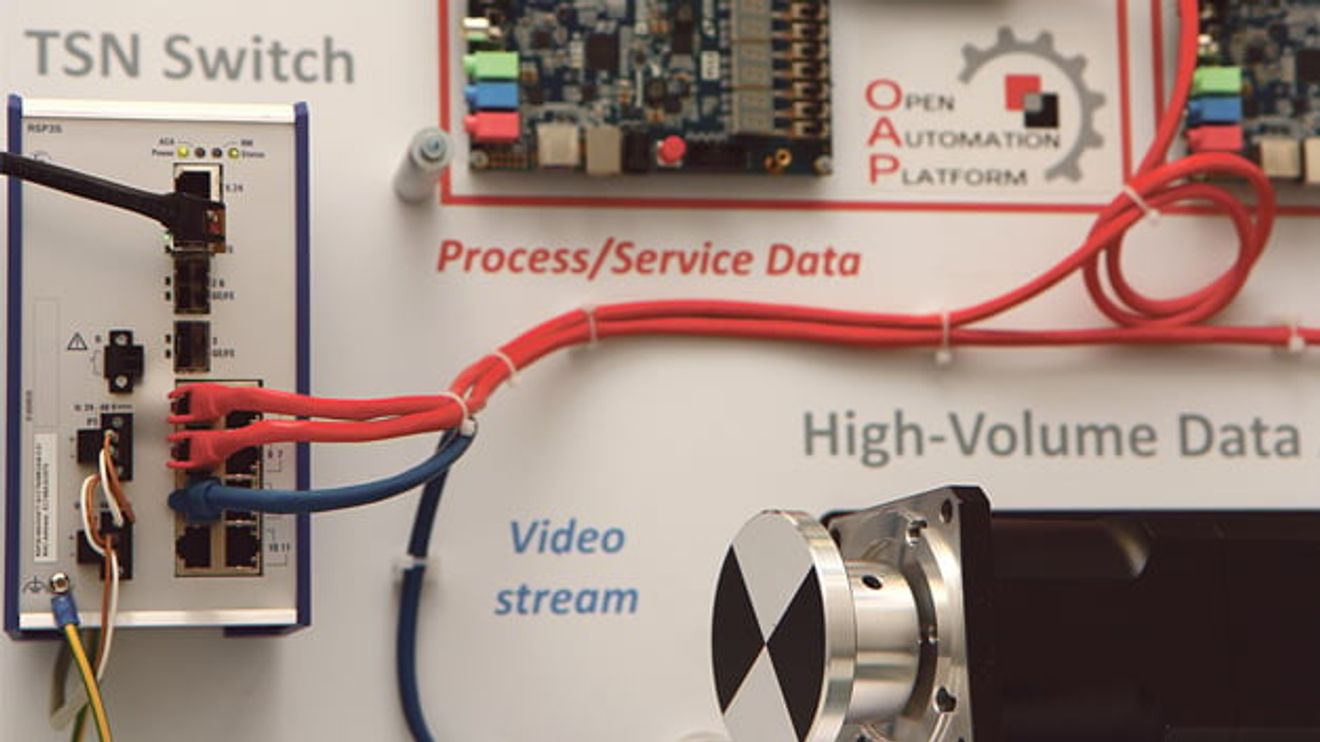
The drive setpoints generated by a PC-based numerical controller are sent via native Ethernet with TSN mechanisms instead of a fieldbus stack. These are prioritized in their own time slots (using IEEE 802.1Qbv) across two industrial switches (Hirschmann RSP35 with TSN firmware) and transmitted to two FPGA-based drive inverters. Both drives achieve a synchronicity of less than 100 ns. Parallel TCP/IP traffic from a webcam does not affect the real-time behavior in any way.
Figure 2 shows the set-up with the two data streams: the transmission of the setpoint/actual values to and from the drives under real-time requirements (RT) and the transmission of the webcam stream with high bandwidth (NRT). The best possible time synchronization of the participants is an essential prerequisite for low-latency transmission via several network components (each traffic class is processed at the right time), but is also indispensable for the respective application - in this case the exact synchronization of the two drives as required for motion applications. The IEEE 1588 standard was used for this purpose, which will be incorporated into TSN in a slightly modified form as IEEE 802.1AS-rev. Corresponding functions are already integrated in the switches.

For a better understanding of the implementation, Figure 3 shows the schematic structure of the NC master. Standard PC hardware with a Windows operating system was used. For deterministic execution of the real-time-critical tasks, these are implemented under the real-time extension 'Intime' from Tenasys. The 'Intel i210' network adapter, which also has corresponding hardware functions for time synchronization and is accessible via the high-performance Ethernet interface, ensures real-time-capable bus access. In addition to generating the drive setpoints within the NC using 'ISG.kernel', another important task in the software is time synchronization with the other network participants, for which a PTP stack from the Zurich University of Applied Sciences (ZHAW) is used. Non-real-time critical traffic, for example for configuring the drives, is transmitted outside the reserved time slot.
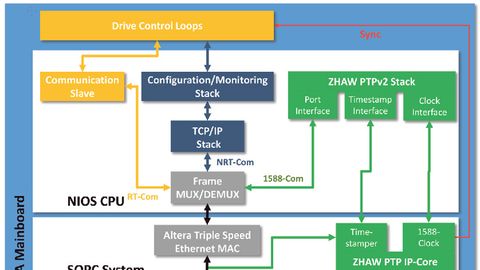
The drive platform shown in Figure 4 or used in the ISW demo is characteristic of a TSN-capable end device: The implementation is based on an FPGA platform in order to be able to use maximum flexibility in software and hardware. Functions are implemented at the appropriate level. For example, the PTP stack or management tasks used here also run within an embedded CPU - corresponding time-critical functions such as the necessary time-stamping of the Ethernet packets or the control loops of the drives are implemented directly in hardware.
Here, too, there is still room for further improvements. One example is the switch to cut-through switching, which minimizes end-to-end latency even in more complex networks. As part of the demonstration presented, a cycle time of 1 ms was implemented for the transmission of set/actual values, with the drive data being packaged in exemplary telegrams based on CANopen. Of the available bandwidth of the 100 MBit connection, for example, 25% was reserved for real-time data and 25% for the reliable transmission of service data. Accordingly, the number of drives - arranged in any topology - could be significantly increased; the individual telegrams only have a minimum length of 72 bytes. As the drives are synchronized via the IEEE 1588 mechanism, the exact transmission time or the latency of the set values is no longer decisive. Using pulses output synchronously with the controller clock, measurements show that the time error between the two drive controllers is less than 50 ns.
The performance that can be achieved when using TSN Ethernet for typical industrial applications is basically comparable to established Ethernet-based fieldbuses and will continue to increase as transmission rates increase. With complex network structures, however, corresponding latencies due to switching must be taken into account, which limit the minimum response time. However, as the synchronization of the participants can be decoupled from the process data, this is not a critical limitation. Further challenges arise with a large number of participants from the overhead, which is caused by the fact that even a simple Boolean measured value always occupies a complete Ethernet frame. For special use cases, such as a very large number of distributed I/O components with small amounts of data, there is still a need for research into optimal bandwidth utilization.
Another TSN demo, in which the ISW was also involved, could be found at the SPS IPC Drives at the Sercos International stand: Here, the control of Sercos drives via a comparable network structure was presented. The necessary modifications here are limited to the NC master and leave the Bosch Rexroth drives used untouched. ISG.kernel' is also used for setpoint generation, while the role of the Sercos master is assumed by 'Sercos III SoftMaster', which is available as open source. Here too, IEEE 1588 ensures a uniform time base for network components and master, so that the setpoint telegrams are forwarded to the drives at precisely defined times.
This scenario can be used to illustrate a possible migration strategy for integrating existing systems and components into TSN networks. By configuring the network appropriately, the sercos telegrams are transmitted transparently and deterministically and protected from further traffic.
What remains of the fieldbus?
As things stand today, the focus on Ethernet-based bus systems is expected to continue in automation technology and other sectors, such as the automotive industry. As part of the upcoming release of the OPC UA pub/sub model, the combination with TSN promises to eliminate the previous lack of suitability for real-time data. However, this leaves the task of porting existing device profiles to this new communication infrastructure - taking into account compatibility with legacy devices and systems wherever possible.
Many of the fieldbuses in widespread use today have specifications for the network topology and therefore restrict the arrangement and wiring of the participants. Furthermore, any required redundant connections are not possible at will, but are restricted to those topologies provided for by the fieldbus - for example, rings. The use of TSN Ethernet as a transport layer removes such restrictions. Overall, a rapid increase in compatible chipsets and protocols can be expected due to manufacturer-independent standardization and cross-industry significance.
Against this background, it cannot be assumed that the classic fieldbus will disappear from the factory floor tomorrow. However, now is the right time to think about what TSN will mean for the various players and to prepare appropriate strategies. Relevant aspects are:
- Convergent networks with simultaneous high bandwidth and real-time guarantee
- Native Ethernet instead of proprietary communication protocols
- Manufacturer-independent, future-proof and cost-effective
- Flexible network topologies and redundancy
At the same time, industrial communication still presents a number of unresolved challenges: From standardized data description, engineering and monitoring to safety and security, there are still a number of unanswered questions. In order to clarify such questions from a practical point of view, to try them out and to create model solutions, the ISW is planning to establish a corresponding interest group 'TSN for Automation' for the practical application of real-time Ethernet(http://www.tsn4automation.com). Among other things, various events are planned for the exchange of experts and user training, the provision of best practices and reference implementations as well as the joint use of a TSN lab.
Authors:
Florian Frick works at the ISW on innovative platforms for automation technology;
Peter Zahn is group leader at ISW and responsible for drive, control and machine technology.
Armin Lechler is deputy director of the ISW.


You might also be interested in
Wago gears up for Time Sensitive Networking (TSN)
In the future, Ethernet TSN will enable continuous communication in machine and plant engineering without gateways and interruptions. Wago is launching two new automation systems on the market for the SPS, with which users can take advantage of all...
 read more...
Arrive in reality!
Time Sensitive Networking has firmly established itself in the vocabulary of the automation industry. All well-known suppliers have started activities to evaluate or even introduce TSN. But where exactly are the goals for the use of TSN and what is...
read more...OPC UA and DDS combined
To date, OPC UA and DDS have often been presented as competitors. Competitors that will both be based on the Ethernet standard TSN. - However, the key to successful automation in the future lies in a combination of the three standards DDS, OPC UA...
read more...The interaction of Ethernet TSN, OPC UA and 5G
Only the reliable and structured interaction of all units in an ant colony ensures its survival. Data communication in a modern industrial network works no differently in a figurative sense.
read more...Where there are still problems with 5G
5G in automation - a hot topic at the moment. How quickly can we actually expect 5G to be used in industry? What obstacles still need to be overcome? Thomas Schildknecht summarizes the key points in this interview.
read more...Data pipeline ASi-5
High data width, short cycle times, improved integration of intelligent sensors and actuators using IO-Link and cloud connectivity via OPC UA - ASi-5 makes AS-Interface fit for the requirements of digitalization.
read more...OPC UA - a must for the industry (Part 2)
OPC UA is regarded as the new communication standard for industrial automation. Part 1 explained why a new communication technology is needed in automation and described the OPC UA methods. Part 2 deals with the OPC UA pub/sub methods and the power...
read more...OPC UA, MQTT and co.
The Industrial Internet of Things (IIoT) covers very different areas of application. The available connectivity technologies and standards are just as diverse as the application areas. How can the right technology be filtered out in each case?
read more...The question of licenses
Will OPC UA in combination with TSN become 'the' standard for industrial communication? What role do licenses play in this question and what part does OSADL play?
read more...