
Vortex meter
The optimized steam network
Steam is one of the most important and at the same time most expensive forms of energy in chemical industry plants - making it all the more important to optimize the operation of steam networks and avoid losses.

Plant operators in the chemical industry focus on the security of supply and efficiency in the generation, transportation and use of steam, as well as the transparency of the steam quantity down to the individual consumers. Vortex meter flowmeters are virtually a standard measuring method in steam measurement - and have been for over 30 years. In order to take on more than just the actual measuring task - recording the quantity in the individual production units - modern devices are equipped with a special function for wet steam measurement, among other things.
A question of steam quality

'Factor x' defines the vapor content. At x = 0, the water is completely saturated. At x = 1, dry saturated steam is present. At x = 0.8, 80 % of the mass of the water is in the gaseous state and 20 % in the liquid state.
© Endress+HauserSaturated steam and superheated steam are the gaseous states of water. All water molecules have the physical property of a gas. Here the steam quality is 100%, the steam is invisible to the eye. The term saturated steam refers to a point at which a specific pressure value is associated with a clear temperature - for example, the temperature associated with a steam pressure of 8 bar is 170.4 °C. A series of points for all pressure values results in the so-called saturated steam curve, which forms the boundary line for the aggregate state of water and steam: At a constant pressure of 8 bar, the steam is superheated at a temperature >170.4 °C, at a lower temperature it is wet steam.
It is precisely this area below the saturated steam curve that is important when considering steam quality. This is where the vapor begins to condense due to energy loss and the gas molecules recombine to form liquid droplets due to a change in aggregate state. The vapor quality expresses what percentage of the vapor mass is still gaseous and what percentage is liquid. In figures: With an original 1000 kg of steam, 8 bar pressure and a steam quality of 90 %, this equates to 900 kg of steam (equivalent to approx. 216 m³) and 100 kg of liquid condensate (equivalent to approx. 0.1 m³).
Eliminate energy losses
The main problem is the loss of energy when the aggregate state changes. At 8 bar, saturated steam has a heat content of 2767 kJ/kg. Under the same conditions, the liquid state has only 721 kJ/kg. The difference - 2046 kJ/kg - is the usable heat energy contained in the steam, which should actually be used at a consumer such as a heat exchanger.
Expressed in figures, the following example illustrates the importance of steam quality. 4000 kg/h are conveyed through a steam pipe with a nominal diameter of DN100. 1000 kg of steam costs around 40 euros. With a steam quality of 90 %, 16 euros per hour are lost due to condensation. This amounts to 384 euros per day and 11,520 euros per month!
The problem: as pressure and temperature do not change when the aggregate state changes, it is not possible to clearly determine the state in a steam pipe by measuring pressure and temperature. However, until now there have been no industrially suitable technologies for measuring a multiphase flow in the pipeline.
In the steam network, it is important to transport the saturated steam efficiently to the respective point of consumption and to avoid the formation of wet steam and condensate both there and on the way there. Every drop of condensate means energy loss and poses a safety risk for the system and operating personnel due to possible steam hammer.
Wet steam is usually caused by heat loss, often due to missing or defective insulation on parts of the steam pipes. Wet steam causes a variety of problems:
- The water produced in the steam pipe can lead to water hammer and surge currents.
- As wet steam contains far less energy than dry saturated steam, the efficiency of the steam system is reduced.
- If the formation of wet steam is caused by boiler water foaming over, this can result in stress corrosion cracking.
However, wet steam is also problematic at the point of use:
- If the condensate separator at the boiler outlet does not work, the heat exchanger can fill up, which dramatically reduces the efficiency of the heat transfer.
- If the separator for the production of dry saturated steam does not function properly, wet steam can also be produced and the efficiency can drop accordingly.
The examples show: Wet steam can occur anywhere in the process heating and piping system - even if it is assumed that superheated steam is being produced. It is therefore essential to find out whether wet steam is present or not.
Research cooperation and steam test bench
Together with the University of Applied Sciences Northwestern Switzerland in Windisch, Endress+Hauser has therefore invested in a joint steam test facility to develop practical innovations for wet steam detection and measurement. Steam with different steam contents was produced on this test facility and the effects of the moisture content in the steam on the 'Proline Prowirl' vortex meter were investigated. Steam contents between 70 % and 100 % could be realized for the nominal diameters DN25 to DN100. Steam pressures of up to 10 bar rel. are possible.
The wet steam was generated by supplying water either as a 'liquid flow', as a 'spray mist' or by means of a cooling pipe. In all three cases, the investigations showed that increasingly wet steam in horizontal pipes initially formed a 'channel-like flow' at the bottom of the pipe, which then 'smeared' into the upper area of the pipe walls. This behavior was observed regardless of the type of liquid water supply.
One measuring signal - two usable measured values
In the past, it was common practice to evaluate only the frequency of the vortex for flow rate measurement. With modern electronics, sufficient power is now available for more extensive calculations, which enables a complete evaluation of the signal curve of the raw signal from the sensor:
With the 'Prowirl 200' capacitive vortex sensor, a sinusoidal shape is normally obtained for the flow measurement. If the steam condition changes from 'dry' to 'wet', the height and shape of this sine wave is influenced. In addition, a rhythmic pulsation occurs, which is superimposed on the original sinusoidal signal. A separation is now made into a flow signal and a second measured value, which is attributable to the mass of the condensate flowing past. Using an algorithm, further measured variables can now be calculated and made available to the user - for example, the mass percentage of condensate, the steam quality or the energy content of steam and condensate.
As early as 20 years ago, scientific studies were carried out in the United States on the influence of poor steam quality on different flow measurement principles. An effect on the measuring accuracy was determined: All measuring principles used in this study show a positive error, i.e. the devices display an increasingly larger measured flow value as the steam quality deteriorates. However, the level of deviation differs for each measuring principle and is in the order of 4 to 8 %. The cause is a changed flow profile in the steam. For accurate flow measurement, every measuring device requires a turbulent profile in which the steam moves at the same speed over the entire pipe cross-section.
However, if the steam quality is poor, the condensate also flows through the pipe, but at a much slower speed. This causes a change to a laminar flow profile - the steam flows faster in the middle of the pipe than at the edge. And it is precisely this increased velocity that forms the measured value on the flow meters. A correction is conceivable, as the additional measurement error is constant to the steam quality. Until now, however, there has been no way of permanently measuring the steam quality during operation on an industrial scale. The steam quality measurement in the vortex meter solves this problem; the flow value is corrected for the influence of the flow profile.
Alarm functions for safe operation
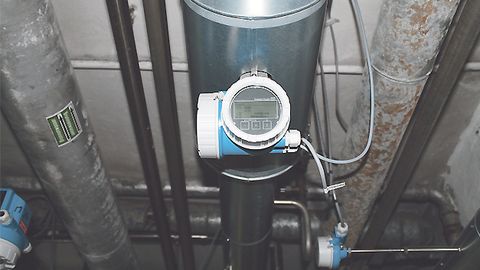
When using the 'Prowirl F 200' with mass sensor, which has an integrated temperature sensor and flow computer, there is no need for external temperature measurement. A pressure measurement value is also read into the device via an input function and the flow meter calculates all relevant parameters. In this case, the warning function is called 'near vapor saturation line'. It triggers when the measured temperature approaches or falls below 2 K of the saturated steam curve.
The wet steam warning can also be implemented with a simple vortex and differential pressure measurement: Here there is always a separate pressure and temperature measurement as well as a flow calculator for the compensation calculation. The principle of measurement here can be described as the classic design of a steam measurement section. A characteristic feature is that the sensors only provide basic measured values and the flow computer makes further calculations from these values - for example, testing a wet steam condition. Here too, a wet steam warning is generated via a temperature limit value of 2 K using a saturated steam curve.
However, the disadvantage of this and the previously mentioned variant is the lack of information about the quantity and extent of wet steam present. All that remains is the indication that wet steam could occur.
Two new functions

Steam quality - made visible in the research facility - provides new insights into system problems with energy losses and steam hammer. The picture shows steam with different steam contents (from left to right: 100 %, 95 %, 80 %).
© Endress+HauserThe Prowirl F 200 offers two new wet steam measurement functions for nominal sizes DN25 to DN100, which are based on the measurable effect of wet steam on the flow measurement sensor signal. The first function is purely a warning function for a steam quality limit value, the second provides continuous measured values even in the wet steam range. The limit value function is set to 80 % steam quality in the default setting and generates a warning message when the limit value is reached or not reached. This enables simple safety-related monitoring. The continuous measurement has several additional measured variables that can be transferred to a downstream system - for example steam quality, mass flow condensate or mass flow steam content only. This allows users to work freely with the measured values and implement their own action functions.
Device testing without removal
Supply networks must function reliably 24 hours a day, 365 days a year. If components in the steam network fail, there is often a risk of production downtime. For this reason, all measuring devices installed in supply lines must be long-term stable, robust and continuously accurate.
However, especially in billing measurements, proving the quality of the measurement results often poses serious problems for the steam supplier: Testing or recalibrating the devices is usually not possible without dismantling and the associated system downtime. Here too, Endress+Hauser offers new possibilities with the integrated 'Heartbeat Technology' and a detailed test with a test depth >98 % without dismantling. Testing at the touch of a button, even from the control room, provides a documented and verifiable test result that also meets the requirements of ISO 9001.
Author:
Kai Weltin is Marketing Manager Flow Measurement Technology at Endress+Hauser in Weil am Rhein.


You might also be interested in
Largest construction project in the company's history launched
The Endress+Hauser Group's oldest and largest production site in Maulburg is being extensively modernized and expanded. To this end, the provider of measurement technology and automation solutions is investing more than 100 million euros in the...
 read more...
Endress+Hauser Liquid Analysis
New managing director from October 2024
Dr. Thomas Buer will become Managing Director of Endress+Hauser Liquid Analysis on October 1, 2024. He succeeds Dr. Manfred Jagiella, who is retiring at the end of September after 17 years at the helm of the competence center for liquid analysis.
read more...Good figures crown the anniversary year
Endress+Hauser celebrated the Group's 70th birthday in 2023, initiated a change at the top and posted good figures for incoming orders, sales, profit and employment in its anniversary year. The audited figures have now been presented at the annual...
read more...Strong growth recorded
The specialist for measurement technology and automation solutions increased its consolidated turnover in 2023 by 11% to over EUR 3.7 billion and created 715 new jobs worldwide.
read more...Matthias Altendorf joins the Board of Directors
Matthias Altendorf moves to the Board of Directors at Endress+Hauser and hands over the position of CEO to Dr. Peter Selders. The management of Endress+Hauser Level+Pressure has also been restaffed.
read more..."Digitalization remains a driver on many levels"
Endress+Hauser can look back on 70 years of company history this year. To mark this anniversary, we spoke to Matthias Altendorf, CEO of the Endress+Hauser Group since 2014.
read more...Innovation cluster opened
Endress+Hauser brings together several teams for sensor and software development at the FRIZ innovation center in Freiburg. The 70 employees work in a close network and are embedded in an environment of research institutes, start-ups and other...
read more...Around the world for a good cause
As part of the Endress+Hauser Water Challenge, the company's employees raised money for a water project in Vietnam in record time with charity runs. The campaign is now entering a second round.
read more...Solid figures for measurement technology specialist
Endress+Hauser reports record figures for incoming orders, sales and employment for the 2022 financial year. Despite strained procurement and supply chains, more than 2.9 million devices were delivered worldwide. Klaus Endress will retire at the end...
read more...