
Precision manufacturing
Accurate to the picometer
Precision requirements down to the sub-nanometer range are common in semiconductor manufacturing, productronics and optics. And mechanical engineering has also long been on the way to the 'nano world'!
Higher pitch accuracies are a suitable means of better distributing the internal forces on the gear teeth in precision gearbox construction. More precisely manufactured tooth geometries lead to lower stress peaks and higher load capacity. Even in multi-row rolling bearings, the distribution of internal forces depends crucially on the smallest manufacturing tolerances because these systems are statically overdetermined. Precision manufacturing and consequently also measurement in the sub-nanometer range are an important prerequisite for developing existing mechanical systems to an even higher power density.
In addition, the miniaturization of products and production processes is increasing the development pressure from micro to nano dimensions. This dimensional leap must be made available on a broad basis and at manageable costs in order to ensure the competitiveness of products and sustainable production. In terms of sensor technology, for example, an easily integrated ultra-precision measuring system is an important building block for this.
What stands in the way of precision
Glass scales are currently regarded as the benchmark in the industry. They are used when other measuring systems no longer achieve the required precision. However, due to the dimensional scale on the glass scale, this measuring method reaches its limits in the sub-micrometer range due to the manufacturing process. As these and other inductive displacement measuring systems are attached to the machine bed, they are always at a certain distance from the workpiece. Therefore, the measured position only corresponds to the position of the moving sensor head, but not exactly to the position of the workpiece. Systematic errors such as tilting errors due to guides and bearings (Abbe errors) are added up to the workpiece. In addition, there are operationally variable errors, such as different temperature expansions, machine deformations due to process forces, wear and vibrations. These deviations cannot be detected by the known displacement measuring systems, as the measuring points are too far away from the action. Therefore, further development of these measuring systems down to the sub-micrometer range would not lead to a higher positioning accuracy of tools or workpieces.
Distance measurement directly on the target
In order to overcome the physical and practical limitations of existing measuring systems, it makes sense to move away from their measuring principle. Instead, it is necessary to use a measuring principle that can detect the position of workpieces directly. In this way, machine and operational measurement errors can be eliminated from the outset. The interferometric measuring systems used in research offer one possibility for this. They optically measure changes in distance to objects directly on the target and achieve accuracies down to the nanometer range. However, these systems are extremely expensive, very large, unwieldy, sensitive and not suitable for integration into machines and production processes. The so-called Michelson interferometers have therefore only been used in industrial environments for the calibration of machine tools and measuring machines.

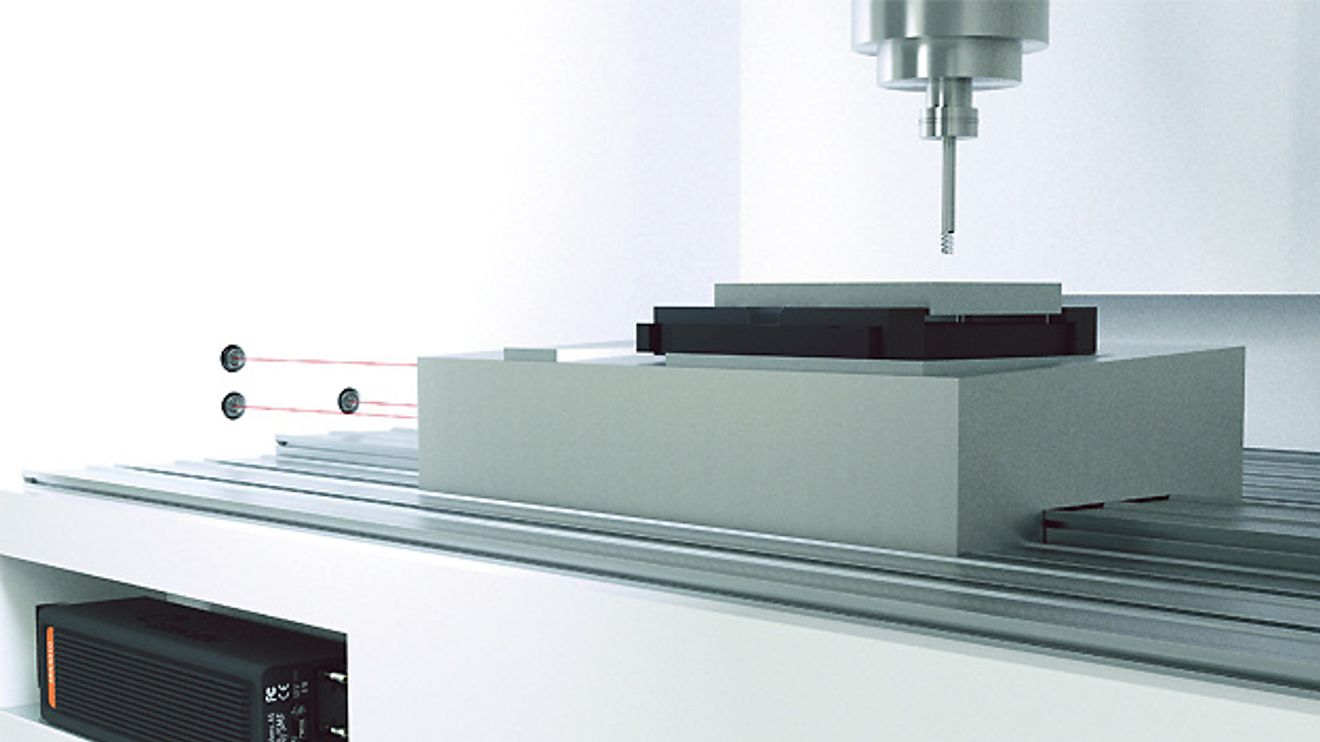
Up to three sensor heads can be connected to the 'IDS3010'. This allows the linear movement of objects, guiding errors such as vertical/ lateral run-out, yaw/pitch/roll and out-of-roundness of rotationally symmetrical parts to be detected.
© Attocube SystemsAttocube has set itself the task of closing this gap and providing the industry with the measuring accuracy of interferometers in the form of a robust, compact and economical solution. The result is an interferometer called 'IDS3010'.
The sensor heads of the 'Industrial Displacement Sensor' are only a few millimeters in size and are coupled to the base unit using a simple glass fiber. Up to three sensor heads can be connected to one base unit, so that a single measuring system can record three axes. The systematic measurement deviation of the system achieved and officially confirmed by the Physikalisch-Technische Bundesanstalt is 0.0 ppm in the measuring range from 0 to 3000 mm. This means that calibrations of machines or axes are no longer necessary if the sensor is integrated into them. The fiber optic-based design, the very small sensor heads and the base unit, which can be positioned anywhere, enable measurements to be taken in places where space is limited or difficult to access. The non-contact measurement directly on the target (workpiece, tool, machine parts) avoids the measurement errors described above. The high bandwidth opens up new fields of application in the vibration analysis of machines and processes. Roughly speaking, the interferometer can be used
- as a displacement sensor in quality assurance: for the calibration of axes and entire machines, in coordinate measuring machines or as a universal measuring and testing device in quality assurance (precision measuring rooms);
- as a displacement sensor in production machines: as an integrated displacement measuring system with up to three axes in high-precision production machines (machine tools), as a resolver system for high-precision servo drives (exact path curves in CNC technology) and for the position control of axes;
- as a measuring system in production: for workpiece inspection during series production or as a machine-integrated measuring system for measuring workpieces;
- as a vibrometer: for real-time process analysis and control, for real-time vibration measurements on machines and systems for detecting machine damage, for determining the service life of tools, for predictive maintenance, for detecting imbalances and for real-time vibration measurement for active vibration compensation.

In contrast to conventional Michelson interferometers, the 'IDS3010' is based on modern fiber optic technology. The glass fiber itself forms the classic reference arm, which is why the sensor is extremely compact.
© Attocube SystemsUnlike other interferometers, the sensor is based on a fiber-coupled Fabry-Pérot concept. Thanks to the use of modern control technology, Attocube has been able to extend the typically very limited range of this measuring principle to up to 5000 mm. As the sensor heads are fiber optic-based and contain only optical components, the entire electronics can be integrated into a single base unit. During the development of the interferometer, the expensive HeNe gas laser used in almost all interferometry applications was replaced by a much cheaper wavelength-modulated semiconductor laser. The light from this semiconductor laser is transmitted to the sensor head via a fiber optic coupler. The glass fiber ends in the sensor head, where part of the light - around 4 % - is reflected and thus forms the reference beam of the interferometer. The other part leaves the glass fiber and is converted into a parallel light beam by a collimator and directed onto the target object - targets are, for example, workpieces, tools or machine parts. This light beam forms the actual measuring beam of the interferometer and is reflected by the object to be measured and coupled back into the glass fiber, where it interferes with the reference beam. The resulting interference signal is in turn transmitted via the fiber optic coupler to a detector, which displays a sinusoidal interference intensity depending on the position of the object being measured.
While conventional interferometers can mainly measure on highly reflective surfaces, the sensor developed by Attocube can also measure directly on rough surfaces with very low reflectivity - for example on silicon wafers, glass and ceramics - by converting the laser beam into a focused beam.
Flexible sensor heads

Concentricity measurement on a rotating object: The concentricity of a shaft is measured simultaneously by two sensor heads of the interferometer at right angles to the rotating axis. The black lines show the concentricity error of the rotating motor shaft.
© Attocube SystemsMeasurements can also be taken on plastic, aluminum, copper and polished steel surfaces. If the reflection of the surface is not sufficient, flat mirrors or so-called retroreflectors can be used.
The sensor, which was specially developed for the industrial market, is equipped with a web server, making the device compatible for Industry 4.0 applications: Data exchange, alignment, initialization as well as configuration can be controlled, adjusted and monitored via remote access from any location. An integrated visible pilot laser simplifies alignment and adjustment, while a bar graph shows the current signal strength. After mechanical alignment, the interferometer is initialized and immediately displays the distance between the sensor head and targets.
Interview with the CEO of Attocube Systems: "Time to rethink!"

Dr. Martin Zech, CEO of Attocube Systems, Munich: "The 'IDS3010' can be used to measure where a machine part, workpiece or tool is located, as well as how fast it is moving and how strongly it is oscillating or vibrating."
© Attocube SystemsEngineers in precision mechanical engineering are being called upon to rethink in view of the constant miniaturization of products and the associated need for greater precision. Dr. Martin Zech, CEO of Attocube, explains the challenges that engineers will have to overcome in the future.
Attocube serves customers from both research and industry. What will change with regard to the requirements of a 'nano world' for mechanical engineers?
Dr. Zech: In the nano world, nothing is - almost - as static as it appears on the outside: as an example, we like to show customers an experiment with a fixed distance measurement in a thin-walled hollow body - we physicists call this a cavity - where the distance value jumps back and forth wildly from the fourth and fifth decimal place. It is not the measuring device that is defective - the value actually changes! A mechanical engineer has to get used to the idea of 'static matter'. This also provides an aha effect for experienced developers. In the sub-micrometer range, effects suddenly play a role that you didn't even have to consider before.
At the Hannover Messe 2017, you presented an innovative displacement measuring system. What exactly is it?
Dr. Zech: If you look at the IDS3010 as a displacement measuring device, then that is the purely static view. We prefer to call it a motion sensor - because for us physicists, the physical variables of displacement or position, speed, acceleration or vibrations are 'a single phenomenon', namely simply motion. Processing the motion signal into the various variables is then just a matter of various mathematical operations such as derivatives or Fourier transformations - because our signal is so good that it also contains all the motion information. We record the position with a resolution of one picometer at a bandwidth of up to 10 MHz. By comparison, in mechanical engineering, one sensor is used for each movement variable - for example, a glass scale for position and an acceleration sensor for measuring vibrations. Our measurement signal, on the other hand, contains all movement information because the movement is 'scanned' with such a high bandwidth.


You might also be interested in
Keysight Expands Test Automation
Keysight is expanding its Eggplant test platform with the "Find by Description" feature. This feature identifies UI elements based on descriptions rather than screenshots, reducing the maintenance effort required for automated tests.
 read more...
Sensors and measurement technology
Application start for AMA Innovation Award 2026
The AMA Association for Sensors and Measurement (AMA) is inviting scientists and developers from industry and research to apply for the AMA Innovation Award 2026. We are looking for research and development results in sensor and measurement...
read more...Change in management
Althen Mess- und Sensortechnik will be managed by Edwin Goezinne in the future. He succeeds Dr. Timo Hartmann, who was at the helm of the company in Germany for six years.
read more...New composition of the Executive Board
The Management Board of the ifm group of companies presents itself in its new composition for the first time.
read more...A new generation of condition monitoring solution
With 'ibaCMS', Iba is presenting a completely revised condition monitoring solution following the acquisition of Hainzl's condition monitoring division in summer 2023.
read more...Test digital simulation live
On September 26 and 27, students at Amberg-Weiden University of Applied Sciences will be able to find out how computer simulation can be applied directly to research and development projects. CADFEM and Ansys invite you to the big live simulation...
read more...Standard-compliant, agile verification and validation
Model-based design simplifies the development of mechatronic systems by using virtual models from the outset. The second part of the article series highlights methods and functions in the area of software testing - also in relation to the IEC 61508...
read more...AI-based acoustic quality control
'Sounce', an AI-supported acoustic testing software from MHP, has been in use at e-bike drive manufacturer Fazua, part of Porsche eBike Performance, since April 2024. The software detects noise anomalies in production.
read more...Condition monitoring in the sensor
Whether conveyor belt, industrial robot, hydraulic unit, motor or pump - the failure of individual components can bring the entire system to a standstill. This makes condition monitoring all the more important - for example using a condition...
read more...