

Transformation hub wiring harness
Robotics Challenge 2025
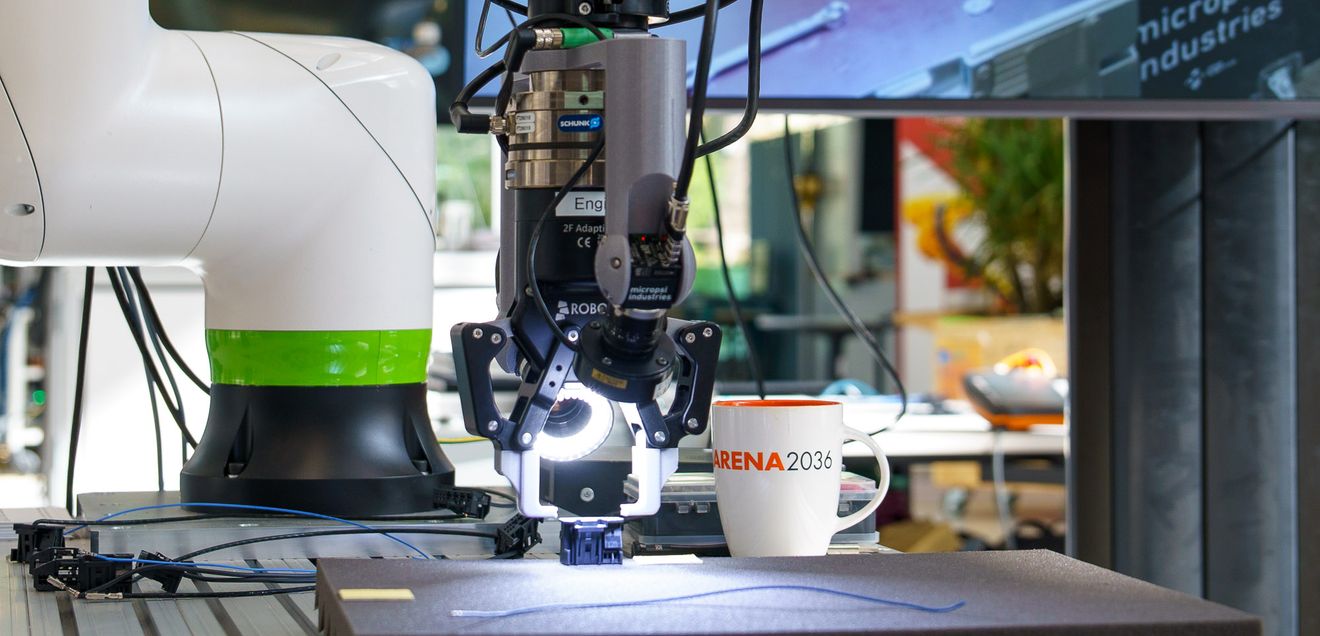
Automation is becoming increasingly important in wire harness production: The Transformation Hub Wire Harness invites you to the second edition of the Robotics Challenge on November 1, 2024.
Due to the great response to the first challenge, in which basic processes of wire harness assembly, such as the assembly of connectors, were successfully automated, the follow-up format is now setting the bar higher: the focus is now on the fully automated production of a wire harness module by robots. This challenge is therefore aimed primarily at system integrators and AI experts and offers all participants the opportunity to develop practical automation solutions for the industry.
Challenges and potential of automation
With the growing demands of electromobility and autonomous driving, the automotive industry is facing technological challenges. Until now, modern wiring harnesses comprising up to 1500 cables have largely been assembled manually on mold boards, often in regions with lower labor costs. However, this process is not only labor-intensive and costly, but also places high logistical demands. Automation solutions offer the potential to increase efficiency, improve precision and reliability and reduce the space required in production. Compact, robot-based assembly cells can be the solution to many of these challenges.
The miniaturization of connector systems and the increasing variety of cable types bring with them new technical requirements. Limited installation spaces in vehicle bodies require precise and intricate work steps that can only be carried out manually with great effort. This applies in particular to gripping and fitting miniaturized connectors, which in practice represents a considerable workload for the workers. These repetitive processes can be optimized and scaled through the use of innovative automation technologies.
Seven central process steps
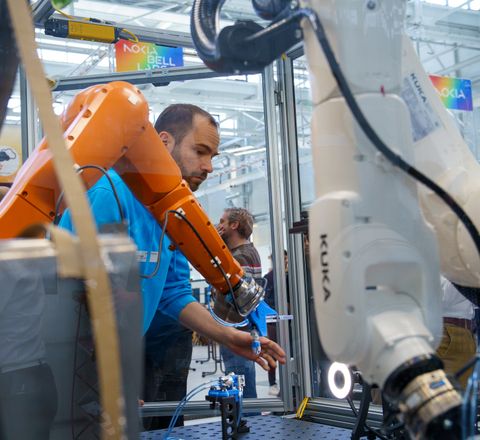
In collaboration with industry experts, seven key process steps in wire harness assembly were identified that are to be automated as part of the challenge: from the provision of components to the assembly of connectors and fixing of wire bundles. These steps form the basis for the development of modular robot cells that can be efficiently integrated into existing production processes.
As part of the upcoming challenge, research institutions and companies are invited to develop demonstrators that can map the entire process chain. The competition gives robotics companies the opportunity to present their transofrmation solutions directly to the industry and promote exchange with experts from the automotive industry.
Participants in the challenge can decide for themselves which of the identified process steps they would like to focus on. The aim is to develop creative and innovative approaches that stand out from conventional assembly processes and demonstrate new technical possibilities for wire harness production. At the end of the challenge, a demonstrator should be created that shows the practicality of the proposed solution.
Future prospects for the industry
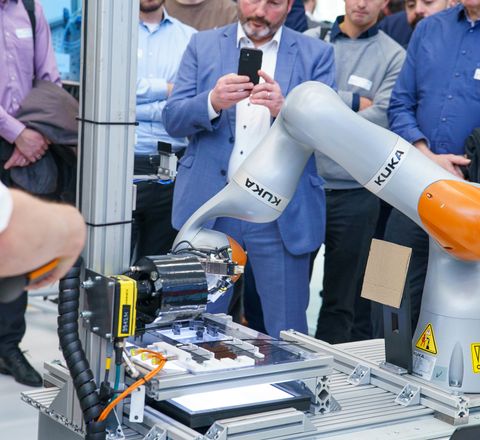
The processing time for the participants is four months, starting on November 1, 2024 and ending on February 28, 2025. The results of the Robotics Challenge 2025 will be presented at the Innovation Forum of the Transformation Hub Leitungssatz on April 9, 2025.
Through the Robotics Challenge, the Transformation Hub Wire Harness contributes to the further development of wire harness production and to ensuring its future viability. Further information on participation, the detailed task description of the challenge and how to register can be found at Robotics Challenge 2025 - Transformation Hub Wire Harness
The Transformation Hub Wire Harness is part of the Future Fund for the Automotive Industry funded by the German government. The consortium - consisting of Arena2036, Bayern Innovativ and the Open Hybrid LabFactory - combines research and practice to drive forward the automation and digitalization of wire harness production.


You might also be interested in
Regulation and safety slow down robotics projects in Germany
QNX has published the study "Inside the Robot: Architecture Benchmark Report". The results of the global survey of 1000 robotics developers show that software and safety requirements are increasingly becoming the central bottleneck for innovations...
 read more...
Dr. Olaf Munkelt becomes new Chairman
Dr. Olaf Munkelt, co-founder and Managing Director of MVTec Software, is the new Chairman of the VDMA Robotics + Automation Association. He succeeds Dr. Dietmar Ley, former CEO of Basler, who stepped down from the board for statutory reasons.
read more...Change in the VDMA Robotics + Automation Board
Dr. Michael Jürgens, CEO of Kuka Robotics, is a new member of the board of the VDMA Robotics + Automation Association.
read more...Application phase for Innovation Award 2026 begins
How can robotics help to make packaging more sustainable? Kuka is looking for creative and innovative ideas in the new round of the Innovation Award.
read more...International Federation of Robotics
10.7% more robots in the US car industry
The US automotive industry is investing more heavily in robotics and automation: the number of installations rose to a total of 13,700 units in 2024 - an increase of 10.7 %. This is according to preliminary results from the International Federation...
read more...'Roibot Award' goes to inclusion project
The Wittekindshofer Werkstätten are creating a disabled-friendly workplace with a low-cost robot. The foundation has now received the 'Roibot Award' from Igus for this creative inclusion project.
read more...Intralogistics Next Level
Logimat 2025 will occupy all ten halls of the Stuttgart exhibition grounds from March 11 to 13. Global players, medium-sized companies and start-ups will provide an overview of the current state of the art in the intralogistics sector.
read more...International Federation of Robotics
EU employment rises to 20-year high
Employment in the European Union has reached its highest level in twenty years across all sectors: the employment rate of 15 to 64-year-olds rose to 71.7%.
read more...International Federation of Robotics
World Robotics Association has a new president
The Executive Board of the International Federation of Robotics (IFR) has elected Takayuki Ito as President. At the same time, Jane Heffner was appointed as the new Vice President of the IFR.
read more...