

KIT at the Hannover Messe
Focus on the sustainable future
Under the title 'Research for a sustainable future', the Karlsruhe Institute of Technology (KIT) is showcasing exhibits and presentations at the Hannover Messe - in the Future Hub in Hall 2 and at the Energy Solutions in Hall 13.
"A more sustainable industry is not only ecologically sensible and necessary, it is also a decisive driver of technological development in our country: in resource-saving production processes as well as in the energy supply and automation of industrial processes. KIT researchers are working across disciplines to find appropriate solutions. We are very pleased to present some of them in Hannover this year as well," says Professor Oliver Kraft, Vice President Research, representing the President of KIT.
The KIT in the Future Hub
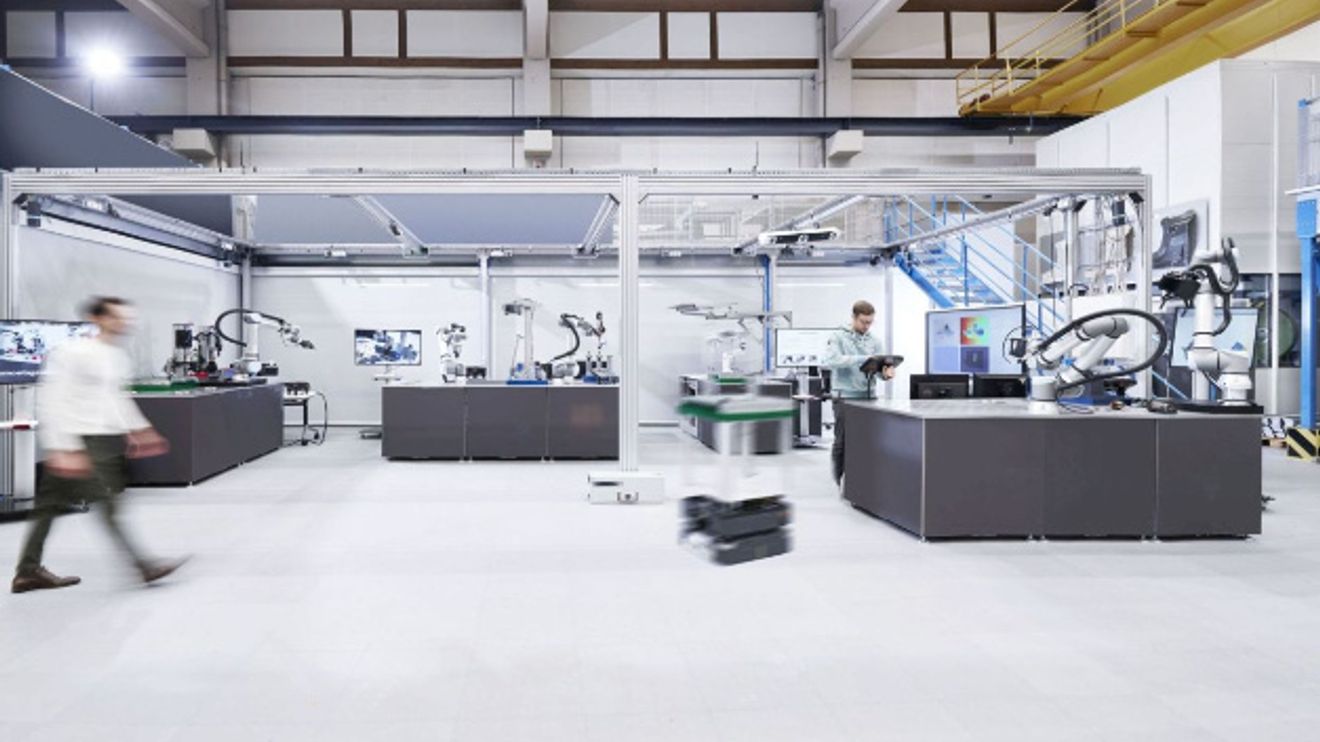
In the Future Hub (Hall 2, Stand B35), KIT and the FZI Research Center for Information Technology, an innovation partner of KIT, will be presenting their projects at a joint stand. 'AgiProbot' is particularly worth mentioning here. The aim of the AgiProbot project is to enable factories to adapt autonomously to constantly changing conditions. Remanufacturing is an ideal use case for this: Used products are brought up to the quality standard of new products through disassembly, refurbishment and reassembly so that they can be reused. Remanufacturing thus contributes to a sustainable circular economy.
KIT uses two tasks to demonstrate how the robots in AgiProbot learn: Inspecting used products and recording disassembly processes.
- The inspection involves assessing whether a used product can be refurbished and reused. In AgiProbot, the initial inspection of used products, which is usually carried out by humans, is automated at an inspection station. The station uses optical measurement technology such as a robot-guided camera system and artificial intelligence methods. This enables the station to learn to determine the condition and defects independently.
- A specially constructed station is used to observe people during manual disassembly. The sensors used can record eye and gaze movements as well as human posture, arm and hand movements in combination with the tools and product components used as well as individual objects on the work mat. This data serves as input for programming a robot by demonstration. The aim is automated disassembly.
Another research project is 'Anymos'. Whether navigation systems or ticket purchases via smartphone - services for networked mobility require data. How can the data be used in such a way that it fulfills its purpose but does not allow any conclusions to be drawn about individuals? This question is being addressed by the 'Anonymization for networked mobility systems' (Anymos) competence cluster, which KIT and the FZI Research Center for Information Technology are jointly presenting. The researchers are investigating the requirements for anonymization methods and determining the circumstances under which anonymized data could become individual data again. The aim is to develop specific applications from this, such as ticket systems that accurately calculate the distance traveled without revealing which route the person has taken.
The KIT technology exchange will also be represented at the Future Hub stand with 40 other offers. It showcases KIT innovations that can be turned into marketable products and processes.
KIT at the Energy Solutions
Energy Solutions (Hall 13, Stand C76) is all about energy storage systems, which play a crucial role in the sustainable conversion of the energy system and the expansion of renewable energies. KIT will be presenting developments for various applications, for electricity and heat supply as well as for industry.
- With thermal energy storage systems, energy for industrial high-temperature processes, for example in the chemical industry or in metal processing, can be stored directly in the form of heat in line with supply and demand. Liquid metals make it possible to store heat in a very high temperature range. They are combined with ceramic beads, which have a high storage density and long-term storage capacity. A pilot plant is to demonstrate the operation of a liquid metal-based heat storage system.
- The energy transition with the expansion of renewable energies requires large storage capacities. In the BiFlow project, a hybrid storage system is being developed that combines the specific advantages of the lithium-ion battery and the redox flow battery. In addition, the electrolyte tanks of the redox flow battery serve as heat storage, which increases the overall efficiency of the system. This opens up new possibilities for cost- and space-efficient combined heat and power generation.
- The start-up Litona, which was spun off from KIT, is developing energy storage materials for sodium-ion battery cells. Because they can be produced using cheap and readily available raw materials, sodium-based batteries could help to reduce the cost of batteries in the future and reduce Europe's dependence on raw material imports. Litona is currently focusing primarily on Prussian white analogs. These storage materials are particularly interesting for stationary energy storage and for applications in the automotive sector. Watch the video: Battery material for the sodium-ion revolution
- Hydrogen (H2) is suitable as a clean, efficient and reliable energy carrier for many applications. KIT has more than 30 years of experience in H2 safety research. With the HYKA hydrogen test center, it has a globally unique infrastructure for experiments on various release and combustion scenarios. Researchers use the PET tube to investigate turbulent combustion processes in hydrogen-air mixtures in partially enclosed geometries, as can be expected in a leaking H2 storage tank in real rooms with doors and windows. In addition to the experiments, the researchers are developing 3D simulation programs that can be used to specifically test and improve safety situations.


You might also be interested in
"Products of the Year" - The e-paper special of the winners
The winners of the readers' poll, which we present to you in this interactive special edition, were awarded prizes at a live event for the first time this year. Take a look and discover not only all the winning products, but also the video news from...
 read more...
Screen Edition 2024
Welcome to the first issue of the 'Screen Edition', which opens up a completely new way of reading and informing yourself: With the Screen Edition, we offer you a dynamic and always up-to-date source of information with its finger on the pulse.
read more...Sustainability is digital
The motto of Hannover Messe 2024 is Energizing a Sustainable Industry. With numerous research projects, the FZI Research Center for Information Technology presents the possibilities of digitalization on the way to a sustainable and more...
read more...The top articles in July 2024
Innovative spirit and entrepreneurial thinking characterize the most-read articles from July. Find out more about competitive advantages through AI, click through award-winning developments and read more about model-based design and quantum sensor...
read more...Robotics Institute Germany founded
Together, the leading locations for robotics in Germany will establish the Robotics Institute Germany (RIG), which is to become the central contact point for robotics in Germany in the future.
read more...Karlsruhe Institute of Technology
The EDAI project
In the EDAI project, researchers at the Karlsruhe Institute of Technology (KIT) are combining the design of AI algorithms and AI chips. EDAI is based on open source software to facilitate access to AI-based solutions, particularly for small and...
read more...Sustainability is digital
The motto of Hannover Messe 2024 is Energizing a Sustainable Industry. With numerous research projects, the FZI Research Center for Information Technology presents the possibilities of digitalization on the way to a sustainable and more...
read more...Intelligent robots thanks to AI
Festo hosted the conclusion of the Flairop research project, which worked on making order picking robots more intelligent using distributed AI methods. The project was funded by the German Federal Ministry for Economic Affairs and Climate Protection.
read more...Research and teaching should be one
Robots that learn by watching. Assistance systems that enable visually impaired people to study. The federal and state research ministers visit the Karlsruhe Institute of Technology and herald an important innovation.
read more...